
Royalty complexity in the automotive industry is rising because auto Original Equipment Manufacturers (OEMs) now operate across software-enabled features, technology partnerships, supplier-linked intellectual property, branded accessories and global licensing arrangements. According to Deloitte automotive software trends research, software-defined vehicles are expected to account for at least 90% of the new-vehicle market by 2029. As software becomes a larger part of the vehicle value chain, OEMs must manage increasingly complex licensing agreements tied to embedded software, connected services, over-the-air updates, and shared technology ecosystems. As vehicles become more digital and ecosystems more interconnected, royalty management is moving from a back-office accounting task to a strategic capability tied to margin protection, compliance, and business agility.
Trying to manage rights and royalties with spreadsheets and manual work creates delays, disputes and blind spots. Automotive rights and royalty management software streamlines processes, automates rights and royalty calculations, and delivers the visibility teams need to accurately and on time collect and pay royalties and receive compensation for rights.
What is automotive rights and royalty management software?
A royalty management system designed for the automotive sector simplifies every stage of the rights and royalty lifecycle.
Core capabilities and key features of automotive rights and royalty management software include:
- Deal and contract management with rate structures, territories and effective dates
- Automated rights and royalty calculations for complex rules (tiers, minimums, product-level rates, credits, holdbacks)
- Sales and transaction-level data from ERP or other sources to ensure accuracy and reconcile payments
- Rights and royalty statements and invoices automatically generated with configurable templates
- Real-time dashboards and analytics to track owed vs. paid, late payments, and net sales performance
- Audit trails, version control, and compliance checks to satisfy licensors, licensees and internal auditors
- Notifications and workflows for exceptions, approvals, and onboarding new partners
- Secure integrations with ERP, accounting software, and payment platforms for seamless payment tracking
- Centralize rights and royalty data so finance, licensing, legal, and product teams share a single source of truth
Why rights and royalties are becoming more complex to track
For many automotive OEMs, the traditional rights and royalty model was relatively narrow, often limited to select branded products or regional licensing arrangements. Now, connected services, electrification, software-defined vehicle features, co-developed technologies, and multi-party supply relationships have introduced more contracts, more data points, and more audit exposure into the revenue chain.
At the same time, automotive companies are under pressure to manage these obligations across multiple systems, business units, and regions. A contract may reside in one repository, transactional data in an ERP, product information in a Product Lifecycle Management (PLM) system, and commercial terms in spreadsheets or local processes, making end-to-end control difficult without a dedicated platform.
The growing number of royalty-bearing agreements, fragmented contract and transaction data across systems, and the rise of software-driven licensing models are increasing pressure on automotive OEMs to maintain control and accuracy. According to Dykema’s 2026 Automotive Trends Report on intellectual property challenges, 23% of automotive stakeholders identified software-defined vehicle IP licensing risks as a significant concern for 2026, signaling that value is increasingly tied to software, connectivity, and shared technology ecosystems rather than hardware alone. As OEMs expand connected services, embedded software, and co-developed technologies, royalty reporting and management become more critical for maintaining visibility, compliance, and financial accuracy.
The problem with manual tracking of automotive royalties
Manual tracking of automotive royalties may appear manageable in the early stages, but it becomes risky when agreement volumes, product complexity, and royalty payments reporting requirements increase. Spreadsheet-based processes often lead to inconsistent calculations, delayed statements, fragmented audit trails, and a higher likelihood of underpayments, overpayments, or internal disputes over entitlement logic. In essence, that scale makes manual royalty tracking error-prone and expensive.
Spreadsheets and fragmented systems can quickly turn into financial leakage and governance risk. If commercial teams, finance, procurement, and legal functions are not working from the same royalty logic and source data, the result is usually slower close cycles, weaker negotiation positions, and increased exposure during partner or compliance audits.
Vistex enterprise software helps automotive OEMs centralize contract terms, automate even the most complex royalty calculations, and integrate directly with ERP systems to ensure accuracy at the transaction level. By providing a single source of truth across finance, legal, and commercial teams, you are able to reduce revenue leakage, improve audit readiness, and accelerate close cycles. More importantly, it enables automotive organizations to confidently scale new monetization models, such as software-defined features and connected services, without introducing additional operational risk.

What do automotive teams gain from an integrated rights and royalty platform?
Preferably, your royalty platform should do more than automate calculations. It should improve control, reduce leakage, strengthen audit readiness, and give OEMs the commercial agility to launch new products, monetization models, and partnerships with greater confidence.
When evaluating automotive rights and royalty software solutions, ensure that it will provide the following:
- Support complex rights and royalty rules (tiers, credits, product exceptions)
- Integrate natively or via robust APIs with your ERP (avoid duplicate master data)
- Generate configurable rights and royalty statements and invoices automatically
- Provide dashboards, notifications, and role-based visibility
- Offer transactional-level ingestion for accuracy and auditability
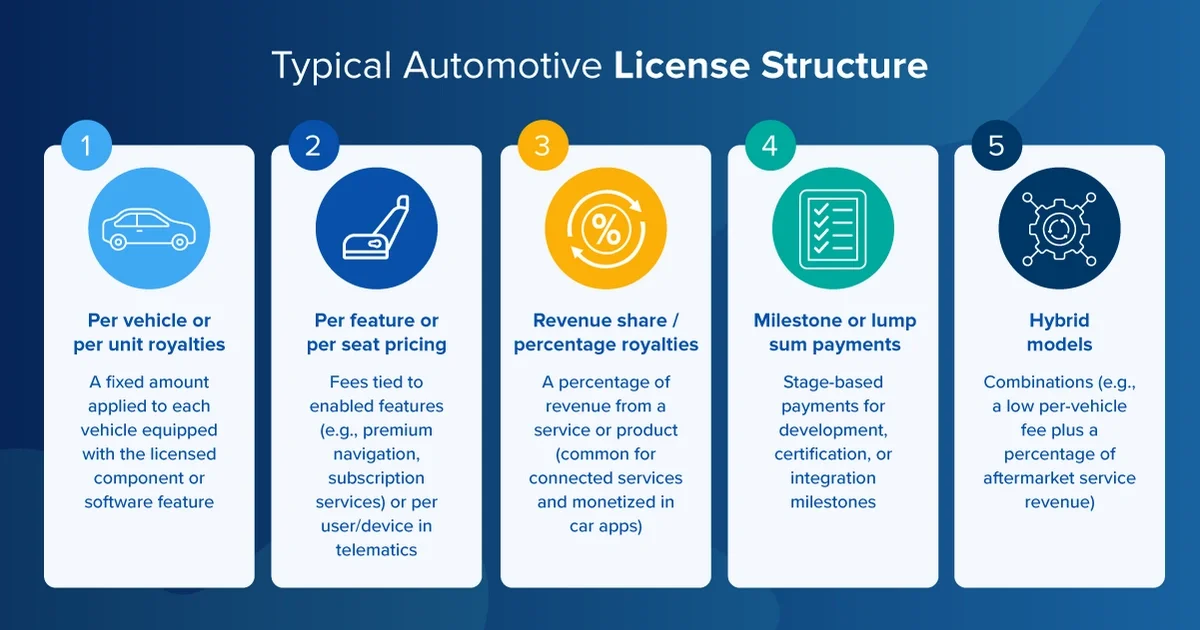
Navigating complex rights and royalty agreements that span per vehicle royalties, per feature fees, milestone payments, and revenue share means that the best software decision is rarely the cheapest one on paper. The stronger choice is usually the solution and contract model that provides the OEM with durable transparency, scalable governance, and the flexibility to support future growth without rebuilding the process architecture each time the business model evolves.
As vehicles become more software-centric, rights and royalty complexity will only grow. Moving from spreadsheets to a purpose-built royalty management platform that integrates with your ERP, automates rights and royalty calculations, and delivers end-to-end visibility is critical to protecting margins, reducing audit risk, and driving better decisions.
Explore more related resources

Get the latest news, updates, and exclusive insights from Vistex delivered straight to your inbox. Don’t miss out—opt in now and be the first to know!