

What are dealer sales incentive programs, and why do they matter?
Dealer incentive programs (also called dealer incentive programs or auto dealer incentives) are structured reward systems that manufacturers and distributors use to motivate dealerships and sales teams to hit sales targets, promote specific product lines, increase sales performance, or improve customer satisfaction and retention. These programs commonly include rebates, bonuses, discounts, co-op marketing funds, spiffs, loyalty programs and experiential rewards such as incentive travel.
Dealer sales incentive programs impact the buying cycle in the following ways:
- Drive immediate results: Incentives directly affect buying behavior at dealerships and can increase product movement in key windows (product launch or end-of-quarter)
- Align channel partners: Incentives focus dealer efforts on strategic goals such as market share growth, product mix changes, or service retention
- Improve long-term outcomes: Well-designed rewards programs also boost dealer loyalty and retention of high-performing sales reps
What automotive and agricultural dealer incentive programs have in common
In many ways, agricultural sales incentives are like automotive incentives, only larger. For example, it’s common for a manufacturer to offer up to 15-20% off MSRP—that will cover the cost of doing business in today’s market. While the value of auto incentives isn’t nearly that much, there are quite a few other similarities between the two:
- Both auto and ag OEMs depend on consumer incentives to move their products
- Even though incentives take a large share of the overall revenue for both, the administration of these tends to be undermanaged, utilizing disparate, cumbersome systems and manual-based processes
- Unnecessary complexity increases the risk of errors, such as improperly paid incentives or lower than expected margins, that can result in significant revenue leakage
Most importantly, we’ve seen impressive results when auto and ag dealer incentives are transparent and automated, helping minimize chargeback discrepancies. The time is right to audit and implement improvements to your incentive operations, too.
Is your dealer sales incentive strategy ready for growth?
If your organization is looking to increase incentives to spur growth amidst the current economic headwinds, you should take an in-depth look at your equipment sales incentive system now. The more complex the incentives are, the greater the likelihood of overall revenue leakage. As you assess the efficiency and accuracy of your current processes, ask yourself these questions:
- Is your data centralized, organized and accessible in one location?
- Are the various regions in your company using different incentive systems? Do you lack a standardized global structure for managing incentives?
- What about your relationships with dealers? Are you making it easy for them to increase sales, or is the process too complicated?
- Can you quickly turn incentives on or off and automatically validate them against external data sources?
If you find areas for improvement with any of these, you’ll want to consider a solution that specifically streamlines your essential incentive management processes.
The greater and more accurate your sales incentive accruals are, the greater the potential benefits. When you optimize and automate the management of your dealer sales incentives, it not only helps your business become more agile, but it also helps your dealers’ and customers’ businesses move faster as well. How? It enables faster, more reliable decision-making, speeds up transaction rates and reduces time-consuming errors. In addition, dealers will receive accurate, consistent and real-time information about current incentive programs, leading to faster claims payments and improved dealer satisfaction. Your customers will experience greater transparency into available deals, increased personalization and frictionless buying.
Consumer incentives vs. dealer sales incentive programs
Consumer incentives may be the most visible part of an automotive incentive strategy, but they are only one side of the equation. Behind every rebate, financing offer, or promotional campaign is a network of dealerships responsible for turning those programs into vehicle sales. That is why dealer sales incentive programs are equally important. While consumer incentives encourage buyers to purchase, dealer incentives motivate channel partners to prioritize specific models, meet sales targets, improve customer satisfaction, and strengthen long-term brand loyalty. Together, these programs create an incentive ecosystem that helps manufacturers drive demand while aligning dealer performance with business objectives.
9 types of dealer incentive programs
When manufacturers and OEMs want to move inventory, launch new products, or increase market share in a competitive automotive market, dealer sales incentive programs are among the most powerful levers available. Done well, they boost sales volume, align channel partners with brand goals, and improve long-term retention. Done poorly, they waste budget and create mistrust.
Understanding the available dealer sales incentive types helps you pick the right reward structure for your sales goals:
1. Volume-based bonuses: Payouts tied to hitting sales targets or sales volume thresholds over a period
2. Product-specific incentives: Bonuses or higher margins for pushing new products or slow-moving SKUs — ideal for product launch campaigns
3. SPIFFs (Sales Performance Incentive Funds): Short-term cash or non-cash rewards for sales reps to push a particular model or accessory
4. Rebates and discounts: Dealer or consumer-facing rebates that reduce the effective price and accelerate purchases
5. Co-op marketing funds: Dollars allocated to dealerships to promote product lines locally, often with claimed reimbursement
6. Service and retention incentives: Rewards to increase warranty work, aftercare product adoption, or maintenance retention
7. Tiered loyalty programs: Multi-level reward systems that recognize cumulative achievement and deepen dealer loyalty
8. Contests and gamified programs: Leaderboards, badges, and experiential prizes like incentive travel to motivate performance
9. Non-cash rewards and experiences: Gift cards, merchandise, recognition events, or travel that appeal to intrinsic motivation
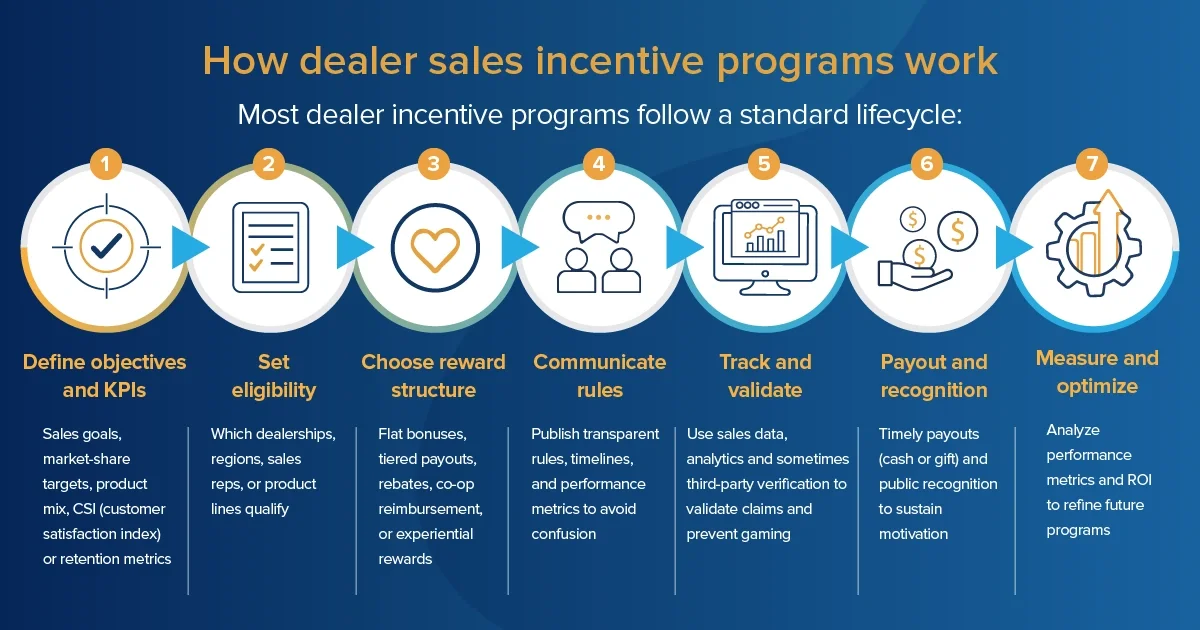
Best practices to create an effective dealer incentive program
Even the most attractive incentive program will fall short if it’s difficult to understand, administer, or measure. Use these proven strategies to boost effectiveness and reduce risk:
1. Align incentives with clear sales goals
Design the reward structure to directly support the objective, whether it's driving sales volume, increasing uptake of new products, or improving customer retention. If your goal is to promote new products, product-specific incentives combined with training/certification rewards yield the best returns.
2. Keep rules simple and transparent
Complex eligibility rules or ambiguous measurements create confusion and reduce participation. Publish clear performance metrics, examples, and a simple calculator where possible.
3. Offer balanced reward structures
Mix cash (bonuses, rebates) with non-cash rewards (recognition, incentive travel, experiences). Non-cash rewards, such as incentive travel or exclusive events, often deliver an outsized motivational impact for top performers while limiting cost leakage.
4. Use tiering to scale motivation
Tiered programs (bronze/silver/gold) encourage sustained performance — dealers aim for the next tier rather than a single binary target. Tiering is especially effective for multi-product lines and long-term loyalty programs.
5. Leverage automation and analytics
Automated incentive platforms reduce administrative burden, speed payout, and integrate with dealership DMS and CRM systems. Analytics help you optimize reward levels and detect anomalies.
6. Communicate frequently and celebrate success
Regular communication (weekly dashboards, monthly leaderboards) keeps the program top of mind. Public recognition—award ceremonies, leaderboard shout-outs—reinforces behavior and loyalty.
7. Protect against fraud and manipulation
Use verifiable sales data, set reasonable caps, require proof of sale for certain rewards, and incorporate independent audits or automated validation rules.
Why automation is essential for dealer incentive management
Effective dealer incentive management depends on having accurate data, consistent processes, and complete visibility into program performance. Automation enables manufacturers to eliminate manual inefficiencies while providing the insights needed to optimize incentive strategies, improve dealer satisfaction, and maximize profitability. Key advantages include:
- Real-time dashboards and analytics to track performance metrics and identify trends
- Faster, auditable payouts that keep dealers motivated (reducing payout friction increases trust)
- Integration with DMS, CRM and finance systems to validate sales data and prevent fraud
- Personalized communications to sales reps and dealers that improve participation rates
Managing dealer sales incentive programs requires more than tracking payments—it requires complete visibility into incentive performance, dealer participation, financial impact, and program effectiveness. Vistex helps automotive manufacturers centralize management of dealer incentives, rebates, chargebacks, and pricing programs on a single, SAP-integrated platform. By automating program administration, validating claims, and providing real-time analytics, Vistex helps manufacturers reduce revenue leakage, improve dealer satisfaction through faster and more accurate payouts, and make better-informed decisions about future incentive strategies. Rather than managing incentives with disconnected spreadsheets and manual processes, manufacturers gain the transparency and control needed to maximize program performance while protecting profitability.
Explore more related resources
Get the latest news, updates, and exclusive insights from Vistex delivered straight to your inbox. Don’t miss out—opt in now and be the first to know!