
AI Helps Trade Spend Managers Find Plan Waste Before It Impacts Profitability
Every year, consumer products manufacturers enter budget planning season with the same objective: allocate trade funds in ways that drive profitable growth. Despite advances in data availability, many organizations still build future trade budgets using assumptions rooted in past spending patterns.
Say a category received a certain level of funding last year. Should it receive a similar allocation this year? A major retailer consumed a significant portion of the trade budget in prior periods; should funding levels remain largely unchanged? Promotional programs that have existed for years often continue because they’re familiar, not necessarily because they’ve been proven effective.
The problem is that historical spending patterns often mask inefficiencies, margin leakage, and missed opportunities. By the time organizations identify underperforming promotions, excessive discounting, or ineffective customer investments, the money has already been spent.
As inflationary pressures persist, retailer demands evolve. Growth becomes harder to achieve. Manufacturers are under increasing pressure to ensure every trade dollar contributes to both revenue growth and profitability. This is where artificial intelligence (AI) is beginning to transform trade planning.
Rather than simply helping organizations analyze past events, AI can identify trade spend waste before budgets are finalized, enabling finance and commercial teams to make smarter investment decisions before funds are committed.
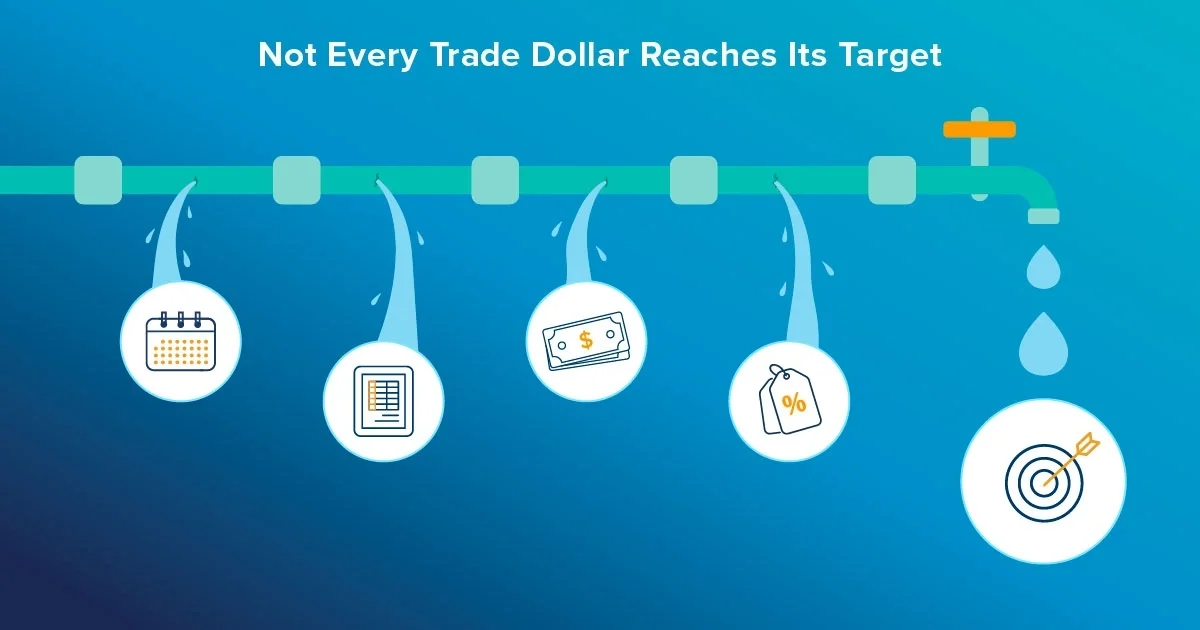
Why Trade Spend Waste Often Goes Undetected
Trade spending represents one of the largest controllable investments for many consumer products manufacturers. Yet it’s also one of the most difficult areas to evaluate comprehensively.
Most organizations track promotional performance through a combination of ERP reports, spreadsheets, retailer scorecards, sales data, and financial analyses. While each source provides valuable information, the disparate trade data inputs are disconnected and rarely present a complete picture of profitability.
As a result, trade teams frequently focus on metrics such as shipment volume, promotional lift, or retailer participation while overlooking broader financial implications.
A promotion may drive incremental sales volume but generate little incremental profit. A customer may consistently exceed growth targets while consuming a disproportionate share of trade funding. A pricing strategy may increase market share but reduce overall margin performance.
These types of disconnects become even more difficult to identify when thousands of products, dozens of customers, and multiple promotional tactics are involved.
The challenge may not be lack of data. It’s understanding which activities create value and which consume budget without delivering meaningful returns.
How To Evolve From Historical Planning With Predictive Forecasting
Traditional trade planning is largely retrospective. Teams review historical results, identify trends, and use those observations to inform future spending decisions.
AI enables a fundamentally different approach to demand forecasting.
Instead of asking:
- Which promotions performed best last year?
- Which customers received the most funding?
- Where was budget exceeded?
Organizations can begin asking:
- Which promotions are likely to generate profitable growth next year?
- Which investments carry the highest risk of underperforming?
- Where can spending be reallocated to maximize margin?
- What is the expected financial impact before we approve funding?
By analyzing historical performance, market conditions, retailer behavior, product attributes, pricing trends, and financial outcomes simultaneously, AI can forecast likely results under future conditions rather than simply reporting on past performance.
This shift from hindsight to foresight allows manufacturers to identify potential waste before it appears in the budget.
Use Constraint-Based Modeling To Optimize Trade Investments
One of the most powerful applications of AI in trade spend management is constraint-based planning.
Most organizations don’t have unlimited resources. Trade planning requires balancing competing objectives and constraints across the business.
Finance teams are focused on profitability targets. Sales teams are pursuing growth objectives. Supply chain leaders are managing inventory and production capacity. Category managers are targeting market share gains. Retailers want additional promotional support. The challenge is determining how to satisfy these competing priorities within a finite budget.
Traditional methods evaluate a relatively small number of options because manual analysis is time-consuming. AI can evaluate thousands of potential investment scenarios simultaneously.
A manufacturer might establish planning constraints like:
- Fixed annual trade budget
- Margin targets by product category
- Growth objectives by retailer
- Inventory availability
- Manufacturing capacity limitations
- Strategic account commitments
AI can then analyze countless funding combinations and identify allocations that maximize desired outcomes while remaining within those constraints. Instead of relying on intuition or historical precedent, planners can make decisions based on optimized financial outcomes.
Run Scenario Modeling Before Committing Budget Dollars
Budget planning often involves making some decisions under uncertainty. Consumer demand may fluctuate. Retailer priorities may change. Competitive activity can intensify. Commodity costs might increase unexpectedly.
AI-powered scenario modeling helps CP manufacturers understand the potential impact of these uncertainties before committing resources.
Trade planning teams can evaluate questions like:
- What happens if retailer funding requests increase by 15 percent?
- How would shifting spending from discounts to display programs affect profitability?
- Which investments should be protected if budgets are reduced?
- How would margin performance change if costs increase unexpectedly?
- What trade-offs exist between volume growth and profit growth?
Rather than building a single annual plan, organizations can evaluate multiple future scenarios and understand the likely outcomes of each. This creates greater confidence in budget decisions while reducing the likelihood of costly surprises later in the year.
Automated Data Extraction And Analysis Reduces Hidden Waste
One reason trade spend waste remains difficult to identify is that critical information is scattered across multiple systems.
Promotional plans may reside in trade promotion management (TPM) applications. Customer agreements may be stored within ERP systems. Financial forecasts may exist within planning platforms. Deduction activity may be managed elsewhere.
Manually consolidating and analyzing these data sources requires significant effort and can delay decision-making. AI can automate much of this process.
Modern AI solutions can extract, classify, and analyze information from structured and unstructured sources, helping organizations identify patterns that would otherwise remain hidden.
Some examples include:
- Repeated overspending within specific customer accounts
- Promotions that consistently fail to achieve profitability targets
- Duplicate funding activities across teams
- Excessive discounting that erodes margin
- High deduction rates tied to specific promotional programs
- Categories where spending growth exceeds revenue growth
By surfacing these patterns automatically, AI allows planners to focus on corrective action rather than manual data gathering.
Real-Time Monitoring Enables Dynamic Adjustment of Trade Plans
Trade planning typically follows a predictable cycle. Plans are created. Budgets approved. Promotions executed. Results reviewed postmortem.
But today’s market moves too quickly for that fixed, sequenced approach.
AI-powered monitoring capabilities enable organizations to continuously compare actual performance against forecasts and planned outcomes. When conditions change, organizations can respond faster.
If a promotion underperforms expectations, corrective actions can be taken before additional funds are committed. If retailer demand shifts unexpectedly, forecasts can be adjusted. If margins begin to deteriorate, planners can identify the root causes sooner.
This transforms trade planning from a static annual exercise into a dynamic process of continuous optimization.
Localized Trade Plans May Deliver Better Trade Performance
Every customer is different.
Promotions that perform exceptionally well in one retailer may generate disappointing results elsewhere. Regional buying patterns, competitive environments, consumer demographics, and category dynamics can vary significantly. And yet many manufacturers continue to apply broad assumptions across large customer groups.
AI enables a more localized approach to trade planning. By evaluating customer-specific, category-specific, and regional performance drivers, organizations can tailor investments based on where they are most likely to generate returns. This allows manufacturers to move beyond one-size-fits-all planning and direct resources toward the highest-value opportunities.
The result is often improved promotional effectiveness, stronger retailer relationships, and more efficient use of trade funds.
Connect Trade And Financial Planning Before Investing Budget Dollars
The greatest opportunity for improvement may lie in bringing trade planning and financial planning closer together.
In many organizations, trade plans are developed separately from broader revenue and profitability forecasts. Commercial teams determine promotional investments while finance teams evaluate business performance through a different lens.
This separation can create blind spots.
A promotion may appear successful from a volume perspective while negatively affecting profitability. A customer growth initiative may increase revenue while reducing overall margin contribution.
AI-powered planning platforms help eliminate these disconnects by linking trade investments directly to financial outcomes.
When trade planning is integrated with financial planning, manufacturers can evaluate:
- Revenue impact
- Margin contribution
- Profitability by customer
- Budget utilization
- Forecast accuracy
- Return on trade investment
…before funding decisions are finalized. This alignment enables better decision-making across both commercial and finance functions.
How Vistex Helps Manufacturers Improve Trade Performance
Identifying trade spend waste requires more than isolated analytics tools. It requires a connected approach linking planning, execution, financial performance, and reporting.
Vistex helps consumer products manufacturers gain visibility into the complete revenue lifecycle by integrating trade spend management, pricing, incentives, financial reporting, and performance management within a unified platform.
Connecting commercial and financial data, Vistex enables organizations to evaluate the profitability impact of trade investments before budgets are committed. Teams can analyze promotional effectiveness, forecast future outcomes, model alternate scenarios, and monitor performance against strategic objectives using a common source of truth.
This integrated approach helps finance and commercial leaders move beyond simply tracking trade spend toward actively optimizing how those investments contribute to revenue growth, margin improvement, and overall business performance.
Budget Planning Is Profitability Planning
Trade budgeting has focused primarily on allocating funds. The next evolution is optimizing investments.
AI helps manufacturers identify waste before it occurs, forecast future outcomes with greater confidence, evaluate alternative scenarios, and align trade investments with financial objectives.
Organizations that adopt Vistex AI-powered software will be better positioned to maximize both growth and profitability while reducing the inefficiencies that often remain hidden within traditional planning processes.
As budget season approaches, the most important question may no longer be how much trade funding to allocate. It may be whether every dollar being planned has earned the right to be spent.
Explore more related resources
Get the latest news, updates, and exclusive insights from Vistex delivered straight to your inbox. Don’t miss out—opt in now and be the first to know!