

Get the Modern AOP Playbook for Pricing, Trade Investment, and Profitable Growth
Why is the Annual Operating Plan Process Breaking Down?
Many organizations want to know how to improve and streamline the annual operating plan process without adding more complexity or time. The answer doesn’t lie in working harder within the same structure. Instead, the solution requires rethinking how planning is designed and executed.
The annual operating plan process is designed to translate corporate strategy into customer execution. But in many organizations, it breaks down under the weight of fragmented data, disconnected workflows, and misaligned incentives.
Data lives across ERP, CRM, and trade promotion systems, often requiring manual reconciliation. Assumptions are difficult to validate. Trade-offs made between revenue, volume, and margin aren’t visible until late in the cycle.
The result? A planning process defined by delays, rework, misaligned resources, and internal friction.
What is a Modern AOP Framework for Consumer Products?
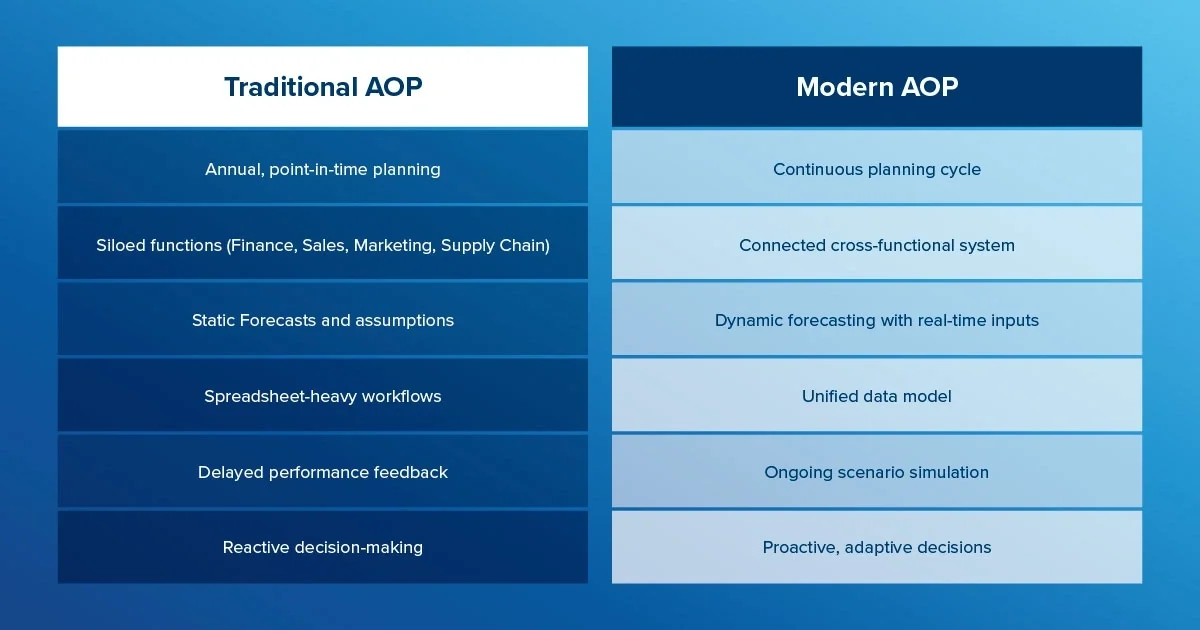
A modern annual operating plan (AOP) framework looks fundamentally different and supports business goals more effectively.
Instead of a linear, annual process rooted in spreadsheets, it flexibly operates as a connected system where decisions are continuously informed by data and elevated based on financial impact.
Three characteristics define this shift:
- Connected data: A single, trusted view across pricing, trade spend, demand, and profitability
- Integrated workflows: Cross-functional collaboration supported by shared tools
- Continuous feedback loops: Performance insights that inform decisions throughout the year
In these ways, a modern AOP roadmap blooms not just from better planning, but better decision-making and resource allocation.
To see how this framework comes together in practice, explore the full annual operating plan playbook.
Who Owns the Annual Operating Plan? Align Stakeholders Across Functions
While the AOP is inherently cross-functional, ownership is often unclear.
Key stakeholders include executive leadership, finance, sales, marketing, and supply chain. Each plays a critical role, but each also operates through a different lens:
- Finance Team prioritizes profitability and risk management
- Sales Team focuses on revenue growth and customer commitments
- Marketing Team emphasizes demand generation and brand investment
- Supply Chain Team ensures feasibility and service levels.
Without alignment, these perspectives create friction instead of value and revenue growth. Establishing clear roles, responsibilities, and decision rights is essential to achieving true cross-functional alignment supporting a strategic plan.
How Do Misaligned Incentives Impact the Annual Operating Plan Process?
One of the most persistent AOP challenges is misaligned incentives and KPIs.
Sales may under commit volume. Finance may constrain investment. Marketing may prioritize reach over return. Individually, rational decisions create collective inefficiency.
The modern framework addresses this by orienting teams around strategic priorities, shared metrics, and a common data foundation.
When everyone operates from the same view of performance and key performance indicators, down to the customer and promotion level, trade-offs become clearer and decisions become faster.
How to Align Demand, Financial, and Trade Promotion Planning
Effective planning cannot happen in silos.
Demand forecasts, financial targets, and trade promotion strategies are deeply interconnected. Yet in many organizations, they’re managed separately, limiting visibility and slowing decision-making.
A connected approach and shared dashboards enable true demand and financial planning integration, linking forecasts directly to pricing and promotion decisions which drive revenue growth management.
This is where capabilities like trade promotion optimization and pricing and promotion planning become critical. Instead of relying on historical allocations, teams can evaluate promotion-level ROI, make informed decisions, and dynamically reinvest spend.
Vistex solutions enable this by connecting pricing, trade, and financial data into a unified model, giving teams real-time visibility and control over performance and profitability.
Move from Annual Planning to Continuous, Closed-Loop Optimization
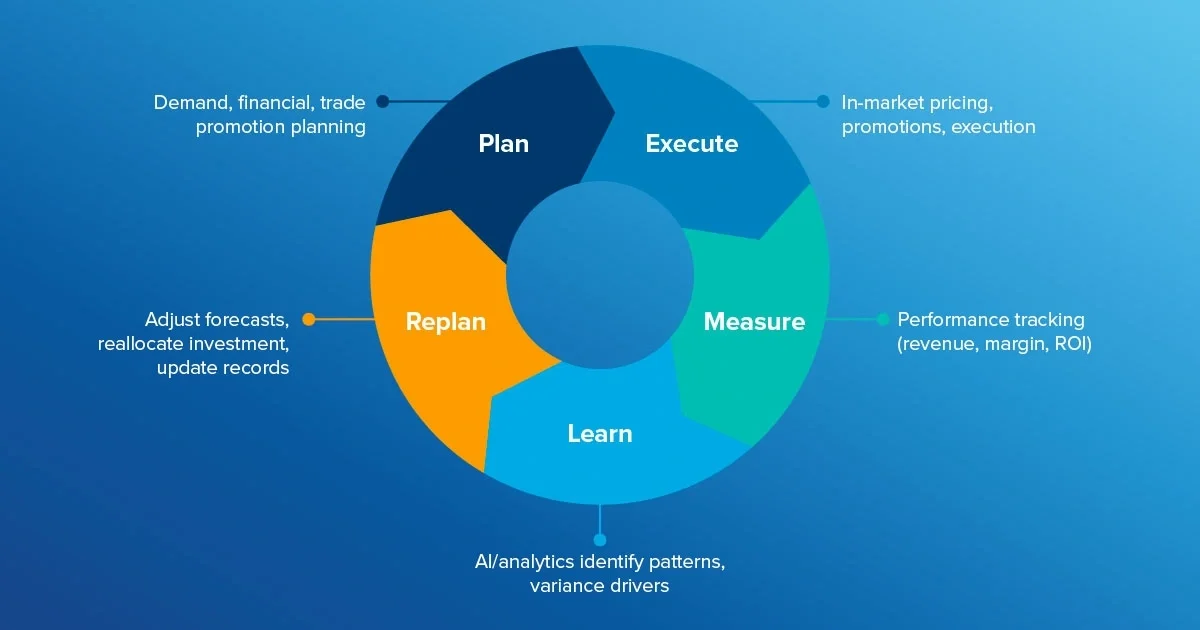
A key evolution in AOP is the shift from static planning and fixed timelines to a continuous planning process.
Leading organizations operate in a closed loop: Plan, execute, measure, learn, replan.
This closed-loop planning approach enables faster response to market changes, from demand shifts to promotion performance. With the support of indicators including advanced analytics and AI, teams can model scenarios, test assumptions, and reallocate resources in near real time. The result is a more resilient business.
How to Improve the Annual Operating Plan Process
Modernizing the AOP centers around creating clarity through connected data, aligned teams, and better decision frameworks. Organizations that invest in these capabilities gain a measurable advantage: faster decisions, stronger alignment, and improved profitability.
If your current approach is slow, fragmented, or difficult to adapt, it may be time to rethink your approach.
FAQ: Annual Operating Plan (AOP) Process for CPG Companies
What is an annual operating plan in consumer products?
An annual operating plan (AOP) in consumer products is a cross-functional framework that translates strategic goals into revenue, margin, and investment plans across sales, marketing, finance, and supply chain.
How do you improve the annual operating plan process?
Improving the process requires connected data, aligned incentives, and continuous planning capabilities. Leading organizations integrate demand, financial, and trade promotion planning while using real-time insights to adjust decisions throughout the year.
Who owns the AOP in an organization?
The AOP is typically owned collectively across executive leadership, finance, sales, and marketing, with finance often leading consolidation and governance. Clear roles and shared metrics are critical for alignment.
What is a modern AOP framework?
A modern AOP framework is a connected, data-driven approach to planning that links strategy, execution, timeline, and performance in a continuous loop. It incorporates scenario modeling, real-time analytics, and cross-functional collaboration to drive more agile decision-making.
Get the latest news, updates, and exclusive insights from Vistex delivered straight to your inbox. Don’t miss out—opt in now and be the first to know!