
What Are Trade Accruals And Why Do They Matter?
For many consumer products manufacturers, the year-end financial close process is one of the most demanding and scrutinized activities of the financial calendar.
Finance teams are under pressure to finalize results, validate financial statements, satisfy auditors, and provide leadership with an accurate picture of business performance. Auditors are evaluating controls and supporting documentation. Executive leadership is looking for a clear picture of business performance. At the same time, sales, revenue management, and commercial teams are evaluating whether promotional investments delivered expected returns and are determining how next year’s budgets should be allocated.
Few activities involved in year-end close create as much complexity or as much financial risk as trade accrual management.
Trade promotions represent one of the largest investments many manufacturers make to drive revenue, increase distribution, grow market share, and strengthen retailer relationships. They’re also the largest controllable expenses for many manufacturers. Despite their significance, the financial obligations created by those programs are often difficult to track with precision because trade accruals are frequently managed through disconnected spreadsheets, manual adjustments, delayed retailer claims, and incomplete visibility into actual spending.
Trade accruals are more than accounting estimates. They represent future financial obligations that the manufacturer expects to settle through deductions, claims, rebates, or direct payments. Because these obligations affect both the income statement and balance sheet, even relatively small inaccuracies can ripple through multiple areas of financial reporting.
At year-end close, the importance of accrual reconciliation extends well beyond accounting. Financial statements can be distorted. Profitability can be misrepresented. Audit exposure can increase, and leadership teams may make important decisions using misleading information.
What Are The Stakes Of Year-End Close For A Manufacturer?
For finance leaders, year-end close is ultimately about confidence. Confidence that liabilities are accurately recorded. Confidence that profitability reflects economic reality. Confidence that executives, auditors, and stakeholders can rely on reported results.
But unlike fixed operating expenses, trade spending is dynamic. Programs evolve throughout the year. Retailer claims may arrive months after a promotion concludes. Agreements may include multiple funding mechanisms, performance requirements, and settlement methods.
Accrual balances, as a result, frequently rely on estimates, assumptions, and ongoing adjustments. Though these challenges exist year-round, they are significantly more visible during year-end close when organizations must ensure liabilities are fully and accurately represented in financial statements.
What Do Trade Accruals Represent? Why Are They Difficult To Manage?
Trade accruals are financial estimates used to recognize the cost of promotional programs before claims are settled or payments are made. These obligations may stem from:
- Off-invoice discounts
- Bill-backs
- Scan programs
- Retail rebates
- Growth incentives
- Marketing funds
- Performance-based agreements
The purpose of accrual is straightforward: record expenses in the period they are incurred rather than when payment occurs. The challenge is determining exactly how much should be accrued.
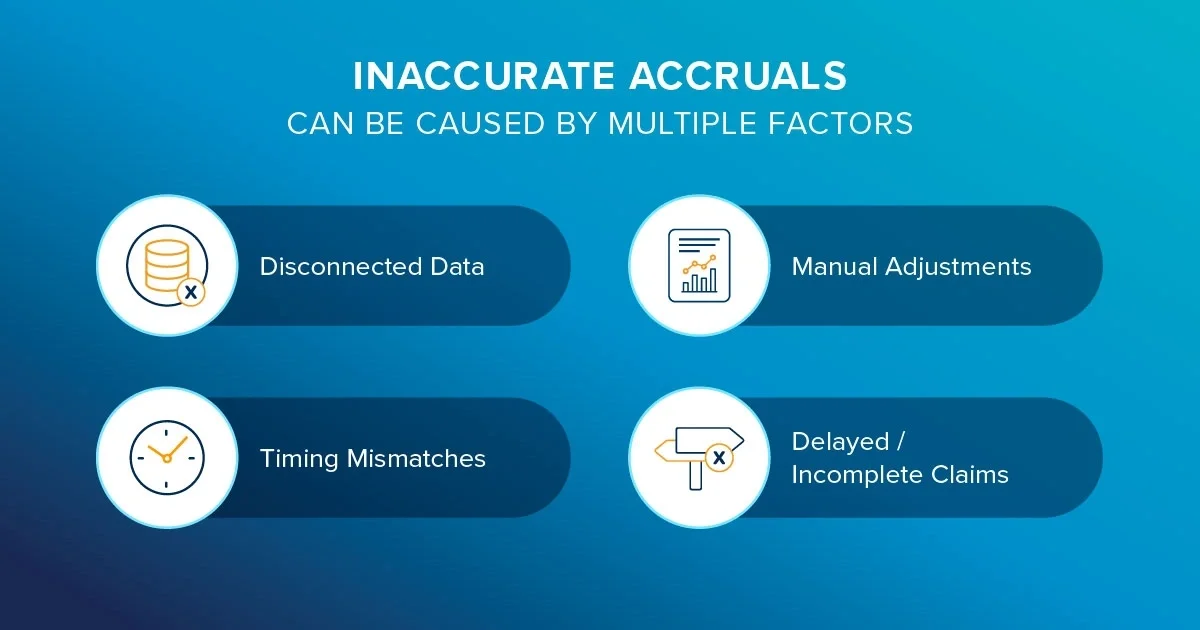
Trade accrual calculations often depend on information spread across multiple systems, including sales transactions, promotional agreements, ERP platforms, retailer claims systems, spreadsheets, and settlement processes. Timing differences between promotional activity and claim submissions further complicate the process. The result is a level of complexity that makes trade accruals particularly vulnerable to inaccuracies.
Vistex’s AI-driven trade spend management solution helps reduce this complexity by centralizing trade agreement data, promotional activity, settlements, and financial reporting into a unified framework.
Year-End Close Reveals Accrual Problems
One of the biggest misconceptions about year-end close is that it causes accrual challenges. The reality? It simply exposes issues that have accumulated throughout the year.
A small variance on a single promotion may appear insignificant. But when a manufacturer runs hundreds or thousands of promotional events annually, those discrepancies compound.
Imagine a manufacturer managing 600 promotions across multiple customers. If each promotion contains only a modest accrual variance, the cumulative impact can quickly become material. Dollars that appeared manageable at the promotion level suddenly become a significant financial reporting issue.
Year-end close forces manufacturers to reconcile those variances, validate liabilities, and ensure financial statements accurately reflect business performance.
The companies that experience the smoothest closes are typically those maintaining trade spend accrual discipline continuously, not just at year-end.
The Financial Reporting Risks Of Inaccurate Trade Accruals
The most immediate consequence of inaccurate accruals is financial reporting risk.
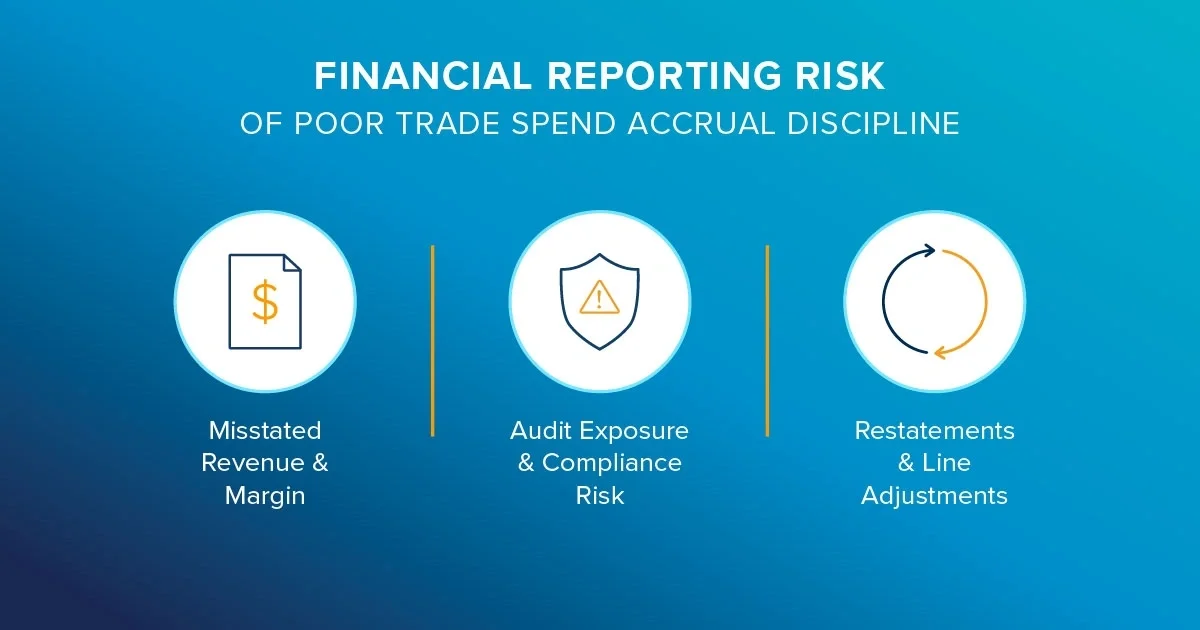
Misstated Revenue And Margin
Under-accruing trade spend can overstate profitability by understating promotional expenses. Over-accruing can have the opposite effect, depressing reporting margins and creating reserves that require future adjustments. Both scenarios create a financial picture that’s different from reality.
Increased Audit Exposure
Auditors expect organizations to demonstrate how liabilities are estimated, monitored, and reconciled. Manual spreadsheets, disconnected systems, and inconsistent methodologies make this process more difficult. Common audit concerns include:
- Unsupported estimates
- Missing documentation
- Inconsistent calculations
- Delayed reconciliations
- Weak audit trails
The result may be longer audits, increased scrutiny, and reduced confidence in reported results.
Inaccurate trade spend accruals can also impair cash flow planning. When liabilities are overstated or understated, organizations may misjudge future payment obligations, affecting cash forecasts and working capital assumptions.
Late Adjustments And Potential Restatements
When accrual inaccuracies are discovered after close, organizations may be forced to make late-period adjustments.
In severe cases, material discrepancies can trigger financial restatements that undermine confidence among executives, investors, and auditors.
Consider a manufacturer that significantly over-accrues for promotional spending in Q4. Reported margins decline, suggesting weaker performance than actually occurred. The excess accrual is reversed in Q1, artificially improving results. Neither quarter accurately reflects true business performance, creating confusion for decision-makers and stakeholders alike.
Why Trade Accrual Accuracy Is A Financial Governance Issue
Executives rely on year-end financial results to evaluate profitability, guide investment decisions, and plan for the coming year. Boards and auditors expect those results to be supported by strong controls, consistent methodologies, and accurate reporting.
Strong governance depends on more than closing the books on time. It requires continuous visibility into trade liabilities, reliable audit trails, and disciplined reconciliation throughout the year. Vistex strengthens these controls by centralizing trade agreements, automating accrual calculations, and providing traceability from promotional activity through financial reporting.
How Inaccurate Accruals Distort Profitability
The consequences of poor accrual accuracy extend far beyond financial statements. They directly influence how organizations evaluate business performance. Trade spending is a critical input for:
- Customer profitability analysis
- Product profitability analysis
- Trade promotion ROI measurement
- Revenue growth management initiatives
- Pricing decisions
- Investment planning
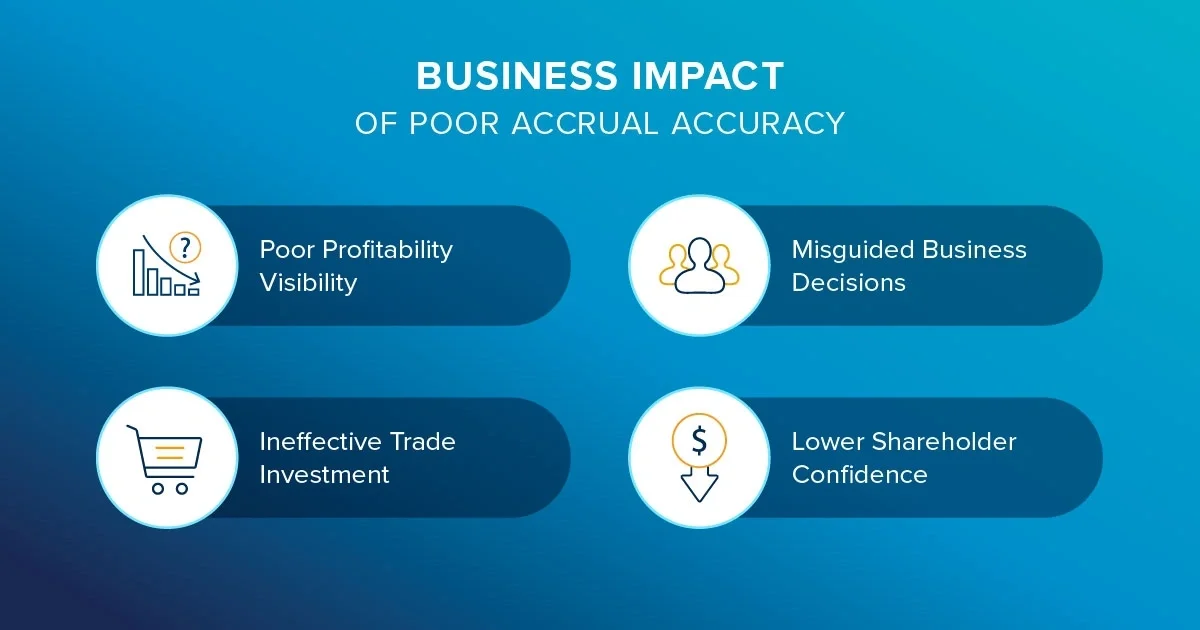
When accruals are inaccurate, profitability calculations become unreliable. Customers may appear more profitable than they truly are. Promotions may seem successful despite failing to generate meaningful returns. Investment decisions may favor programs that are underperforming economically.
Because historical trade spending serves as a key input into future forecasts, inaccurate accruals can introduce errors into spending projections, margin expectations, and annual operating plans.
Inaccurate accruals create inaccurate business insights. Bad accruals lead to bad decisions.
What Causes Trade Accrual Inaccuracies?
Several factors contribute to accrual challenges.
Spreadsheet Dependency: Manual calculations increase the likelihood of formula errors, inconsistent methodologies, and version-control issues.
Disconnected Systems: When trade management and financial systems operate independently, organizations struggle to maintain a consistent view of promotional liabilities.
Delayed Claims Data: Retailer claims often arrive weeks or months after promotional activity occurs, creating uncertainty around actual obligations.
Limited Visibility: Many organizations lack real-time insight into accrual balances, agreement performance, and outstanding liabilities.
Without timely visibility, discrepancies can persist for months after being identified.
Best Practices For Trade Accrual Accuracy
Leading manufacturers are moving beyond periodic reconciliation exercises and adopting a more continuous approach to accrual management. Key practices include:
Real-Time Visibility Into Trade Liabilities: Organizations should be able to monitor accrued obligations are promotional activity occurs.
Automated Accrual Calculations: Accruals should be driven by actual transactional and promotional data rather than manual estimates.
Continuous Reconciliation: Comparing accruals against settlements throughout the year helps identify issues before they become material.
Finance and Commercial Alignment: Finance, sales, and revenue management teams should operate from the same data and assumptions.
These capabilities allow organizations to maintain control throughout the year rather than scrambling to identify discrepancies during close.
How Does Vistex Help Consumer Products Manufacturers Manage Trade Accruals?
Improving accrual accuracy requires more than better spreadsheets. It takes connecting promotional planning, execution, settlement, and financial reporting into a unified process.
Vistex helps manufacturers achieve this through:
- Automated accrual calculations based on live transactional activity
- End-to-end visibility into trade liabilities
- Integrated settlement management and reconciliation
- Centralized agreement management
- Audit-ready reporting and traceability
- Financial and trade spend analytics
By connecting commercial and financial processes, Vistex enables organizations to improve visibility, strengthen controls, and reduce reliance on manual estimation. The result is greater confidence in reported results and a more efficient close process.
The Business Impact of Accurate Accruals Beyond Year-End Close
Extending far beyond financial reporting, the value of timely and accurate accrual reconciliation helps organizations:
- Develop more accurate forecasts
- Improve budget planning
- Make stronger trade investment decisions
- Deliver stronger profitability analysis
- Achieve faster month-end and year-end close cycles
- Foster better collaboration across finance, sales, and revenue management
When leadership trusts the numbers, decision-making improves across the business.
How Accurate Trade Accrual Management Reduces Year-End Close Risk
Accrual accuracy is not simply an accounting requirement. It’s a foundational capability that supports financial governance, profitability analysis, and strategic decision-making.
As trade programs become increasingly complex, maintaining accuracy requires greater visibility, stronger controls, and more automation.
Consumer products manufacturers investing in Vistex’s trade spend management capabilities will transform the year-end financial close process from a reactive scramble into a streamlined process built on confidence, transparency, and financial control.
Explore more related resources


How to Build an Effective Joint Business Planning Process Driving Alignment and Trade Promotion ROI
Get the latest news, updates, and exclusive insights from Vistex delivered straight to your inbox. Don’t miss out—opt in now and be the first to know!