
What is an AI-pricing strategy for fashion retail?
AI is changing the way fashion brands approach pricing. Before implementing a pricing strategy, it's important to understand how AI competitor price monitoring works. If you're new to the topic, start with our guide on AI competitor price monitoring for fashion brands. Pricing has always been one of the most powerful and most difficult levers in fashion retail.
Consumer demand shifts quickly. Competitors launch promotions overnight. Seasonal inventory creates constant pressure to markdown products before they lose value. At the same time, fashion brands must protect brand equity, maintain healthy margins, and deliver consistent pricing across ecommerce, marketplaces, wholesale partners, and physical stores.
Artificial intelligence (AI) helps brands navigate this complexity. Rather than relying on static pricing calendars or manual competitor checks, AI analyzes thousands of variables simultaneously to recommend pricing decisions based on business objectives instead of assumptions.
An AI pricing strategy combines machine learning, competitive intelligence, demand forecasting, inventory data, and pricing optimization to help retailers determine not simply what competitors are charging—but what price best supports revenue, profitability, and long-term brand value.
Why traditional pricing strategies no longer work
Many fashion organizations still manage pricing through spreadsheets, manual reporting, and scheduled markdown calendars. Those methods worked when pricing decisions changed every few weeks.
Today's retail environment moves much faster. Brands must respond to:
- Competitor promotions
- Marketplace pricing
- Inventory fluctuations
- Regional demand
- Consumer behavior
- Seasonal trends
- Currency changes
- Supply chain disruptions
Manual pricing processes simply cannot evaluate these variables at the speed required to remain competitive.
What are the building blocks of an AI-powered pricing model?
Successful AI pricing strategies rely on far more than competitor prices.
The strongest pricing decisions combine multiple data sources that provide a complete picture of market conditions and business performance.
1. Competitor Intelligence: AI continuously monitors competitor pricing, promotions, bundles, assortment changes, shipping offers, and marketplace activity to identify meaningful market shifts without encouraging reactive price matching.
2. Demand Forecasting: Forecasting models estimate future demand using historical sales, seasonality, product lifecycle, and emerging fashion trends. This helps retailers price products according to expected demand rather than historical assumptions.
3. Inventory Intelligence: Inventory should influence pricing decisions. A fast-selling product with limited inventory rarely requires aggressive discounting, while excess seasonal inventory may justify earlier markdowns to maximize sell-through.
4. Customer Behavior: AI can identify differences in customer purchasing behavior across channels, regions, and customer segments, helping brands personalize offers while maintaining consistent brand positioning.
How AI helps fashion brands make better pricing decisions
The value of AI isn't simply automation. Its greatest strength is helping retailers make more informed competitive pricing decisions, such as:
- Detect competitor price changes in near real time
- Recommend pricing based on demand elasticity
- Predict the financial impact of promotions before launch
- Identify products at risk of over-discounting
- Recommend markdown timing
- Balance inventory objectives with profitability
- Discover unauthorized sellers and MAP violations
- Surface pricing opportunities that manual analysis often misses
Instead of reacting to every competitor move, retailers gain the confidence to make strategic pricing decisions supported by data.
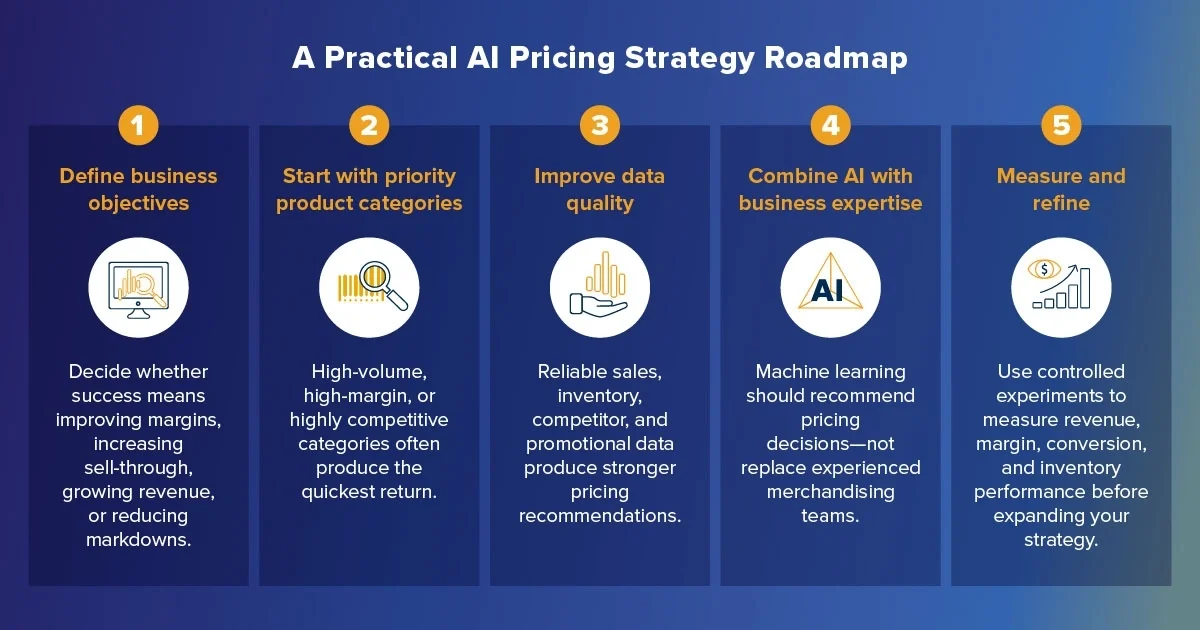
Proactive practical steps to build an AI pricing strategy in fashion
Implementing AI-powered pricing doesn't require replacing every pricing process overnight. Many successful fashion retailers begin with focused pilot programs before expanding across additional categories.
Common pricing mistakes fashion brands make
Many companies invest in AI pricing technology but struggle to realize its full value. Common pricing mistakes can include:
- Matching every competitor's price
- Ignoring inventory levels
- Focusing only on lowest price
- Allowing AI to operate without business guardrails
- Treating every product the same
- Measuring only revenue instead of profitability
The goal isn't to become the cheapest retailer, it’s to become the smartest.
Why AI pricing is about strategy, not speed
One of the biggest misconceptions surrounding AI pricing is that faster pricing automatically produces better results. In reality, speed only creates value when it supports the right business strategy.
The most successful fashion brands use AI to understand market dynamics, evaluate pricing scenarios, and make deliberate decisions that align with merchandising goals, inventory positions, and brand value. Sometimes that means matching a competitor's promotion. Other times it means maintaining price because customer demand, product exclusivity, or inventory levels support a premium position.
AI provides the intelligence. Fashion retail leaders provide the strategy. Together, they create pricing decisions that improve profitability without sacrificing long-term brand equity.
How Vistex helps fashion brands build AI-powered pricing strategies
An effective AI pricing strategy requires more than algorithms—it requires trusted data, competitive visibility, and the ability to execute pricing decisions consistently across every channel.
Vistex solutions help fashion brands transform competitor intelligence into actionable pricing strategies by monitoring competitor pricing, promotions, assortments, and market activity in near real time. Rather than simply identifying who has the lowest price, Vistex enables retailers to evaluate competitive data alongside demand forecasts, inventory positions, promotional calendars, and business objectives.
AI-powered pricing improves profitability for fashion companies
The question is no longer whether AI should influence pricing decisions—it's how organizations can use AI strategically to improve profitability while protecting brand value.
Fashion retailers that combine competitive intelligence with demand forecasting, inventory optimization, merchandising expertise, and clear business guardrails will be better positioned to navigate market volatility, respond confidently to changing conditions, and maximize profits.
Explore more related resources

Get the latest news, updates, and exclusive insights from Vistex delivered straight to your inbox. Don’t miss out—opt in now and be the first to know!