

AI in Foodservice Revenue Management: Turn Facility Data into Margin Decisions
Where Do Foodservice Pricing Strategy And Market Reality Diverge?
Foodservice manufacturers operate in one of the most complex commercial environments in consumer products. Pricing changes by facility, contracts lock in margin before demand materializes, and menu decisions often prioritize availability over profitability.
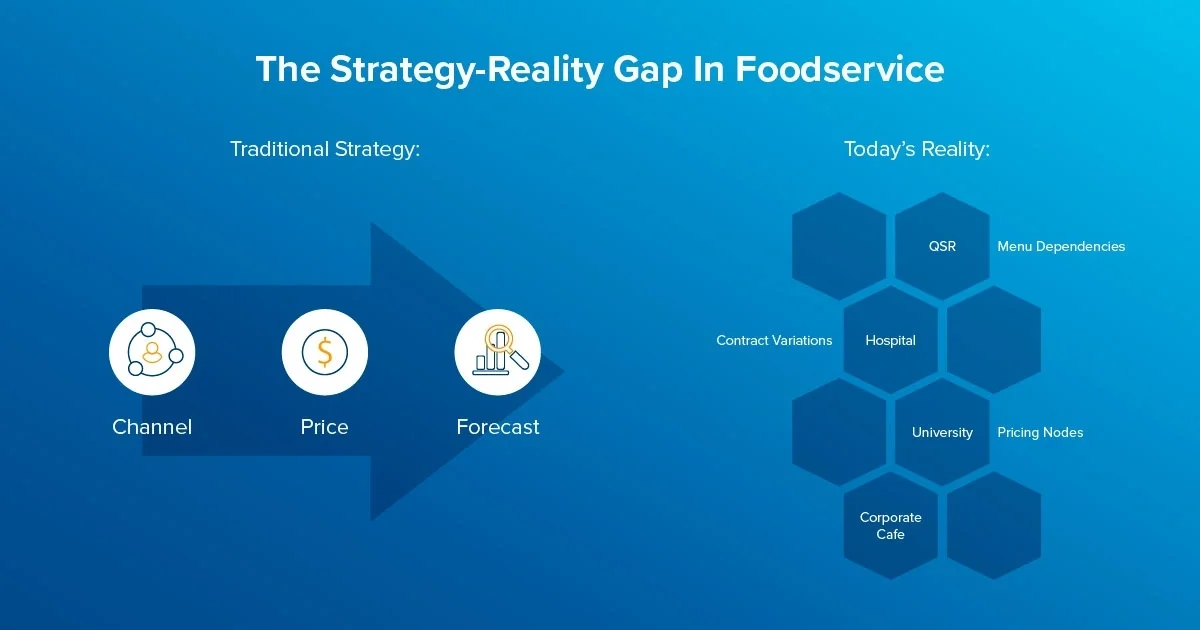
Despite these and other challenges, many foodservice pricing strategies still resemble those practiced in a simpler era, in times when volumes were predictable, costs moved slowly, and pricing could be managed at the channel level. Today’s market behaves differently.
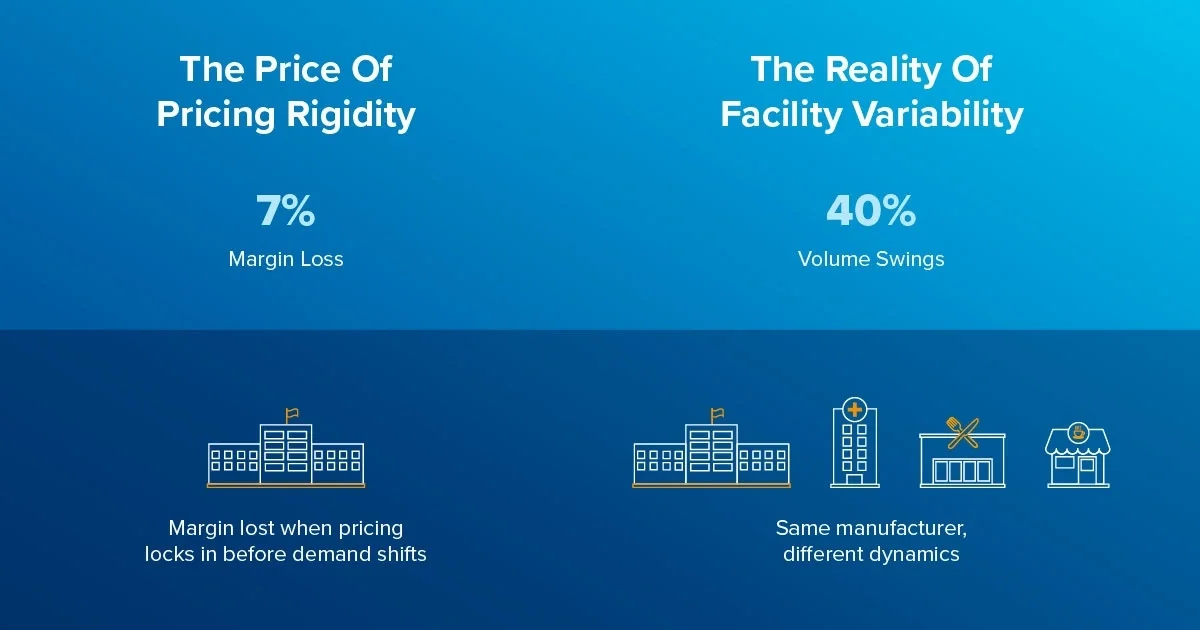
Consider this example: A national foodservice manufacturer discovered they were losing 7% margin across their university channel. The issue wasn’t the products, but rather the pricing that was locked in before fall enrollment dropped. The contract terms seemed sound, and the forecasts were reasonable. But the revenue model assumed static demand in a shifting market.
The gap between how foodservice works and how it is managed? That's where revenue leaks. AI’s role in foodservice revenue management strategy should prioritize turning fragmented data into coordinated revenue decisions.
The market opportunity is substantial and growing. The AI food market is projected to reach $49B by 2029, up from $9.7B in 2024 (Modor Intelligence), while the AI in food processing market specifically is expected to hit $22B by 2032 (Market.us). This growth reflects recognition that competitive advantage in foodservice increasingly depends on decision speed and precision, areas where AI excels.
Why Does Traditional Foodservice Revenue Management Miss Today’s Market Reality?
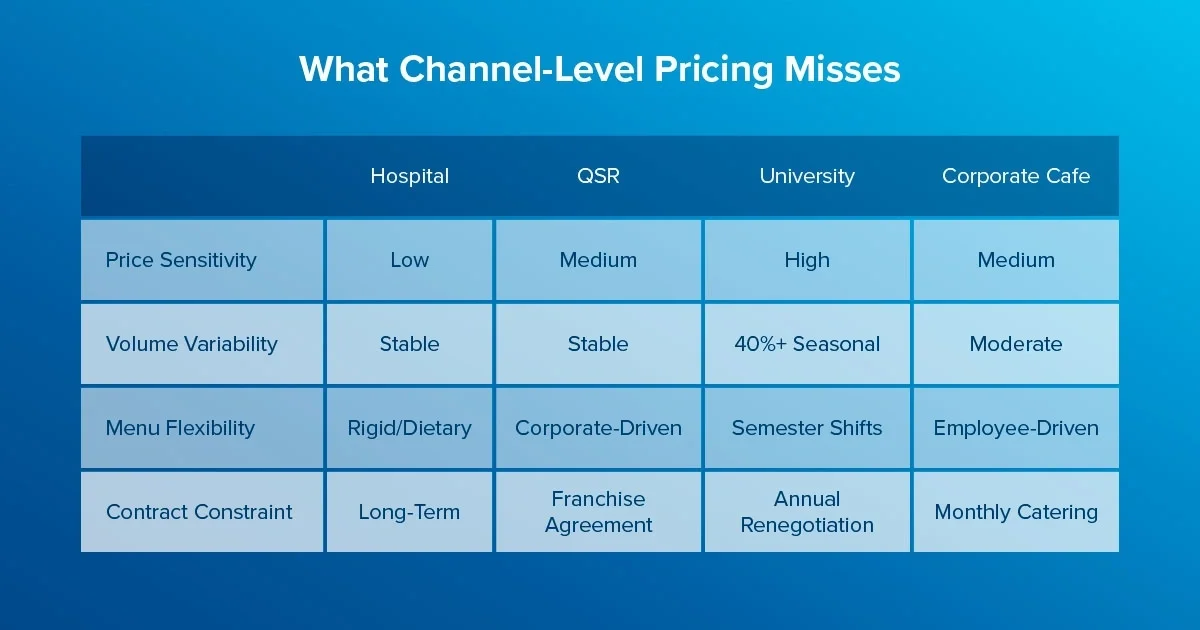
Foodservice pricing strategy has not evolved at the same pace as the business itself. Most organizations still plan around broad assumptions, even as reality becomes more granular: facility-level variability means that a hospital, university, quick service restaurant (QSR), and corporate café operate very differently, even within the same contract.
Think about it: A hospital cafeteria operates with rigid meal schedules, long-term dietary contracts, and minimal price sensitivity. A QSR franchise optimizes for speed and consistency, with menu changes dictated by corporate. A university dining hall faces seasonal volume swings of 40%+ and menu preferences that shift by semester. Each of these entities buys from the same consumer products manufacturer and selects the same products under completely different commercial dynamics, yet most manufacturers price and promote as if they’re homogeneous. AI enables the facility-level differentiation that manual processes can’t scale.
Contract-driven pricing rigidity locks in margin assumptions long before real consumption patterns emerge.
Menu decisions disconnected from profitability prioritize SKU presence without understanding elasticity, substitution, or true net revenue. The result? A strategy model designed for stable variables operating in a volatile world.
While yesteryear's foodservice manufacturers reflected on scenarios like "What should we sell this year," today's operators face such questions as "What should we price, promote, and stock this week by site, contract, and customer type?" Traditional planning cycles aren't suited to address today’s question at the speed of business.
Where Does AI In Foodservice Revenue Management Fail?
Many foodservice teams adopt AI to improve forecasts, automate reports, or surface anomalies. Those improvements are certainly important and useful, but they rarely move revenue on their own.
In foodservice, demand forecasting accuracy improves nothing if:
- Prices cannot be adapted by individual operation or contract
- Assortments remain bloated and misaligned with menu relevance
- Trade dollars fund volume without a margin return
AI creates real value when it informs commercial trade-offs, not operational hindsight.
If a model predicts demand but pricing is politically fixed, nothing changes. If AI flags underperforming SKUs but menus remain untouched, margin erosion continues. If promotions grow shipments but destroy net revenue, forecasting simply accelerates the wrong behavior. The difference between automation and strategy is whether AI is in place to influence the decision before money is committed.
So if the risk of AI initiatives failing is high, what does success look like?
Where Does AI Actually Create Value In Foodservice Margin Optimization?
Facilities are where foodservice strategy evolves from theory to reality.
Facilities operations are an ideal environment for AI because they:
- Repeat decisions on pricing, product assortment, and order regularity.
- Operate within known constraints, including volume agreements, menus, labor, and budgets.
- Produce measurable outcomes like waste, margin, satisfaction, and mix.
These levers make facilities the perfect environment for an adaptive margin optimization to better account for variability.
Instead of the question, “What worked last quarter?” guiding critical decisions, AI enables leaders to ask, “What should this site do next based on price sensitivity, contract exposure, and menu performance?” AI stops being theoretical and starts shaping commercial strategy when facility or site behavior feeds directly into pricing, promotion, and assortment logic.
When Is AI Not the Answer To Foodservice Pricing Challenges?
Not every foodservice challenge requires AI. Clear contract terms, disciplined SKU rationalization, and aligned incentives between manufacturers and operators solve many margin problems without the need for algorithms. AI's value emerges when the decision environment is too complex for rules-based approaches, when variables interact in non-linear ways across hundreds of facilities.
Before investing in AI, foodservice manufacturers should assess whether simpler interventions are better suited to their needs:
- Contract discipline: If you’re allowing customers to negotiate unlimited customization, no algorithm will save you. Optimize after first standardizing contract terms.
- SKU proliferation: If you’re carrying 2,000 SKUs because sales teams bend to customer whims, AI will only optimize a bloated portfolio. Let AI fine-tune assortment by facility type after focusing on 200-300 core items.
- Pricing governance: If regional managers can override pricing with a handshake, AI recommendations get ignored when they’re inconvenient. Deploy models after establishing pricing authority and clear boundaries.
- Data quality: AI can generally handle missing data, but it can’t overcome systematically wrong inputs (shipped cases that don’t match distributor pull-through, or contract terms that aren’t accurately captured in the system). Fix data integrity before building models.
Organizations implementing AI without clear strategies simply get faster at making inconsistent decisions. Rally your team around the question, “Have we solved the foundational strategy and governance issues that would prevent us from acting on AI insights?”
What Separates Successful AI Adoption From Failed Pilots?
Large language models and AI technology alone don’t change operational strategy, though clearly present compelling opportunities and benefits.
No amount of tech will overcome structural issues like:
- Over-customized contracts that prevent intelligent pricing adjustments.
- Politically driven price decisions that ignore elasticity.
- Rubber-stamp promotion strategies built on habit rather than evidence.
- Misalignment between operators and manufacturers over margin responsibility.
AI doesn’t create exceptional strategy. It exposes the need for advanced tools, operational readiness for AI, and sound change management to adjust mindsets and processes.
- When AI reveals that a contract destroys margin, leadership must act.
- When models indicate price insensitivity at a facility, pricing must follow suit.
- When trade spend fails to return net revenue, investment logic must change.
Successful AI adoption in foodservice requires three organizational shifts:
- Decision rights realignment: Facility managers need authority to execute AI-recommended pricing within guardrails, rather than seeking approval for every adjustment.
- Incentive restructuring: Sales compensation must reward net revenue, not just volume, lest AI insights create internal conflict.
- Contract evolution: New agreements should include pricing flexibility clauses that allow adjustments based on verified demand signals.
How Does AI Enable Adaptive Foodservice Revenue Strategy?
A sound foodservice strategy doesn’t rest on a shelf or computer drive, optimized once a year during annual planning. Instead, it's continuously adaptive.
Machine learning models enable:
- Pricing adjustments that would take traditional analysis quarters to uncover
- Ongoing price and assortment calibration instead of static lists.
- Faster response to cost and demand shocks, from commodities to consumer behavior.
- A shared source of truth between facility managers, manufacturers, sales, and finance.
Rather than planning around assumptions, AI-driven revenue management enables foodservice organizations to plan around reality, facility by facility, contract by contract, and decision by decision.
What’s At Stake For Foodservice Manufacturers?
The foodservice manufacturers who will lead the next decade are already making this shift, not because they have better data, but because they’ve built organizations capable of acting on it. The question isn’t whether AI will reshape foodservice strategy; it’s whether your organization will shape that transformation or simply react to it.
Start by asking: Which three facility-level decisions, if optimized weekly instead of annually, would most impact your net revenue? That’s where AI belongs and where competitive differentiation begins.
Get the latest news, updates, and exclusive insights from Vistex delivered straight to your inbox. Don’t miss out—opt in now and be the first to know!