
How can AI improve channel spend ROI in high tech manufacturing?
In our earlier look at the operational gaps in channel management that AI exposes, we examined the structural barriers that keep AI from delivering its full value in the channel. Once those gaps are closed, something shifts: AI stops being a reporting layer and starts being a decision engine. Channel spend becomes measurable, predictable, and continuously optimized for ROI.
For many high tech companies, this is where the real challenge begins.
You already invest heavily in rebates, incentives, market development funds (MDF), and partner programs. But when channel leaders need to understand which investments are driving profitable growth, the answers are often delayed by fragmented systems, disconnected data, and manual analysis. Without effective channel data management, high tech companies like yours struggle to connect channel spend directly to revenue outcomes.
The challenge is that most channel leaders still struggle to answer a fundamental question:
“Which partner programs are driving revenue?”
By the time most companies can produce an answer, the quarter has ended, budgets have been spent, and opportunities to improve performance have already passed.
The difference in ROI visibility and growth becomes clear when comparing how two companies manage the same level of channel investment.
Why some high tech companies achieve higher ROI from the same channel spend
Take two global OEMs with comparable scale, ecosystem complexity, and ambitions for channel growth. Channel leaders at both companies would tell you they’re investing in the right things: Tiered rebate programs, co-marketing funds, and partner incentives designed to drive sell-through. On paper, the portfolios look nearly identical. Same spend levels. Similar ecosystem complexity. Comparable program structures.
But when you look at what each company can do with that investment, how fast they can see performance, how quickly they can respond, how confidently they can attribute outcomes, the gap becomes stark.
Two OEMs. Same spend. Very different ROI.
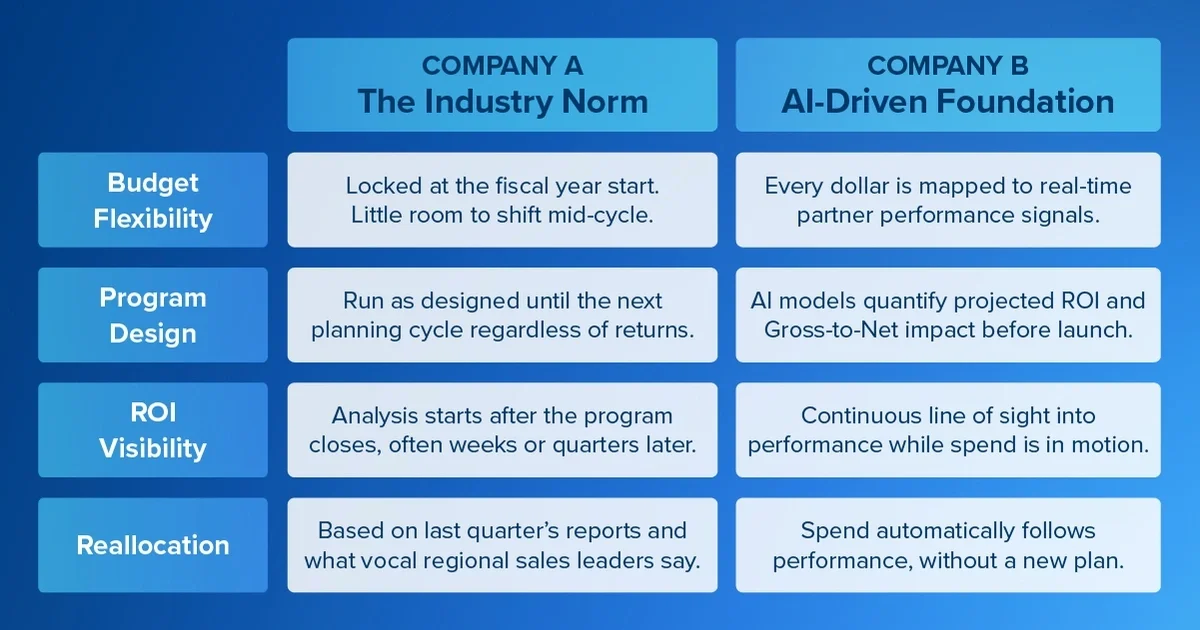
Company B has full visibility into measurable ROI growth on the same channel spend. Company A cannot explain its performance gaps. The difference is not the budget. It is the operational foundation behind the decision.
When that foundation is in place, AI does not just surface channel data. It connects spend to outcomes, enabling channel leaders to measure performance, predict results, and continuously optimize ROI.
Ways AI can improve visibility into high tech channel spend and partner performance
Company A has channel data. It just lives across five different systems, is reconciled manually every quarter, and lacks the centralized channel data management processes needed to support AI-driven decision-making.
Company B has the same underlying data and a unified, continuously updated view of it across programs, systems, and regions. That visibility is what AI enables and what separates a channel operation that can respond from one that can only report.
For most high tech companies, channel data management remains fragmented because channel data lives in disconnected systems: ERP, PRM, CRM, and spreadsheets that have accumulated over years of ecosystem growth.
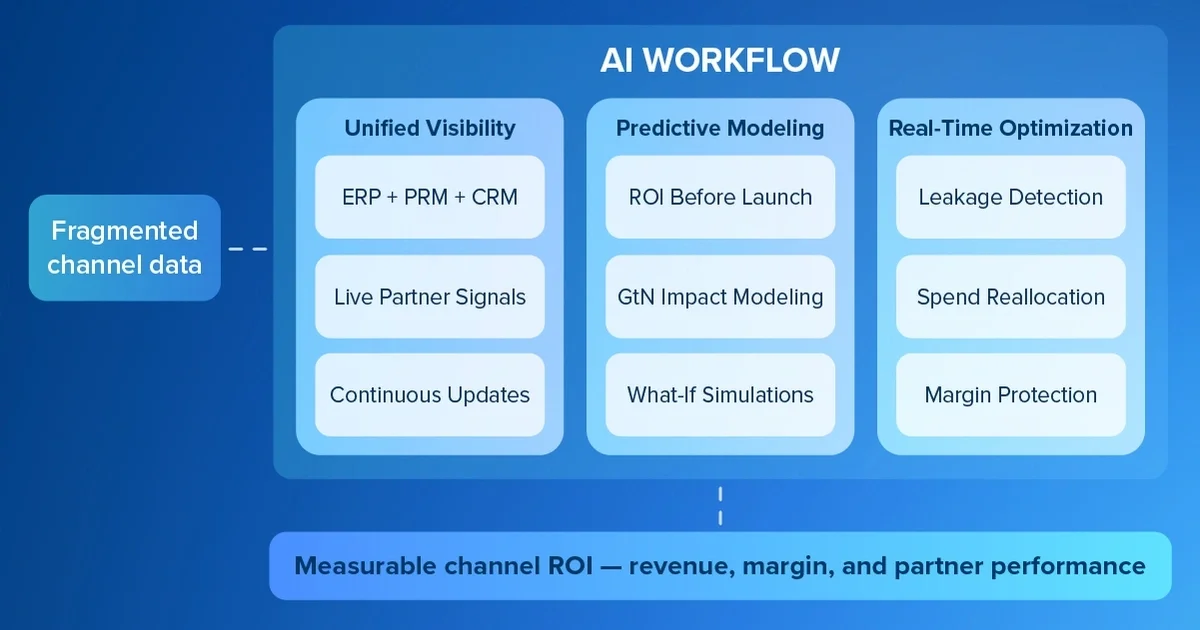
As we outlined when examining why channel complexity limits AI’s impact in high tech ecosystems, layering AI on top of siloed data does not fix the problem. It amplifies it. The prerequisite for AI-driven channel visibility is a consolidated data foundation, achieved by implementing a single-source-of-truth software solution.
With that foundation in place, AI delivers something most high tech companies have never had: A unified, continuously updated view of channel partner performance and spend effectiveness. Not a quarterly report. A live operational signal.
Vistex enterprise software creates this foundation by consolidating channel data and integrating directly with ERP systems, eliminating spreadsheet dependency, automating data flows, and reducing the errors that make channel visibility unreliable. When that integration is in place, insights that once required weeks of manual analysis become available in minutes.
What is the best way to predict ROI before channel spend is committed?
Company A designs incentive programs based on last year’s results, peer benchmarks, and whoever made the strongest case in the planning meeting.
Company B models outcomes before a dollar is committed, simulating partner behavior, projecting ROI, and quantifying Gross-to-Net impact so structural decisions are made with financial confidence, not internal advocacy.
Incentive programs represent one of the largest go-to-market investments your high tech company makes. Yet most high tech companies still design those programs based on historical precedent, peer benchmarks, and internal advocacy rather than AI predictive modeling.
With AI-powered channel management software, questions that used to require weeks of analysis can be answered before the next planning meeting:
- Which programs are generating measurable ROI, and which are not?
- How should incentive budgets be reallocated across tiers and regions?
- What happens to partner behavior if we shift a volume threshold or restructure a rebate tier?
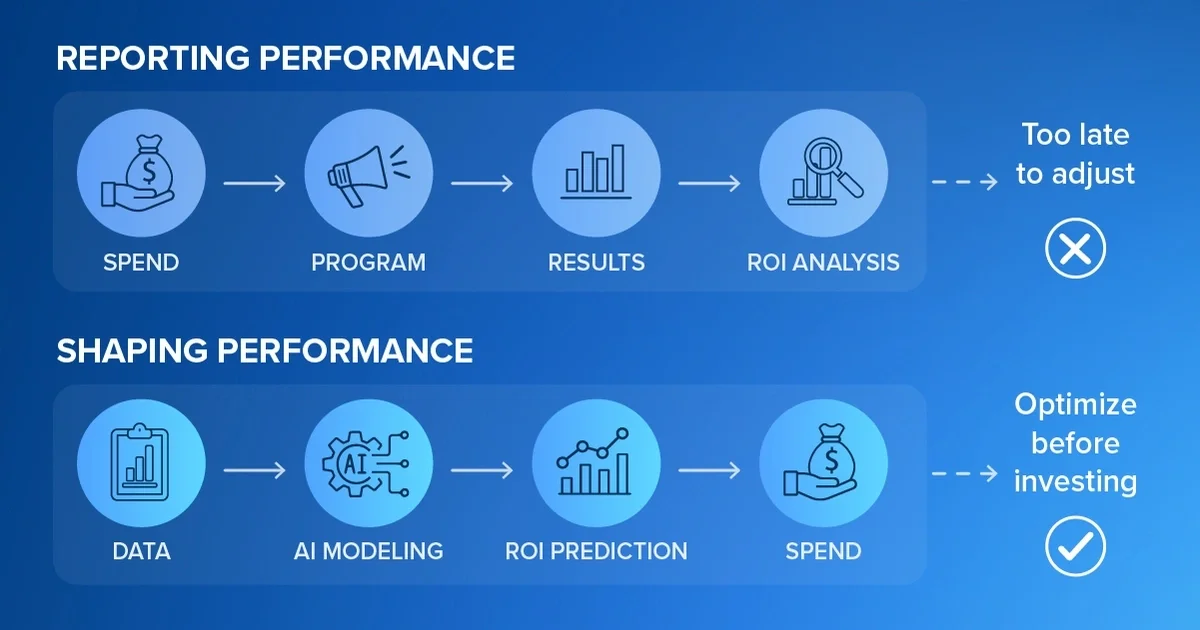
This is the type of AI predictive intelligence that Vistex channel management solutions deliver, transforming high tech channel incentive programs from reactive commitments into strategic ROI tools.
How can high tech channel leaders reduce incentive leakage while improving ROI?
Company A finds out about incentive leakage the same way most high tech companies do: During a quarterly review, weeks after the damage was done, with no practical way to recover the margin. Channel budgets were set at the start of the year, performance was reviewed on a lag, and by the time a reallocation cleared internal approval, the window had closed.
Company B never waits for that review. The single source of truth software solution gives real-time performance signals that trigger reallocation decisions while programs are still running, and AI-powered models surface where incentives are eroding Gross-to-Net before leakage can compound.
Most high tech companies aren't operating like Company B yet. Channel budgets are set annually, performance is reviewed quarterly, and by the time a reallocation decision clears internal review, the opportunity or the leakage is already weeks old.
Vistex software solutions close that gap with business AI built to protect margin and improve ROI simultaneously. By continuously analyzing:
- POS data
- Claims activity
- MDF utilization
- Rebate flows
- Sell-through signals
AI models can provide a clear view of where incentives are driving activity but eroding Gross-to-Net.
The prioritized recommendations are to pull back a rebate tier, tighten price protection, and reallocate MDF to higher-yield partners. Each recommendation is paired with what-if simulations that quantify the margin and revenue impact before any funds move.
As leaders accept or adjust those recommendations, the models retrain on realized outcomes, thereby progressively reducing leakage and steering incremental spend toward actions that preserve or expand margin in real time.
- Partner-level margin signals: A ranked view of each partner’s contribution to gross margin, the leakage drivers behind it (claims, over-discounting), and recommended corrective actions.
- Safe simulation and audit trails: Rapid what-if ROI and margin projections, paired with traceable decision logs that satisfy procurement, finance, and audit requirements.
Connect your channel spend directly to measurable ROI outcomes with business AI
Channel spend directly connects to measurable ROI when AI integrates incentive programs, partner performance, and financial outcomes through a unified channel data management framework.
This connection has historically been difficult to establish. Channel programs involve multiple stakeholders, systems, and data sources, and the gap between committed spend and attributed revenue has often been too wide to close reliably. Company B closed it. That single capability changes how programs are governed, funded, and scaled. Company A is still explaining its performance gaps to leadership.
AI bridges that gap. When partner performance intelligence is built on a consolidated data foundation, channel leaders can move beyond activity metrics and demonstrate measurable business impact: Revenue growth, partner engagement rates, and margin performance by tier and region.
The shift from reporting activity to demonstrating impact changes how channel programs are governed, funded, and scaled.
Prepare to turn your high tech channel spend into measurable ROI with AI
AI is giving high tech channel leaders new ways to improve visibility into spend, reduce incentive leakage, predict ROI before investments are committed, and optimize partner performance in real time.
But these outcomes depend on more than AI alone. Operational readiness still matters. AI can only deliver meaningful insight when partner data, incentive programs, and financial performance are connected across the business through effective channel data management.
Vistex AI-driven enterprise software provides that foundation by extending ERP systems with end-to-end integrated capabilities for pricing, rebates, incentives, and channel program management. When partner data is consolidated, incentive programs are modeled before launch, and performance intelligence is continuous, AI stops being a reporting tool and starts shaping commercial strategy.
The high tech companies that employ the right end-to-end channel management software solution now will be the ones who can answer the question posed at the start:
“Which partner programs are driving revenue?”
They will answer it in minutes, not weeks, and they will set the pace their competitors are trying to match.
Explore more related resources
Get the latest news, updates, and exclusive insights from Vistex delivered straight to your inbox. Don’t miss out—opt in now and be the first to know!