
How does medical device bundling affect Gross-to-Net and compliance?
Medical device manufacturers are increasingly turning to medical device bundling to grow revenue, strengthen customer relationships, and align with value-based care. From device-plus-consumable models to portfolio pricing and outcome-based purchasing, these strategies are expanding quickly. And as they do, the complexity of bundled agreements is growing with them.
That complexity creates a specific problem: it becomes harder to see how margin is realized through Gross-to-Net. You can’t manage what you can’t see. And right now, your bundling agreements may be costing you more than you know. Isn’t it time to find out?
Overlapping pricing structures, layered discounts, and performance-based terms create interdependencies among contract management, reimbursement, and government pricing calculations that are easy to miss and costly when overlooked. The result is margin leakage, audit exposure, and compliance risk that compound quietly until they surface in your numbers.
Do you know the difference, before it shows up in your numbers?
Can you see the full margin and compliance impact of every bundled agreement before it is executed?
What are the most common types of medical device bundles? How do they impact revenue, GtN, and compliance?
Understanding each bundle type and how it flows through Gross-to-Net is the first step toward managing margin effectively. Each model shapes how discounts are applied, how revenue is allocated, and how net price is realized over time. Compliance is not separate from margin. It is a driver of it, where misalignment can lead to pricing exposure, reporting discrepancies, and significant financial penalties.
Understanding how each bundling model impacts revenue, margin, and compliance is essential:
Device + consumable models
A capital device is paired with consumables, often lowering upfront cost while generating recurring revenue through usage or add-on services.
GtN impact:
Can shift value throughout the customer relationship. Because the device and consumables may be priced differently, the bundle can affect revenue allocation, margin timing, and the overall net price realized over time.
Compliance impact:
The pricing relationship between the device and consumables can expose your company to federal anti-kickback and government pricing frameworks. How the bundle is structured and documented matters. The specifics are covered in the compliance section below.
Value-based bundles
Devices are combined with digital tools, monitoring, or apps, often tied to subscription or performance-based pricing.
GtN impact:
Introduces variable, outcome-based adjustments that increase the complexity and uncertainty of accruals. Require identification and increased scrutiny downstream.
Compliance impact:
Outcome-based structures that include services or digital tools alongside a device can trigger reporting and safe harbor obligations. The compliance considerations depend heavily on who receives value and how the arrangement is priced. Ensuring compliance is addressed in the next section.
Procurement and portfolio bundles
Multiple products are grouped to simplify purchasing and to support full procedures or disease-state treatment.
GtN impact:
Blurs product-level margin visibility and complicates unbundling for accurate reporting. These structures can make it harder to see product-level margin and to evaluate the economics of each component separately. They may also require closer review of pricing disclosures, discount treatment, and contract terms to ensure the bundle is accounted for consistently. Where tiered portfolio discounts affect Medicaid Best Price or a Federal Supply Schedule Tracking customer, that exposure feeds directly into rebate accruals. This has a GtN impact that is easily underestimated without product-level visibility.
Compliance impact:
Tiered portfolio discounts can affect government pricing calculations and disclosure requirements across multiple frameworks simultaneously. The compliance section below covers the key obligations to evaluate.
Volume and temporal bundles
Discounts are tied to purchase thresholds or time-based commitments.
GtN impact:
Creates timing mismatches between revenue and discounts, reducing forecast accuracy.
Compliance impact:
Retroactive discount structures introduce compliance risk alongside their GtN complexity. The same tier adjustment that affects your accruals may also have implications for government pricing and safe harbor. How those obligations interact is covered in the next section.
Product with service bundles
Devices are sold alongside training, maintenance agreements, or other services to drive adoption and long-term loyalty. Product calibration, ongoing support calls, and ongoing service contracts are common additions.
GtN impact:
Add accounting and compliance complexity because the product and service components may need to be evaluated separately. They may also require attention to transparency and reporting obligations, depending on the parties involved and the nature of the services provided.
Compliance impact:
Bundling services with a device raises distinct compliance questions around transfer of value and fair market value documentation. The nature of the service and who receives it determines the specific obligations.
What medical device bundled adjustments most commonly affect Gross-to-Net?
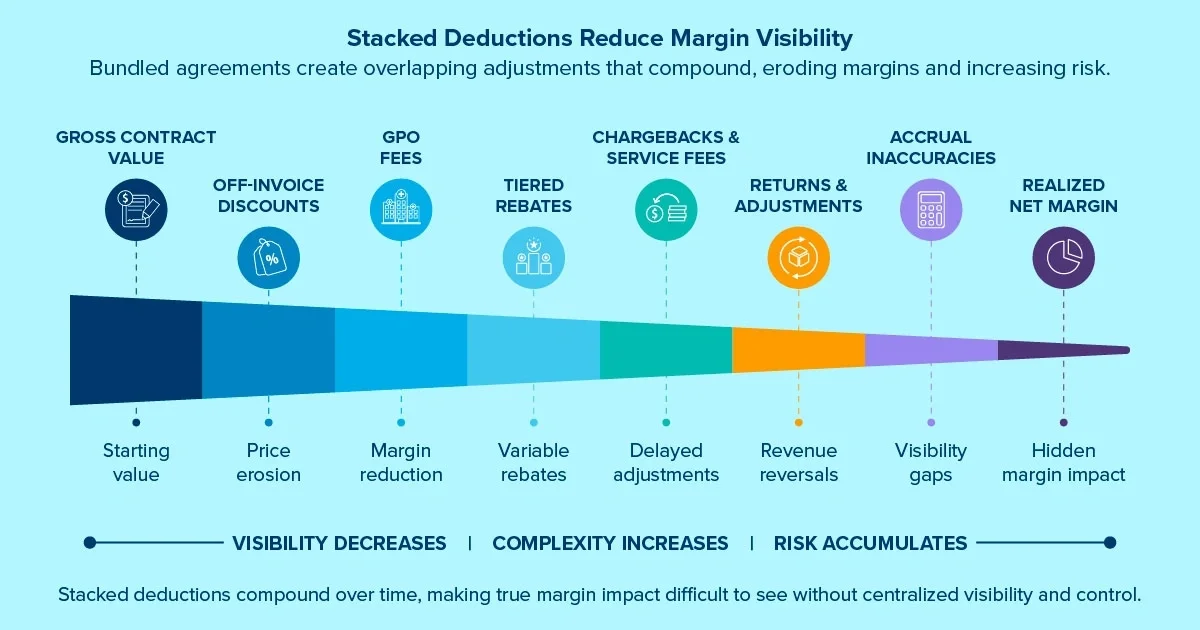
Bundled agreements often include overlapping deductions, including:
- Off-invoice discounts and promotional allowances
- GPO administrative fees
- IDN (Integrated Delivery Network) tiered rebates
- Distributor chargebacks and service fees
- Returns and financial adjustments
- Accrual inaccuracies
What compliance risk must medical device companies manage when bundling?
Bundling introduces compliance obligations that need to be built into your GtN and pricing strategy from the start. When discounts, services, and contract terms are layered together, they create exposure across multiple compliance frameworks simultaneously.
Three areas require attention so that you remain compliant when bundling:
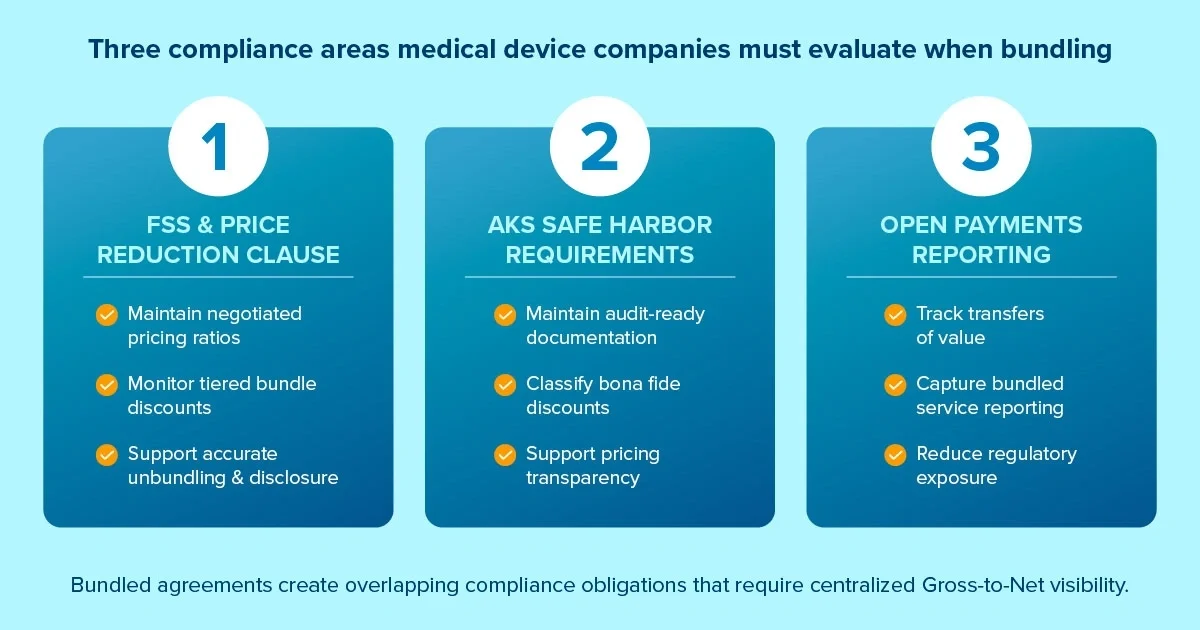
1. Federal Supply Schedule (FSS) and the Price Reduction Clause
For manufacturers selling to the federal government through the VA FSS, the Price Reduction Clause (552.238-75) requires maintaining a negotiated ratio between the tracking customer’s net price and the FSS-awarded price throughout the contract term.
Bundled or portfolio discounts, particularly those with tiers, can trigger downward pressure on FSS pricing and create retroactive adjustment obligations if the ratio is not maintained. Unbundling, when required, may be difficult without an appropriate system. If the unbundling and allocation are not accurate, you may automatically lose margin on the VA government contract. The key requirement is full disclosure of pricing terms, not necessarily the allocation of a discount to each item.
2. Anti-Kickback Statute (AKS) Safe Harbors
Bundled or conditional discounts must satisfy the AKS discount safe harbor under 42 CFR §1001.952 to avoid liability. A 2024 federal court decision brought important clarity to documentation expectations, confirming that full price-level transparency across the bundle matters most, rather than breaking out a separate discount value for each item within it.
Proper documentation is essential. Your system should be able to classify discounts as bona fide or non-bona fide, maintain an audit trail, and support safe harbor determinations. Manufacturers should always seek guidance from outside counsel before initiating new bundling strategies.
3. Increased reliance on off-invoice adjustments
If your organization is an “applicable manufacturer” of an FDA-cleared or approved device reimbursed by Medicare, Medicaid, or CHIP, you are required to track and annually report payments or transfers of value to covered recipients, including physicians, teaching hospitals, and certain non-physician practitioners, to CMS for publication in Open Payments.
Bundled product-plus-service arrangements can generate reportable transfers of value that must be accurately captured, classified, and reported. Missing or misclassified entries create both regulatory and reputational risk.
What does a GtN software solution need to support medical device bundling?
Fragmented systems and manual processes are the root cause of most Gross-to-Net and compliance failures in bundled environments. When discount data, contract terms, and reporting obligations live in separate places, visibility breaks down, and so does control.
To manage bundled agreements effectively, these capabilities need to operate together within a single system of record:
- Real-time GtN accrual and modeling across bundled agreements
- Flexible bundling and unbundling to support accurate product-level reporting
- Discount classification (bona fide vs. non-bona fide) with full audit trail
- Government pricing support, including FSS, Medicaid, and managed care
- Sunshine Act and Open Payments reporting integration
- Compatibility with SAP and other ERP platforms
Your medical device company is not struggling because bundling is complex. It’s because the financial and compliance impact of each bundled agreement is fragmented across systems, teams, and timelines.
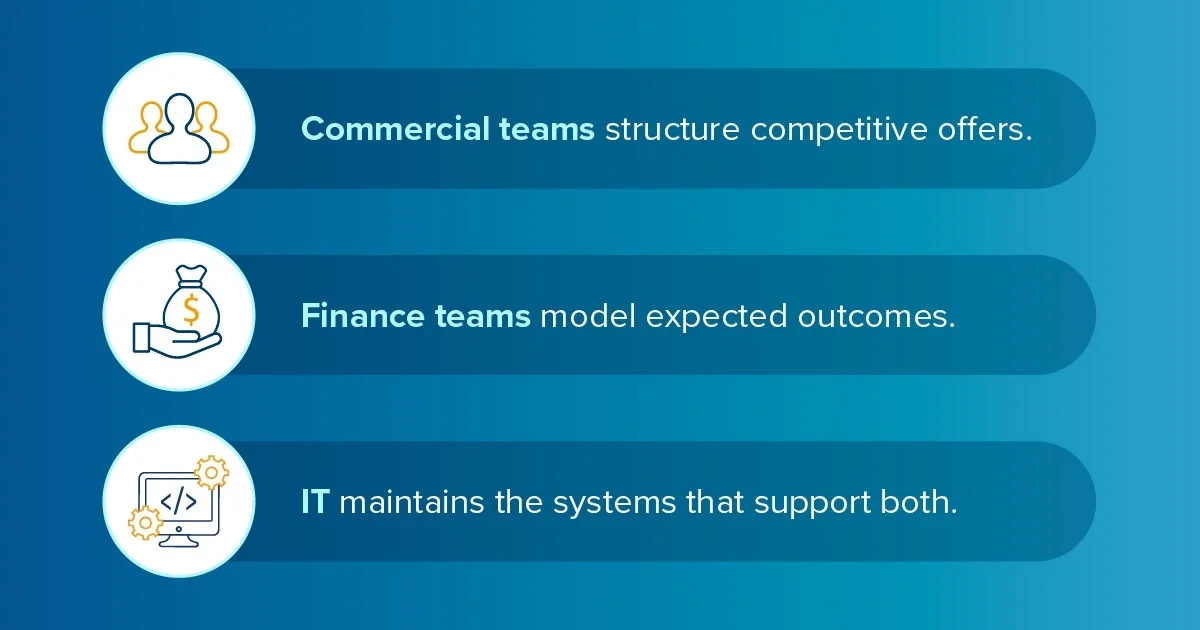
But when Gross-to-Net is not unified, those functions never fully connect. The business keeps moving, but clarity does not.
This is where a unified platform becomes necessary. Vistex enterprise software connects Gross-to-Net, government pricing, rebates, chargebacks, and analytics into a single system, enabling these capabilities to operate together, along with the teams that support these processes, by supporting more proactive, informed decision-making.
Device companies losing margin on their best deals aren’t making strategic mistakes. They’re making visibility mistakes.
Are you one of them?
Bundling is accelerating across the medical device industry because it works. It strengthens relationships, aligns to outcomes, and opens new revenue pathways.
Gross-to-Net complexity increases as bundled pricing structures, rebates, and compliance obligations overlap.
Vistex enterprise software changes this by transforming Gross-to-Net from a fragmented set of processes into a connected system of margin and compliance execution.
Instead of reconciling outcomes after they happen, Vistex lets you manage bundled agreements with full visibility from the start:
- Model the true financial impact of bundles before they are executed
- Maintain product-level visibility, even within complex bundles
- Classify and track discounts in real time with audit-ready transparency
- Connect Gross-to-Net, government pricing, and reporting in one system
- Turn Gross-to-Net into a continuous decisioning layer, not a retrospective exercise
Here is the shift: You move from reacting to complexity to operationalizing it.
With this shift, you can build the operational infrastructure to see, manage, and optimize every dimension of those offers in real time.
Because in a market where medical device bundling continues to grow, margin is not lost to strategy.
It is lost in the gap between decision and visibility. And that is the gap Vistex is built to close.
Explore more related resources

Leveraging an Integrated Gross-to-Net Process for Time Savings, Accuracy, and Profitability


Get the latest news, updates, and exclusive insights from Vistex delivered straight to your inbox. Don’t miss out—opt in now and be the first to know!