
How does AI help pharma teams control contract pricing and bid strategy across revenue, compliance, and reimbursement?
Pharma contract pricing is no longer a spreadsheet game. Artificial intelligence (AI) is forcing that reality into the open. What once lived comfortably in spreadsheets is now shaped by interconnected data, regulatory pressure, and global pricing dependencies that do not stay contained. Contract pricing decisions move across markets. Bid strategy decisions influence reimbursement, compliance exposure, and ultimately revenue. Yet most teams still make those decisions without seeing their full impact.
Machine learning and AI can process pricing inputs at scale, including payer requirements, real-world evidence, and bid data. But the shift is not speed. It is visibility. AI shows how decisions behave across the business before they are executed.
Where pharma pricing decisions break down
The challenge is not complexity. It is fragmentation.
Contract pricing and bid strategy are managed as discrete steps, even though their impact is continuous. A price is set in one system. A bid is submitted in another. Revenue impact is measured downstream, often after financial exposure already exists.
Without a connected layer, your teams cannot see how a pricing decision affects global reference pricing, Gross-to-Net, or compliance risk. Decisions move forward. Visibility does not.
AI integrates those decisions into a governed system, allowing pricing and bid strategy to be evaluated with full awareness of the impact on margin, compliance, and reimbursement impact before execution.
That is what turns decision-making into control.
How does AI help manage contract pricing and bid strategy complexity?
AI doesn’t reduce complexity. It makes it visible and governable. Contract pricing and bid strategy are difficult to manage because their impact extends beyond the point of decision. This issue is not a lack of data. It is the inability to evaluate decisions within the full system that they affect.
AI introduces a connected decision layer. Pricing inputs, bid requirements, and their full business impact are evaluated together, not in isolation. Your teams can model contract pricing, assess bid strategy, and understand revenue and compliance impact before execution.
This is not about moving faster. It is about making decisions that hold up as they move through the business, and the final proposal becomes visible.
Because complexity has always been there, AI makes it visible.
What is making contract pricing and bid strategy harder to manage?
Contract pricing and bid strategy are harder to manage because an increasingly interconnected set of factors now shapes every decision. In US reimbursement markets, IRA negotiations introduce Maximum Fair Prices, Most-Favored-Nation (MFN) clauses extend concessions into reference pricing, and 340B growth continues to widen list-to-net gaps. Deloitte’s Market Access (MAx) framework reinforces that pricing strategy, value-based contracting, and contract performance monitoring need to work together to support market access.
In international tendering environments, reference-pricing linkages and parallel-trade dynamics create their own cascading commercial pressures.
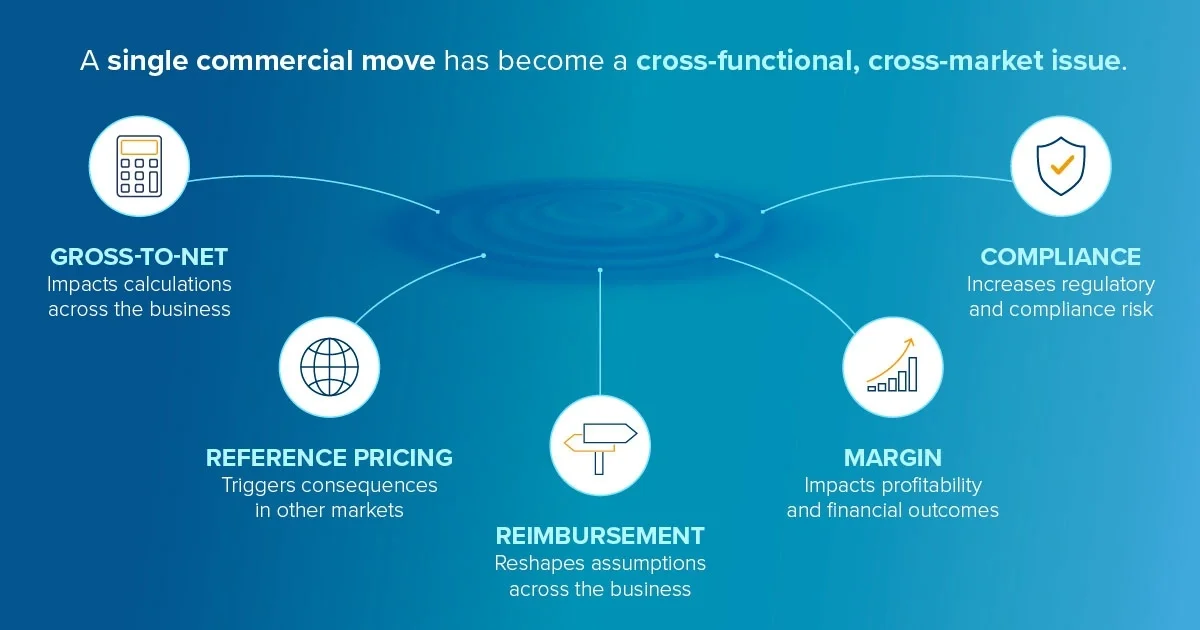
When you adjust a contract or bid price in any market, that decision rarely stays contained; it flows into Gross-to-Net calculations, triggers reference-pricing consequences in other markets, and reshapes reimbursement assumptions across the business.
AI addresses this through governed layers:
- Predictive AI Forecasts bid viability and margin risk before decisions are made
- Generative AI Extracts and structures terms from unstructured inputs into consistent formats
- AI agents Execute discrete steps (completeness checks, compliance screening, and scenario variants) with traceable outputs
- Agentic AI Orchestrates the end-to-end workflow from opportunity identification through qualification, modeling, review, and recommendation. Pauses on exceptions like Best Price triggers with full context
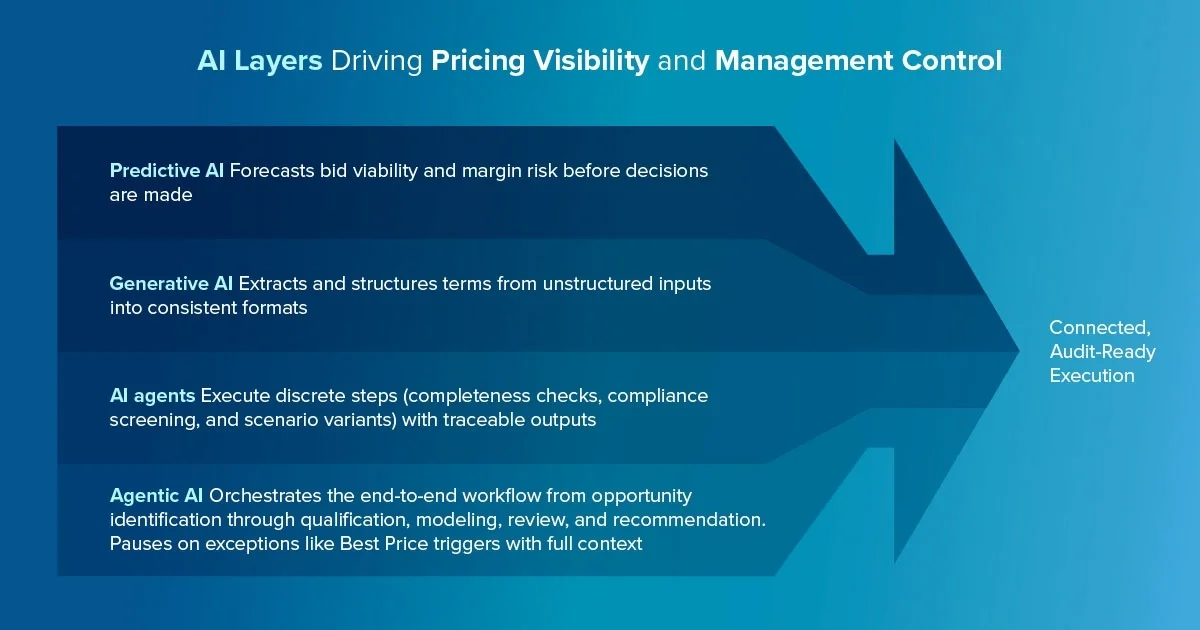
Control comes from structured inputs and outputs, predefined decision rules, and audit-ready logs that align margin, compliance, and execution in one process.
From a global perspective, how does AI improve pharma tender strategy and pricing decisions?
The pharma tender process has evolved from a submission process into a connected, data-driven workflow. This requires your pricing teams to evaluate opportunity, pricing, and downstream impact simultaneously, not as isolated steps.
Value-based pricing and outcomes-based models are increasingly central to global pharma tenders, especially in Europe and emerging markets, where payers tie awards to real-world evidence and patient results. The tender process now requires evaluating opportunity, pricing, value pricing risk, and broader impact simultaneously within an integrated decision framework.
This shift introduces a new level of complexity. Pricing teams are no longer just responding to tenders; they are making decisions that ripple across markets and influence margins, compliance exposure, and global reference pricing. Evaluating each bid in isolation is no longer sustainable.
AI drives connected control across the tender lifecycle:
- Opportunity identification: AI rapidly scans tender documents in real-time, extracts key criteria, and highlights opportunities aligned with strategic priorities, eliminating hours of manual review.
- Qualification and prioritization: Commercial and pricing rules such as margin thresholds, volume parameters, and channel strategies are applied as opportunities enter the pipeline. This ensures that effort is directed toward bids that are not only winnable but also strategically and financially sound.
- Pricing and win probability: Advanced models simulate bid scenarios using historical results, competitor trends, pricing thresholds, and value-based outcomes data. These models factor into patient health metrics and real-world evidence. Teams gain a clear view of how different price points influence win probability, profit margins, and the impact on global pricing benchmarks.
Consider a tender in a reference-priced market. AI evaluates multiple bid scenarios in context, revealing not only the win probability but also the full impact on margin and global pricing.
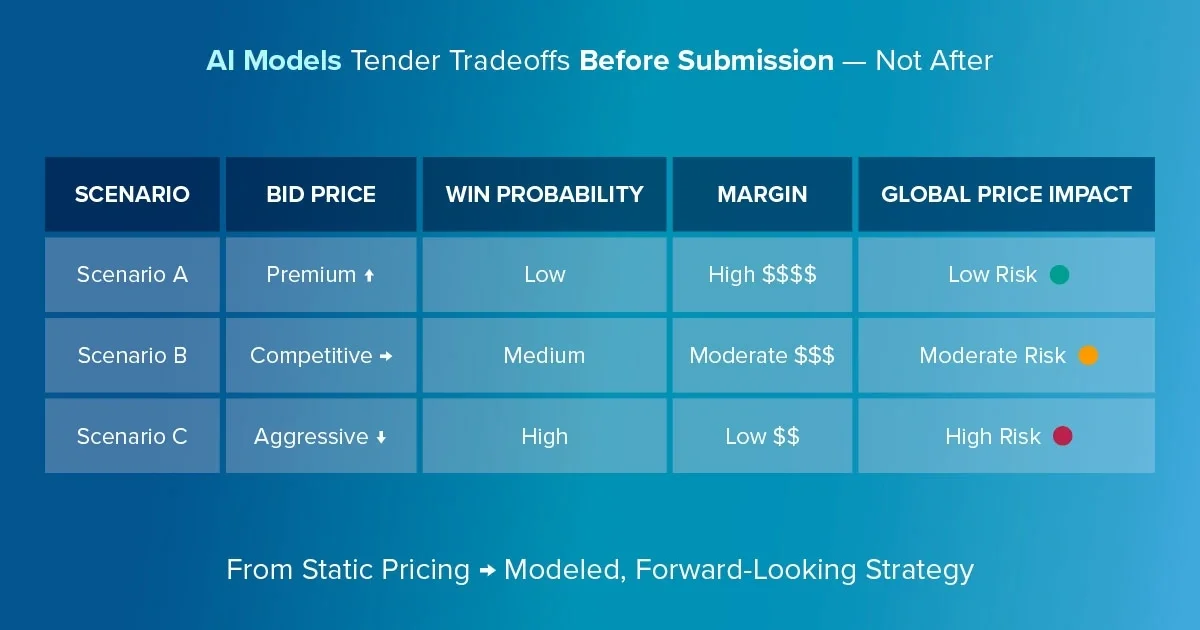
The result is a fundamental shift. Tendering moves from reactive execution to informed, globally aware decision-making, in which pricing is evaluated in context rather than in isolation.
Vistex enables this shift by embedding AI-driven insights directly into global pricing and tender management workflows. Decisions are not only more informed, but also consistent, governed, and scalable across the enterprise.
How does AI help manage compliance risk in pharma contract pricing?
Compliance risk originates in pricing decisions, not reporting processes. Every contract price becomes an input into regulatory calculations, whether that connection is visible at the time or not.
A pricing concession intended to secure formulary position may trigger Best Price status. This can alter rebate obligations and affect downstream ASP calculations without being identified during contract execution.
The risk factors include:
- Interconnected pricing obligations: MFN clauses and reference pricing link contracts across markets. One adjustment can trigger unintended cascading effects.
- Classification gaps: Inconsistent handling of discounts, rebates, or fees, plus a lack of audit-ready documentation, can create audit exposure even when pricing intent is understood.
- Scale of regulatory exposure: A single misclassification can cascade across Gross-to-Net reporting, government pricing (340B, Medicaid), and international compliance, risking multimillion-dollar penalties.
AI transforms this minefield into managed risk
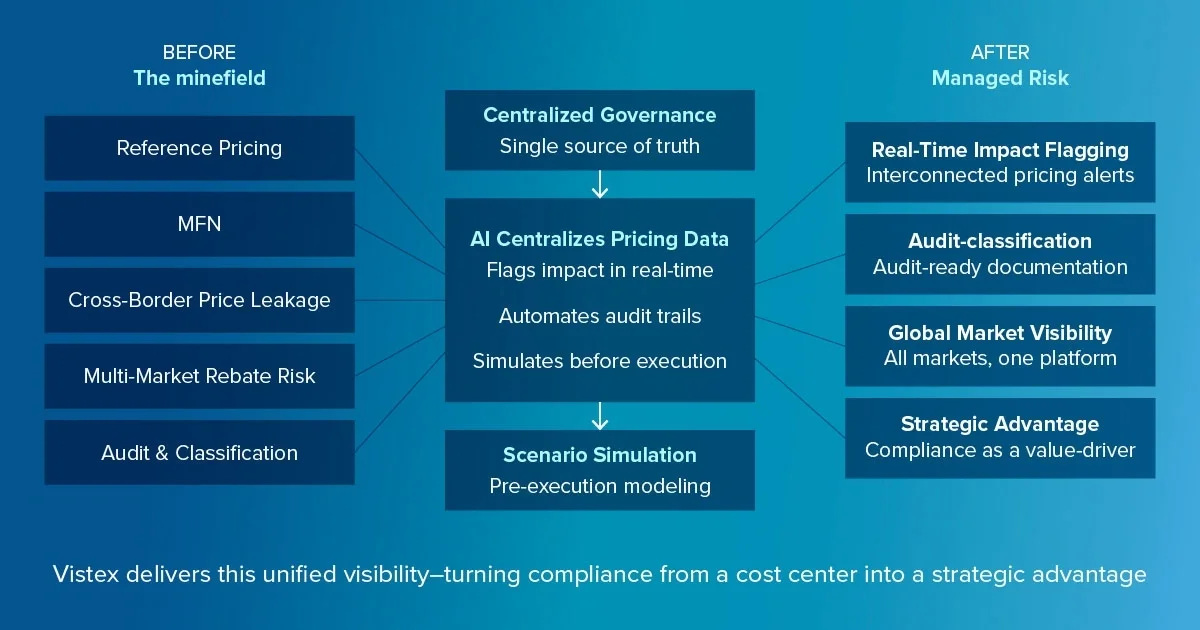
By centralizing pricing data in governed platforms, AI flags interconnected impacts in real time, automates classifications with audit trails, and simulates downstream scenarios before execution. Vistex delivers this unified visibility, turning compliance from a cost center into a strategic advantage.
These hidden connections turn routine pricing into a compliance minefield. Without unified visibility across the pricing ecosystem, even well-intentioned decisions expose companies to millions in penalties and years of regulatory scrutiny.
AI is what brings control to pharma contract pricing and bid strategy
Pharma contract pricing and bid strategy have become difficult to control because every decision now affects revenue, compliance, and reimbursement.
The challenge is not the number of decisions. It is the inability to see how those decisions behave once they move through the business.
Commercial teams structure contracts and pursue tenders.
Pricing teams evaluate competitiveness and model scenarios.
Finance tracks Gross-to-Net and margin realization.
Compliance monitors regulatory exposure across markets.
Those decisions are made without seeing how they will affect margin, compliance, or downstream global pricing.
Contract pricing is set, and bids are submitted without full downstream visibility.
Risk is identified only after exposure has already been created.
Margin is understood only after it has already shifted.
The business continues to operate, but the decisions themselves are not fully controlled. AI changes this by making pricing decisions visible, connected, and continuously evaluated before execution.
This is how Vistex enterprise software applies AI to pharma contract pricing and bid strategy. Instead of reacting to outcomes, Vistex enables teams to act with full context:
- Evaluate contract and bid pricing against global impact before execution
Understand how each decision affects Gross-to-Net, margin, and reference pricing. - Model scenarios across revenue, compliance, and reimbursement simultaneously
Move from static pricing to forward-looking, scenario-based decision-making. - Identify compliance exposure in real time
Surface compliance risk, classification issues, and regulatory impact before they occur. - Unify contract pricing, tender strategy, government pricing, and margin management in one system
Align commercial, finance, and compliance teams around a single source of truth. - Turn pricing into a continuous decision layer
Adapt strategy based on real-time data, performance, and risk signals.
Here’s the shift: AI does not simply improve pricing. It enables control over it.
Leading pharma companies are not adopting AI as a feature. They are embedding it into how pricing decisions are made, evaluated, and governed.
Because in today’s pharma environment, contract terms and bid decisions don’t fail at the point they are made.
They fail in how their impact is understood across the business. AI is what makes that impact visible, connected, and controllable.
And that is the gap Vistex is built to close.
Explore more related resources


Get the latest news, updates, and exclusive insights from Vistex delivered straight to your inbox. Don’t miss out—opt in now and be the first to know!