

From generative AI and automated workflows to intellectual property governance and royalties management, the media and entertainment industry is operationalizing transformation.
By the end of the first morning at NAB Show 2026, a pattern had already settled across the event: media transformation was no longer theoretical. The industry had stopped debating AI and started demanding proof. Not demonstrations or roadmaps, but measurable outcomes, deployed at scale, right now.
Conversations were focused and consequential. At the Vistex booth, the first question from almost every walk-up was some version of the same thing: What are you doing with AI? Whether you were at a booth or in a session, a pattern emerged fast:
- Artificial intelligence in media was expected to be operational — not aspirational.
- Streaming was infrastructure, not strategy.
- Sports has become a core revenue model, not just a content category.
- Integrated platforms are replacing fragmented workflows in real time.
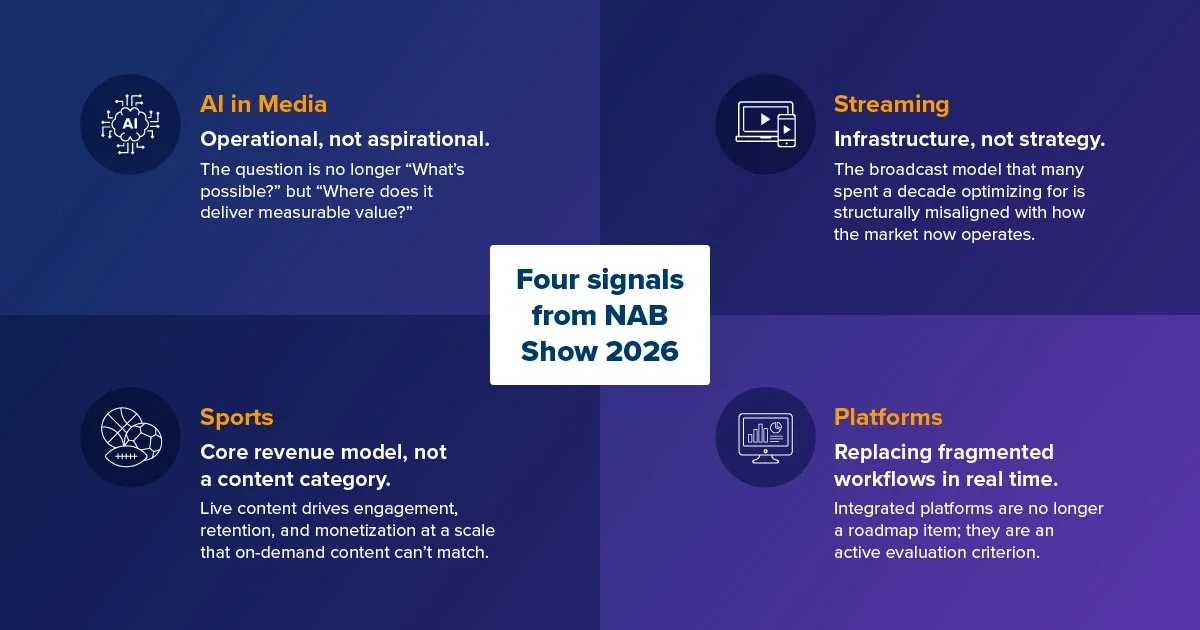
The media and entertainment industry transformation now underway — driven by advanced analytics, machine learning, and increasingly connected operational systems — is reshaping how content is created, distributed, and monetized end to end. The broadcast model that many organizations spent a decade optimizing for is structurally misaligned with how the market now operates.
NAB Show 2026 revealed what’s replacing the traditional broadcast model: a unified, data-driven ecosystem where content, rights, and revenue are tightly connected and expected to perform as one. If your organization is still structured around disconnected systems and limited visibility, you are operating against the market's direction.
Why is operational failure the real AI story in media and entertainment?
AI use in media and entertainment was visible across every hall at the show, but the conversation has matured. A year ago, discussions centered on possibility. This year, they centered on outcomes. Where is artificial intelligence deployed? Where is it delivering measurable value?
Across those conversations, the same operational failures kept surfacing: fragmented systems, inconsistent metadata, and manual processes that have not scaled with distribution complexity. For years, these gaps were accepted as operational reality. Now, with advanced analytical capabilities and connected data environments, those inefficiencies are quantifiable and increasingly indefensible.
- Metadata gaps translate directly into missed monetization events.
- Delayed reconciliation compresses cash flow and distorts forecasting.
- Disconnected workflows limit decision-making speed at exactly the wrong moment.
AI use reveals what’s broken, but doesn’t fix it
The highest-traction AI use cases at NAB Show 2026 weren’t about generating content; they were about controlling it. Organizations are automating metadata enrichment to improve discoverability, tracking usage across distribution channels in real time, improving royalty accuracy to reduce revenue leakage, and enabling predictive forecasting tied directly to contract terms and revenue outcomes.
There is also growing momentum behind agentic AI — systems that don’t merely support individual tasks using a single AI tool, but actively orchestrate entire operational sequences, from contract ingestion through rights interpretation to financial reconciliation.
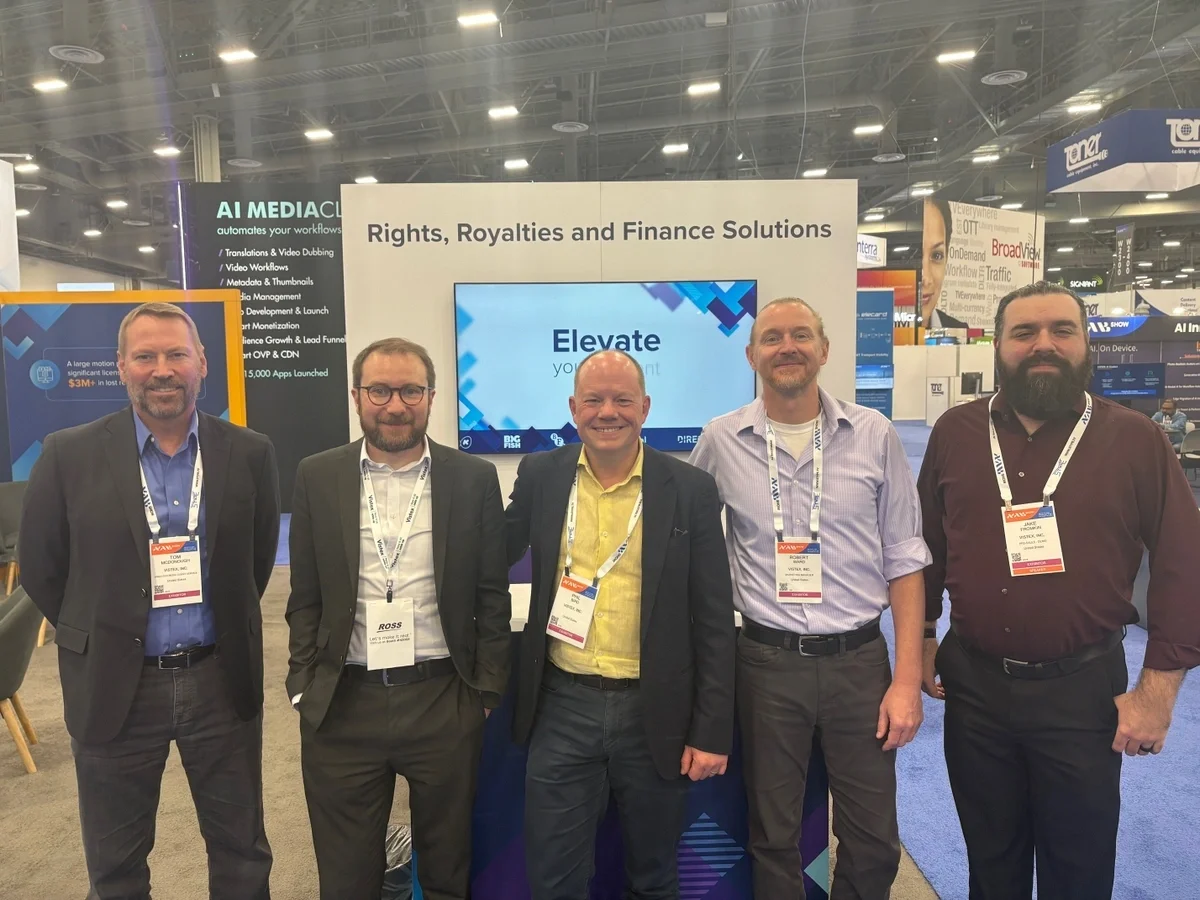
Vistex demonstrated this capability directly at our NAB session, “AI-Powered Rights & Royalties: Faster Workflows, Better ROI,” presented April 20 in the Tech Chat Theater. The audience response confirmed that agentic workflows aren't a future roadmap item; they're an active evaluation criterion. That represents a fundamental shift: leveraging AI to move from a support layer to core operational infrastructure.
It’s also raising harder questions. As these systems take on more of the rights and monetization function, governance frameworks, clear guidelines around intellectual property, and the role of human judgment in IP decisions become more critical. The organizations getting this right aren't choosing between automation and oversight; they're building systems where both operate in parallel.
How has live streaming transformed the economics of the media and entertainment industry?
If you wanted a single signal of where momentum is concentrated, you only needed to walk the exhibit floor. A live-streaming infrastructure provider near the Vistex booth experienced significant traffic throughout the week. That's not incidental. The highest-traffic areas all pointed in the same direction: live content, with sports leading the way.
Live streaming has moved past differentiation. It’s becoming the foundational revenue model for modern media businesses because it consistently delivers engagement, retention, and monetization at a scale that on-demand content alone cannot match. And it’s being accelerated by the same forces driving the broader media and entertainment industry transformation: cloud-native production infrastructure, low-latency delivery, and real-time analytical capabilities that inform how content is packaged, priced, and personalized at the moment of consumption.
Data drives the broadcast
Emerging formats are extending the model further. Interactive live experiences, dynamically inserted advertising, and hybrid events that integrate traditional broadcasting with social media and direct-to-consumer engagement are all gaining traction. Creatives across production are now expected to build for this environment, designing content that generates data signals before, during, and after the stream ends.
The operational infrastructure underneath that environment — rights clearance, distribution licensing, and royalty tracking at live-event speed — has to keep pace with it. If the content engine is running in real time, the rights and revenue engine has to as well.
The user experience no longer ends when the broadcast does. A live event is no longer a broadcast moment; it’s an active, data-rich monetization environment. Organizations that treat it as anything less are leaving measurable revenue on the table.
Why has rights and royalties management become a strategic growth driver?
One of the most consistent themes at NAB this year surfaced in direct conversations. Organizations across the media and entertainment industry know that they lack real-time visibility into rights, usage, and revenue performance. In a fragmented distribution environment, that gap is no longer a back-office inconvenience; it’s a growth constraint.
Content now moves instantly across platforms, formats, and geographies. Every interaction is either a potential monetization event or a missed one. Rights windows close. Royalty obligations vary by territory and contract. Content pipelines are growing more complex, often involving third parties, licensed materials, and increasingly AI-generated elements, raising new questions about ownership and attribution.
Existing systems at most organizations weren’t designed for this environment. They were built to track and report, not to inform real-time decisions. The result is a structural lag between when a monetization event occurs and when the business has visibility into it.
Tracking rights isn’t enough; you must act on them in real time
What is gaining traction is a different architecture: integrated platforms that connect contract terms, rights windows, usage data, and financial outcomes into a streamlined operational layer. Knowing exactly what rights are open, in which windows, across which territories, and at any given moment, is shifting from a competitive differentiator to a baseline operational expectation.
The objective is the ability to act on what you know, at the speed the market now requires. Rights and royalties management has become central to how media companies capture — or fail to capture — the full value of their intellectual property.
Is your content library an asset or a dormant system?
There’s a persistent tendency across our industry to describe large content libraries as a competitive advantage. Scale matters. But scale alone doesn’t generate revenue; activation does.
Content is continuously repurposed, localized, and redistributed across an expanding set of platforms, from major streaming services to social media and direct-to-consumer channels. The same underlying asset might be clipped for social, localized for a new territory, and personalized for a subscriber segment simultaneously, across platforms the original licensing agreement didn't anticipate. Each asset has multiple potential revenue paths. Most organizations aren’t capturing all of them.
Generative AI and automation are enabling creatives and content teams to unlock value at scale by identifying which assets have untapped distribution potential, which rights windows remain open, and how content performs across different audience segments.
More automation and complexity, less margin for error
But utilizing these capabilities also introduces complexity. As content is adapted, recombined, or built upon using AI tools, ownership becomes less clear, attribution becomes harder to track, and rights enforcement grows more fragmented. The legal framework governing AI-generated and AI-assisted content is still actively evolving, so organizations can’t wait for regulatory clarity before building governance structures to accommodate it.
Many organizations still lack a real-time understanding of what their intellectual property is actually worth across active channels, which directly limits its ability to be monetized.
The media organizations making real progress have recognized something important: the content library is not an archive. It requires clear guidelines, active governance, and continuous optimization to meet current market demands. Creators and creator-driven content require the same rigor. Creativity is a business input. Like any input, it needs to be tracked, protected, and monetized with precision.
How is market consolidation changing media technology strategy?
One theme at this year's NAB Show emerged without a session agenda, a keynote slot, or a booth promoting it. There are fewer players in certain segments of the media technology market, particularly in rights management infrastructure. You could see it in the exhibit hall, with fewer logos, fewer companies, and gaps where vendors used to stand. The conversations that acknowledged it directly came in quieter moments, away from the demos. But everyone felt it.
Consolidation can streamline parts of the ecosystem. It can also concentrate dependency, limit flexibility, and narrow the range of viable implementation paths. When fewer platforms control a larger share of the operational stack, technology decisions carry longer-term consequences.
At the same time, demand for unified, cloud-based solutions that connect fragmented workflows is growing. The need for transformation in the media and entertainment industry is accelerating, and the number of viable paths to achieve it is narrowing. That tension makes platform decisions more consequential and harder to reverse.
Platform decisions are now strategic bets
Media organizations that treat these decisions as routine procurement choices, rather than strategic commitments with long-term operational implications, will find themselves constrained at exactly the wrong moment.
The right question is whether the platform you choose will still be independently invested in your success three years from now.
What does it take to lead the next phase of media and entertainment?
None of the trends that defined NAB Show 2026 are entirely new. What has changed is the speed, scale, and convergence. Advanced analytics, connected rights infrastructure, automated workflows, and data-driven monetization are reinforcing each other across the entire value chain simultaneously. That’s forcing a shift not just in technology, but in how organizations are built to operate.
Many are investing in individual applications, running pilots, and testing AI tools against specific challenges. That’s necessary, not sufficient. The harder step is structural: rethinking how content, rights data, and revenue outcomes connect across the business as a single, streamlined operational system.
Delay has a measurable price
A stronger metadata foundation, clearer guidelines around intellectual property governance, and stronger accountability for revenue performance are required, as is a leadership team willing to act before perfect clarity arrives. In this environment, waiting for certainty is itself a decision with a measurable cost.
The media organizations making real progress are already building integrated, real-time models, leveraging advanced analytics across rights and monetization operations, and iterating as the market moves. They’ve recognized that the cost of delay manifests as revenue leakage, operational inefficiency, and a widening competitive distance.
Leading platforms built for the media and entertainment industry enable this kind of integration — connecting rights data, contract terms, royalty calculations, and revenue performance into a single, real-time operational environment. The capability exists, but is your organization structured and committed to utilizing it?
This moment will define the next phase of leadership in media and entertainment, not by who anticipated the transformation, but by who built against it.
NAB Show 2026 felt different because the industry stopped debating and started building. Next year’s show will likely feel different for a simpler reason: the gap between those who moved and those who didn't will be measurable, and on display.
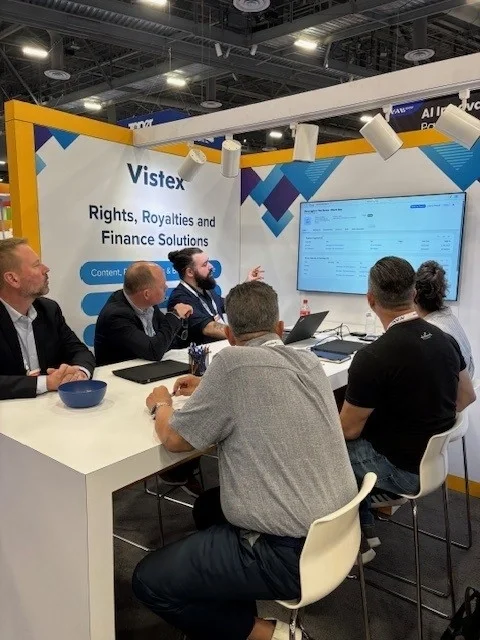
For media and entertainment organizations navigating this environment, the infrastructure question is no longer abstract. This is where Vistex enterprise software is essential, extending core systems with integrated rights and royalties management, real-time usage tracking, and contract-to-cash visibility across complex, multi-platform distribution environments. It's the operational layer that connects what NAB Show 2026 made visible as strategy to what actually executes as revenue.
The opportunity is real, as is the pressure. The organizations that left NAB Show 2026 with a plan are already executing it. How quickly is your organization prepared to respond?
Learn how agentic AI in media manages multi-format distribution at scale in the content supply chain
Get more details on how Vistex Business AI can help you optimize, automate and work smarter to enhance your key business processes.
Get the latest news, updates, and exclusive insights from Vistex delivered straight to your inbox. Don’t miss out—opt in now and be the first to know!