

How AI is turning media rights and royalties systems from compliance tools into strategic growth engines
Content libraries have never been more valuable, or more underutilized. The question media executives should be asking now isn't how to land the next big deal; it's how they’re making current content work harder using rights and royalties AI. The industry is in something of a profitability crisis, and to a significant extent, it's one of its own making: the content and market are there, but execution is falling short.
Streamer subscriber growth in core markets has plateaued. Viewership is fragmenting across more devices, platforms, and formats than ever. Conversations in every boardroom have sharpened around a single imperative: a sharper media content monetization strategy. The focus should be on extracting value from libraries through rigorous analysis and continuous optimization.

Industry data suggests major studios are sitting on content libraries carrying hundreds of billions in latent, unmonetized value. More than 60% of licensed film and TV content rights remain unused, unsold, unexploited, and untouched. That’s an execution problem, not a market problem, and execution problems have a root cause.
Why are media companies missing value without rights and royalties AI?
The answer starts with understanding what these systems actually contain.
Strategic data needs AI capabilities, not just compliance
Rights and royalties systems manage some of the most strategically important data in your organization, including deal history, financial performance, and usage patterns across markets. That’s decades of intelligence about what content rights create value, and where.
You’re using that data to stay compliant, which is great, but it can also power predictive AI capabilities that drive growth.
Legacy infrastructure costs more than you think
Many companies have long-standing systems and processes in place for both rights management and royalty processing. But sticking with legacy typically means operational bottlenecks, weak forecasting, suboptimal monetization decisions, and eroding margins. These are symptoms of treating a strategic asset like an administrative burden.
The culprit is familiar: decades-old technology, heavy reliance on spreadsheets, manual processes built on institutional knowledge, and deeply embedded systems that nobody wants to touch because the perceived cost of change feels higher than the cost of staying put. It isn’t.
How artificial intelligence transforms rights and royalties into growth engines
The data needed to make smarter, faster, and more profitable content decisions already exists in your organization. Your rights and royalties systems hold decades of contract terms and transactional history. Your media asset management (MAM) system stores structured content metadata, while your customer relationship management (CRM) system stores buyer intelligence. Together, these systems contain everything required to run a high-performing content business, but the data is so rich, so fragmented across platforms, and so complex in its relationships that conventional tools simply can’t navigate it.
Rights and royalties AI could immediately change how your leadership team allocates resources and pursues opportunities. Instead, that intelligence sits locked behind legacy architecture, slowing AI adoption and limiting access to key insights.
Institutional knowledge doesn’t scale; machine learning intelligence does
Institutional knowledge that lives in people rather than in systems poses a compounding risk. When key people leave, critical expertise leaves with them. But even when they stay, knowledge that isn't captured, standardized, and maintained in a consistent system creates bottlenecks, produces inconsistent outcomes, and puts a ceiling on how fast your organization can move.
Artificial intelligence changes the equation by making your data work the way it was always supposed to. The rights and royalties systems stop being compliance tools and start being an engine of growth powered by advanced machine learning algorithms.
Automation vs. manual workflows: the mindset shift
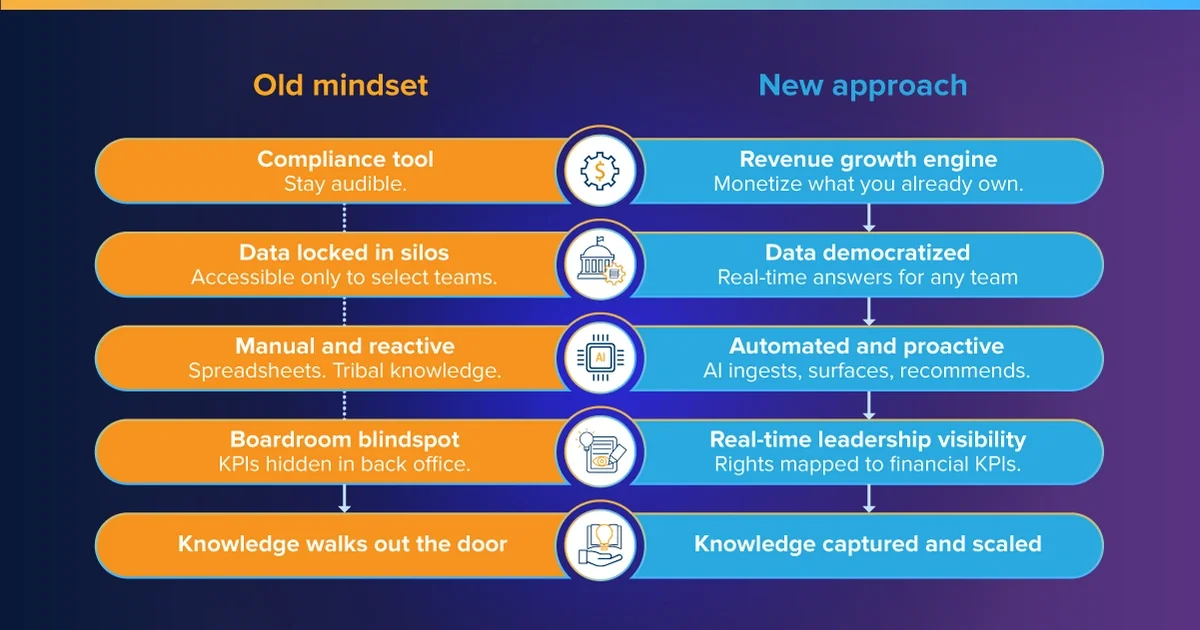
Where rights and royalties AI drives the most impact in workflows
AI isn’t a single intervention in a rights-and-royalties environment. It works across three interconnected steps, each compounding the value of the next and accelerating AI integration across the business.
Faster migration and contract workflows through AI-driven data ingestion
The barrier to modernization has never been a lack of desire; it’s been the sheer complexity of dealing with the data. Contracts in PDFs. Rights data in spreadsheets or only partially codified. Historical records in formats nobody remembers creating.
AI-driven rights management automation eliminates that friction, reading contracts and transactional data from any source, automatically mapping fields, and preparing your data for analysis — without IT setup, templates, or a months-long AI implementation project just to get started.
Improving decision making with AI-driven analytics
Boardroom-ready visibility shouldn’t require a data science team. Conversational AI now lets business users query their rights and royalties data in plain language, dramatically improving the user experience for non-technical teams.
“Show me profit trends by category for the last six months.” “Filter to SVOD in Germany.” “Which genres are underperforming against plan?” The answer comes back instantly. The insight is actionable before the meeting ends, increasing both speed and transparency in decision-making through real-time analytics.
Go from availability to optimization with agentic AI
Classic avails search answers one question: What content can I sell? That is the wrong question. The right question is: What should I sell, and to whom, at what price, in which market, right now?
AI-driven availability intelligence shifts the entire frame. It evaluates your catalog against demand signals, contract terms, and market data using advanced algorithms, continuously surfacing where your highest-value opportunities actually are, before someone else finds them first. That includes rights you may not realize you have, such as clips, language versions, compilation rights, and short-form formats, which are sitting unexploited in contracts that were never interrogated beyond their primary deal terms.
Emerging models like agentic AI go even further by proactively identifying monetization opportunities across your catalog and drafting dynamic short-term licensing deals to be executed on approval. The shift from reactive to proactive isn’t incremental; it’s transformational.
What’s slowing AI adoption in media companies?
Executives who have tried to modernize rights and royalties systems before know the challenges well. Complexity that multiplies across stakeholders, systems, and processes. Legacy data with variable quality and high volume. A business case that competes poorly against initiatives with cleaner ROI stories.
Those barriers are real. But AI addresses them directly by reducing onboarding cost, accelerating time-to-value, and making the strategic case visible where it counts: in the boardroom, driving faster AI adoption.
The ROI of automation and continuous optimization
The margin recapture potential from royalties workflow AI is only the starting point. Royalty leakage, the margin quietly lost to manual reconciliation errors, missed statements, and incorrect splits, is one of the most recoverable line items in a content business.
Add proactive monetization of dormant rights, smarter revenue forecasting, and real-time mapping between rights and financial KPIs, and the ROI compounds through continuous optimization faster than most business cases initially suggest.
Regulatory considerations and data transparency
Enterprise-grade AI means contract data stays in your private cloud. It is never sent to an external model, never used to train AI systems outside your environment. The intelligence comes from your data, and the protection stays with you, ensuring regulatory compliance and full transparency.
What separates media companies winning with AI capabilities?
The content libraries are there, as is the data and the AI capability. What isn’t there, yet, is the organizational decision to stop treating rights and royalties as back-office infrastructure and start treating them as the strategic margin driver they actually are.
Your competitors are making that decision now. The media companies that act will have a significant, compounding advantage in content monetization, forecasting precision, and operational efficiency. The organizations that wait will spend the next three years explaining to their boards why margins kept shrinking while their catalogs kept growing.
Vistex built the only enterprise-grade platform managing the full spectrum of intellectual property rights in a single system. We're bringing AI directly into that foundation, accelerating AI integration, speeding up core workflows, putting boardroom-ready insights into the hands of any business user, and turning back-office processes into intelligent, automated systems.
The only thing standing between your content library and its full value is an organizational decision.
The gold mine isn’t going anywhere, but without rights and royalties AI, it will continue to be treated like a filing cabinet: full of value but underutilized.
Learn how agentic AI in media manages multi-format distribution at scale in the content supply chain
Get more details on how Vistex Business AI can help you optimize, automate and work smarter to enhance your key business processes.

Get the latest news, updates, and exclusive insights from Vistex delivered straight to your inbox. Don’t miss out—opt in now and be the first to know!