
Why content discovery is a streaming rights strategy problem
The grid guide is dying. That much is obvious. What’s less obvious is what replaces it, and what that means for the economics of content licensing. As audiences continue their shift from scheduled viewing to on-demand consumption, streaming rights strategy is the new competitive battleground, determining not only where content appears but also whether it’s discovered at all.
The majority of TV consumption has shifted to on-demand. Viewers no longer follow a schedule; they follow their own intent.
That intent is increasingly expressed through natural-language text or voice search and algorithm-driven recommendations. The platforms and aggregators best positioned to capture that intent will determine what gets watched, and what doesn’t.
But even with sophisticated recommendation engines, viewers still struggle with the “paradox of choice.” According to Gracenote’s 2025 State of Play report, the average global viewer spends 14 minutes per session searching for something to watch. In the U.S., that figure is roughly 12 minutes. In France, it climbs to 26 minutes. Nearly one in five viewers gives up entirely when the search takes too long. And 49 percent say they would cancel a service specifically because it’s too hard to find content.
This viewing frustration isn’t just a user-experience failure; it’s also a revenue failure. Every abandoned session is a transaction that didn’t happen. And the problem compounds at the licensing level, where “static” multi-year deals made years ago are now colliding with how content is actually discovered in 2026. Your streaming rights strategy is either an asset in this environment or a liability. There’s no neutral ground.
Is content discovery a UX problem or a structural one?
Fragmented libraries are the single biggest barrier between viewers and content. Viewers don’t experience the market as one catalog; they experience it as a series of disconnected libraries, each with its own interface, recommendation algorithms, search logic, and access friction.
Platform aggregators like Apple TV, Fire TV, Google TV, and the recently acquired Roku are asserting increasing control over the discovery interface, the layer that sits above individual streaming apps and determines what a content viewer sees first. Although for Gen Z and Alpha audiences in particular, discovery actually begins hours before they press play, through social feeds, algorithmically surfaced clips, and AI assistants that treat the entire content landscape as a single query space.
How agentic AI is taking over the discovery layer
Whether through better in-platform recommendation engines, social media and watchlist integration, or OS-level voice search, the path to more efficient content discovery will most certainly involve AI agents. Agents that find and fetch content will collapse the gap between discovery intent and viewing action. And those agents operate entirely on metadata: the richer, the more granular, and the more machine-readable, the better.
Why metadata is your algorithmic currency
Scene-level tags, mood signals, genre fingerprints, character and aesthetic indexing, transcripts, closed captions, and cast taxonomies allow AI systems to match specific content attributes to specific viewer intent in real time. Think: a detective drama with an ‘80s synth-wave score and a morally ambiguous lead. That search isn’t hypothetical; it’s already happening, but results are limited to content available to the viewer and with rich enough metadata to be surfaced.
When an “offline” recommendation or social media feed surfaces content not available on a user’s current subscriptions, a “friction gap” opens. The recommendation lands; the transaction doesn’t. This is where potential content revenue quietly leaks.
Is your licensing deal built for a world that no longer exists?
The Yellowstone lesson
The clearest illustration of what happens when licensing strategy and content discovery reality result in a “friction gap” is the Paramount–Peacock deal for Yellowstone.
In 2020, ViacomCBS (now Paramount) licensed the exclusive streaming rights for Yellowstone to Peacock. The logic was defensible under the prevailing model: streaming was an extension of syndication, a secondary window for content that had already aired on linear. Discovery happened on Paramount Network; streaming was where the reruns went. That logic aged poorly.
By 2022, viewer behavior had shifted. Audiences no longer fixated on hit titles; they wanted to watch an entire franchise. And by the time Yellowstone became a cultural moment, there were two additional “prequel” series that most people wanted to watch first. Viewers expected to find the entire universe, including Yellowstone, 1883, and 1923, in one place. Instead, they hit a wall. The prequels sat on Paramount+. Yellowstone itself was locked on Peacock under a contract that extended years beyond the show’s finale.
The commercial consequence was direct. Viewers who subscribed to Paramount+ to watch 1883 searched for Yellowstone next. It wasn’t there. The platform lost the retention value of its most valuable IP. Parrot Analytics has noted that had Yellowstone been on Paramount+, it would have ranked among the platform’s top drivers of subscriber acquisition.
Paramount Global’s CEO publicly called the deal “unfortunate.” That’s an understatement. The company had paid to market a franchise that drove traffic to a competitor.
Discoverability is now a revenue variable
As search and discovery become more machine-mediated, content that isn’t licensed to the platforms where intent resides, or worse, whose metadata isn’t sufficiently rich to be surfaced, will lose commercial visibility. The friction gap widens whenever a discovery system evolves faster than the licensing models and rights infrastructure behind it.
That said, every problem presents an opportunity. While the friction gap is real, cross-platform discovery engines also yield faster, more accurate insights into high-intent niche audiences, matching metadata to viewer behavior signals. By leveraging these insights and through more flexible windowing and licensing strategies, rights holders have a real opportunity to capture more demand and improve revenues.
The Suits blueprint: What dynamic windowing looks like when it works
The Suits phenomenon of 2023 was described as a streaming accident. It wasn’t. It was a licensing strategy that worked precisely because it used distribution windows to expand reach while preserving downstream value.
Seasons 1-8 were licensed to Netflix. Season 9, the finale, remained exclusive to Peacock. Netflix’s audience rediscovered a catalog title, driving it to more than 57 billion minutes of viewing in 2023, per Nielsen. Viewers who wanted the ending subscribed to Peacock. That’s catalog remonetization through deliberate windowing. The demand signal was strong enough to greenlight Suits: L.A., generating new IP value from a dormant asset.
The AMC Networks strategy from late 2023 followed the same logic. AMC leased marquee titles, including Dark Winds and Fear the Walking Dead, to Max for a defined 60-day window, using Max’s subscriber base to sample content and drive demand back to AMC for new seasons. Dark Winds Season 3 premiered with more than 50 percent higher viewership than Season 2. A temporary competitive window generated more commercial momentum than an exclusive walled garden.
In both cases, the critical variable wasn’t the content itself; it was the creativity and agility that enabled the windowing decision to be executed at speed.
Two licensing approaches, one infrastructure problem
The Suits and AMC examples above illustrate two distinct but related responses to the discovery problem: dynamic windowing and micro-licensing.
What is dynamic windowing?
Dynamic windowing is a highly flexible media distribution strategy in which the time a title spends exclusively on one platform before moving to the next is adjusted based on real-time performance data and market demand.
Instead of sticking to rigid, industry-standard timelines, studios and streaming networks evaluate how a specific title is performing to dictate its rollout schedule. In the case of streaming, this can mean moving content between SVOD exclusives, AVOD, and FAST, and carefully choosing platforms to maximize reach and revenue capture across the entire lifecycle.
Done correctly, dynamic windowing turns a static asset into a demand engine. Done too slowly, or without the infrastructure to respond to a discovery signal in time, the revenue dissipates before the window can open.
What is micro-licensing?
Micro-licensing is about fractional, hyper-targeted, and demand-driven distribution. In response to spikes in demand, studios and streaming platforms are increasingly keen to take advantage of highly specific non-exclusive windows (sometimes lasting only 30 to 90 days). This model is perfect when there’s a brief wave of interest, sometimes specific to a demographic, that’s satisfied by older library content. Buyers avoid spending millions on stagnant catalogs, only paying to feed their audience’s algorithmic appetite right now. And studios and indies unlock passive income, even for titles that didn’t initially succeed globally.
Rights intelligence is the missing layer between your metadata and your revenue
No matter which streaming rights strategy you adopt, metadata alone isn’t enough to keep up with the speed of discovery. Rights intelligence is the other half of the equation. Already today, geoblocked or expired territories prevent AI agents from surfacing content to users in those markets. Ambiguous exclusivity windows create “no-serve” decisions in programmatic distribution pipelines, automated refusals that block a title from being surfaced to a specific user or market. When an AI engine can’t validate that a title is licensed for distribution in a user’s market, the safe default is to decline. Invisible content, despite latent demand.
But these are just today’s problems. As discovery data uncovers real-time demand trends, and as dynamic windowing and micro-licensing become standard practice, the industry is clearly moving toward fully automated licensing. AI engines will soon buy rights and process payments autonomously in real-time. Eventually, rights clearances will shift from micro-trends to individual user views. We’re heading toward a new era of TVOD (transactional video on demand): instead of viewers manually purchasing specific titles, algorithms will automatically execute the buy whenever it makes financial sense for the platform.
Programmatic discovery and rights clearance by AI at a massive scale is the next frontier. If your content and rights aren’t ready to be exposed to and found by these AI engines, they are far less likely to generate revenue.
Is your rights management system (RMS) capturing revenue or destroying it?
What modern discovery demands
Rights management systems (RMS) sit at the center of every licensing decision. In a traditional model, they function as systems of record: databases that store deal terms, track rights by territory, media and language, integrate into content distribution workflows, and generate royalty reports on a quarterly cycle. That model is no longer sufficient.
Micro-licensing, in particular, places new demands on the rights infrastructure. When an AI tool identifies a title that a platform wants to license for a short time, the rights infrastructure must verify territorial permissions and confirm use-type clearance in milliseconds, not hours, and not through a manual queue. Speed of rights clearance is now a competitive variable. The platforms and rights holders that can respond at the speed of discovery will capture the transaction. The ones that can’t will watch the revenue disappear into another friction gap.
The more basic requirement is interoperability. APIs, industry-standard identifiers, and consistent asset data turn your catalog into an operational dataset that AI tools, distribution partners, and aggregators can actually use.
Where legacy RMS platforms fall short
Most legacy rights management systems were built for annual deal cycles and quarterly reporting. They aren’t designed for the volume, granularity, or speed required by real-time micro-licensing. Three gaps define the problem:
- The API gap. Most legacy platforms are designed for reporting, not transactions. They can answer “export all avails,” but not “Is this title available for commercial use in Germany right now?”
- The granularity gap. They track titles, such as whole movies, full seasons, and episodes, but not segments, clips, or other elements. The time-coded metadata structure required to license a specific scene or brief clip doesn’t exist in most legacy systems.
- The transaction gap. They can calculate royalties, but they can’t execute payment. They depend on external ERP systems that operate on timelines incompatible with the economics of high-frequency licensing.
The gap between where most rights holders operate today and where discovery will demand they operate isn’t a rounding error; it’s a structural disadvantage.
Micro-licensing is already here. Is your infrastructure ready for it?
The direction of travel is clear. Rights management must evolve from deal-based to rule-based, from static contracts to automated, pre-cleared logic that executes licensing decisions at the moment of intent.
The primary barrier to micro-licensing today isn’t a lack of demand; it’s the prohibitive transaction cost. Processing a license for a single episode, short, or clip through traditional legal and administrative workflows can cost more in staff time than the content is worth. Closing that gap requires a shift toward automated, low-touch licensing flows in which pre-cleared assets move through defined rule sets with minimal human intervention.
From operational convenience to revenue imperative
The direction is clear: the rights transaction needs to move to the point of intent, not lag behind by days. Automation isn’t an operational convenience here; it’s a revenue-recovery mechanism.
Three steps toward discovery-ready streaming rights infrastructure
The trap is trying to modernize the entire library at once. The practical path is to build a controlled pilot on a defined subset of assets, a sidecar operation that proves the model without disrupting core business operations. Here’s what that looks like:
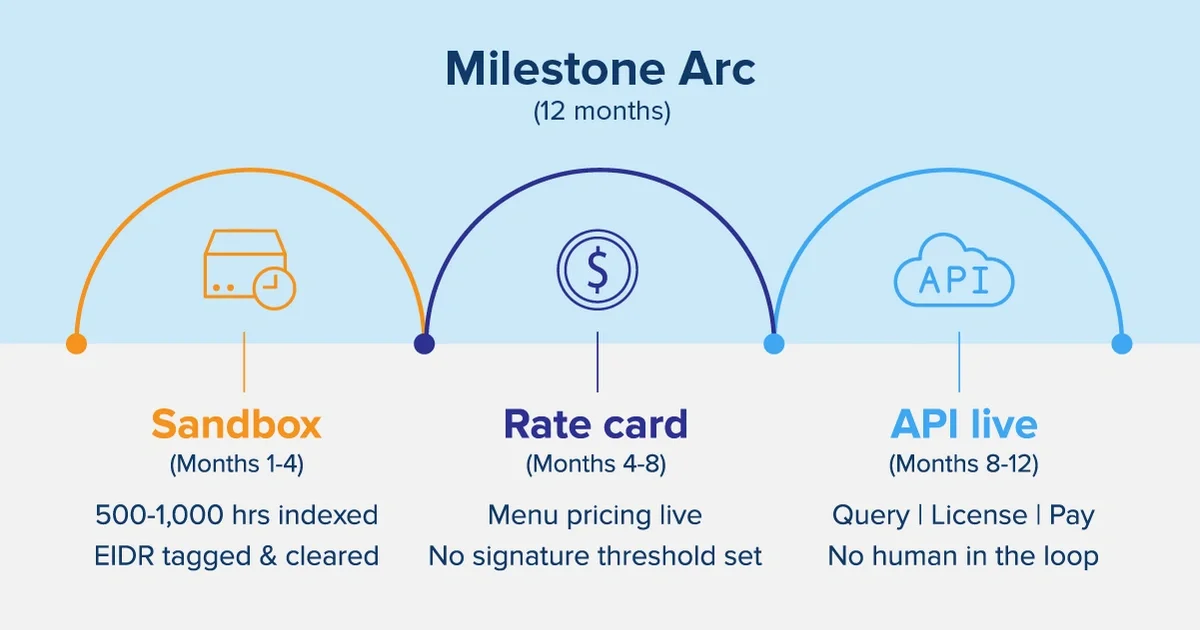
Step 1: Isolate a clean sandbox (Months 1-4)
Identify 500 to 1,000 hours of content where you hold 100 percent of the rights: owned news footage, unscripted content, sports b-roll, corporate archives. Don’t start with scripted drama involving complex residual structures. Run this content through an AI indexing tool to generate time-coded metadata, establish EIDR identifiers, and map each asset to a cleared status in your rights database. This is the foundation. Nothing else can be built without it.
Step 2: Build the rate card (Months 4-8)
Replace negotiation with menu pricing. Convene legal and sales to establish fixed pricing tiers by use type, such as digital, broadcast, social, and documentary, and create a master click-through license that triggers automatically at checkout for deals below a defined threshold. The goal is to eliminate signature cycles for low-value transactions. When the price is preset and the terms are pre-cleared, the human bottleneck disappears. That’s not a legal workaround; it’s how automation at scale becomes possible.
Step 3: Expose the library via API (Months 8-12)
Deploy a lightweight integration layer, software that sits between your existing RMS and the outside world, that allows external partners or internal platforms to query asset availability and execute a licensing transaction without human intervention. An availability query returns a yes or no. A confirmed transaction triggers the license. The goal at this stage is a fully automated flow for the sandbox library, with measurable transaction volume as the proof point.
Done correctly, this 12-month cycle produces a working model, not a roadmap. Your pilot catalog is live, generating revenue through automated licensing. The rate card is in market. The API is queryable. That’s the foundation you scale from.
Content is king. Discovery is the gatekeeper.
The content that wins in an AI-mediated market won’t simply be the best content; it’ll be the content that discovery systems can find, verify, clear, and deliver at the speed of intent.
If your rights infrastructure can’t answer a territorial availability query in real time, you’re not competitive in that market. If your metadata is too shallow for AI tools to surface your catalog with specificity, your content will lose commercial visibility to content that’s more structured for the machines to find, parse and serve. Your streaming rights strategy is the variable that determines which side of that line you’re on.
The companies that will lead are already building this infrastructure. They aren’t waiting for industry standards to converge or legacy vendors to catch up. They’re moving from static deal libraries to dynamic, API-driven rights systems because they understand that licensing infrastructure is now a front-line revenue function, not a back-office compliance task.
This is where Vistex is already working, with an enterprise platform that manages the full spectrum of media rights management, royalties, and content accounting in a single system. With Vistex, the infrastructure that powers content discovery, dynamic windowing, and micro-licensing can operate at the speed the market now demands.
Is your company building that infrastructure now, or waiting until the deals you sign today become the cautionary tales of 2028?
Explore more related resources
Get the latest news, updates, and exclusive insights from Vistex delivered straight to your inbox. Don’t miss out—opt in now and be the first to know!