
If the industry is thriving, why are millions in music catalog royalties left unclaimed?
A music catalog has never been more valuable, or more difficult to monetize fully. U.S. recorded music revenue hit a record $11.5 billion in 2025, while paid streaming subscriptions exceeded 100 million accounts in the United States alone.
By every headline measure, the business of music has never been healthier. Yet many companies still fail to realize the full value hidden within their music catalog.
A substantial share of royalties generated every reporting cycle remains unmatched, delayed, or sitting in black-box pools that no rights holder can access. Revenue growth is real. So is the gap between what music catalogs generate and what their owners actually collect.
The problem isn’t demand or the market. It’s operational visibility: the ability to see what a catalog is generating, across every rights type, territory, and platform, and to ensure that earnings find their way to the people who own them. The companies pulling ahead in this environment are building a discipline around the catalogs they already own. Some are even calling it a music catalog yield engine.
What is a music catalog yield engine?
A music catalog yield engine is the operational discipline that continuously identifies, validates, prioritizes, and activates unrealized value already hidden within a music catalog. It isn’t software, an AI upgrade, or another royalty administration platform. Those are tools, and tools are only as effective as the discipline guiding them.
A common misconception among music executives is that software and AI can be programmed to automatically surface and recover catalog value. They can’t, at least not fully. The human intelligence required to understand how to identify and exploit the intrinsic value of a catalog isn’t something a system can replicate on its own. Technology accelerates that process. It doesn’t replace it.
What a mature music catalog yield engine does is create the operational framework that connects the capabilities most companies currently run in isolation: metadata management, rights administration, sync licensing, AI-driven analytics, valuation intelligence, and capital allocation. When those capabilities are connected and continuously active, a music catalog stops being a collection of songs to be managed and becomes a financial asset to be optimized.
Where does music catalog revenue get lost?
Before you can optimize catalog value, you need to understand why revenue isn’t reaching it. The failure points are well understood across the industry. They are also consistently underprioritized, which warrants examination in its own right.
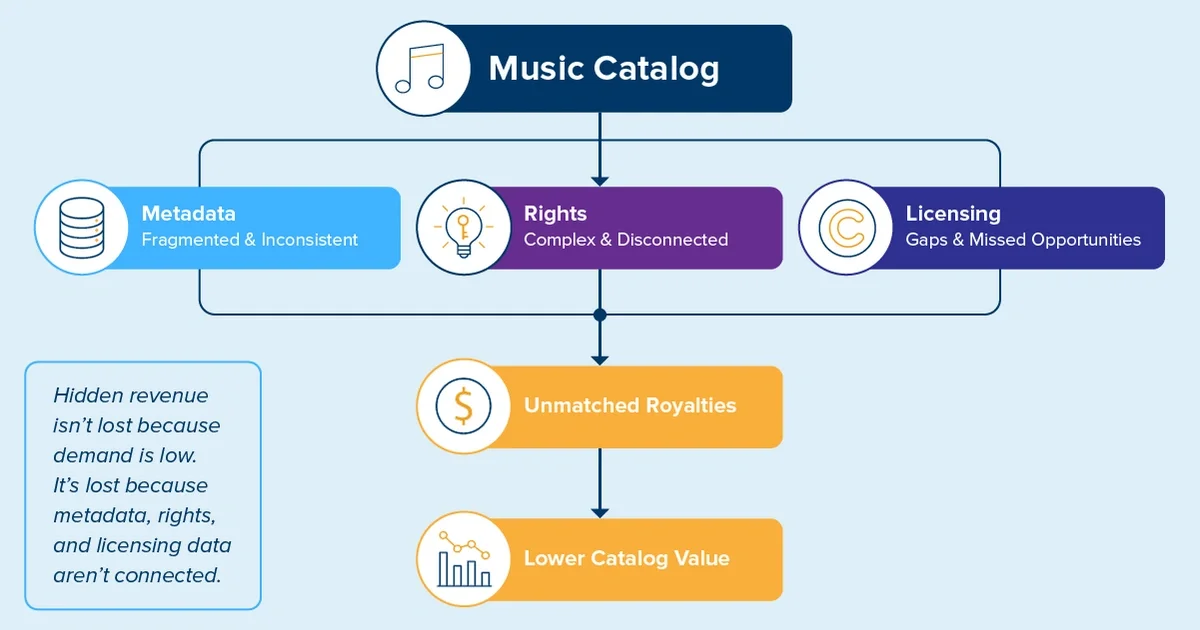
Fragmented metadata creates invisible revenue
Inconsistent metadata, incomplete registrations, disconnected systems, and inaccurate ownership records prevent royalties from being matched correctly. The result is revenue that’s already been earned sitting unattributed in black-box pools rather than reaching the rights holder who generated it.
Metadata remediation is a foundational capability of any catalog yield engine. It’s also the most consistently deprioritized. The reason is partly psychological: recovering existing revenue feels less exciting than generating new revenue. But the economics are unambiguous. Fixing fragmented records is retrieval, not investment. The return on metadata remediation is often faster and more certain than any new licensing campaign.
Rights complexity obscures music catalog value
Publishing rights, master recordings, neighboring rights, mechanical royalties, and performance royalties each follow different ownership structures, payment models, and reporting cycles. Companies that can’t clearly distinguish and manage these rights across their catalog consistently undervalue what they own, and create friction at every point where that catalog touches a licensing deal, an acquisition, or an audit.
Publishing royalties and master recording income are different assets with different valuation implications. Conflating them is a consistent source of undervaluation in catalog transactions and a consistent point of negotiating weakness when buyers come to the table. The inability to clearly separate and quantify each rights layer accounts for more catalog value destruction than any other operational failure in the business.
Streaming success can hide monetization weakness
Impressive streaming numbers can create a false sense of financial health. The RIAA reported that:
- Streaming accounted for over 80% of U.S. recorded music revenue in the first half of 2025, representing at least 82% of total U.S. revenue for five consecutive years.
- Paid subscriptions alone delivered $6.4 billion, or 55.3% of all U.S. recorded music revenue in 2025.
- Synchronization (sync) licensing, which can expose catalog works to substantially wider audiences through film and television placement, accounted for just 3% of total revenue in the same period.
That gap between streaming's dominance and sync's underweight share is precisely where monetization weakness hides.
A catalog generating strong streaming numbers while underperforming in sync licensing, international rights, and direct licensing is leaving meaningful revenue on the table. It will be interesting to see how the current resurgence of physical media, particularly among younger listeners who want something tangible, develops as an additional revenue stream for catalog owners.
Where should your next music catalog dollar come from?
Once you understand where revenue is being lost, the question shifts to decision-making: where is the highest-return opportunity for the catalog you already own? In most cases, the answer is closer than expected.
Recover earned revenue before chasing new revenue
Companies frequently invest heavily in creating new revenue while leaving unmatched, delayed, or inaccurately reported royalties unaddressed. Recovering earned revenue is consistently the fastest, lowest-risk opportunity available. It’s also consistently the last thing on the priority list.
Fix data visibility and estimate the unmatched revenue gap for cost-benefit realism
Two reasons explain that deprioritization, and both are worth naming.
The first is data visibility. Companies that have grown quickly or acquired catalogs from multiple sources often end up with piecemeal systems that fragment data across platforms that were never designed to communicate with each other. With some extremely large entities, the head of a major division still manages a complex catalog in an Excel spreadsheet, which is saved in several different locations with no clear consensus on which version is current. That is a brittle foundation for a financial asset of any significance.
The second reason is cost-benefit realism. Sometimes, companies invest in tracking down unclaimed royalties and discover that the recovery is not commensurate with the effort. That is a legitimate outcome, not a failure. But it requires a directional estimate of the unmatched revenue gap before the work begins, not after. The first question every catalog owner should be able to answer is: how large is that gap, and how long has it been accumulating?
Treat sync as a portfolio strategy, not an opportunity
Consistent sync licensing success is a data discipline, not a creative instinct. The companies that consistently secure valuable placements have clear visibility into the rights for every work in their catalog, from publishing rights and sound recording rights to approval rights correctly identified and documented, which allows them to respond quickly when a music supervisor needs a fast answer.
Music supervisors look for frictionless clearance. Nothing damages a catalog holder’s standing more quickly than a placement that falls through at the last moment because the rights were not properly documented. That reputation travels. A catalog yield engine treats sync licensing as a repeatable, data-driven capability rather than a collection of isolated opportunities. The difference between companies that consistently win sync placements and those that wait to be found is almost always operational, not creative.
Verified cash flow commands better valuations
The catalog acquisition market has matured significantly. Primary Wave closed its $1.5 billion acquisition of Kobalt in July 2026, creating a combined entity valued at approximately $7 billion. BlackRock-backed Influence Media bid over $650 million for Anthem Entertainment, whose catalog includes music from Rush, Timbaland, and the Spider-Man franchise.
In the first quarter of 2026 alone, music catalog companies raised more than $4 billion in capital, surpassing the total for all of 2024. These are cases of institutional capital seeking annuity-like returns from verified royalty streams.
For many music catalog acquirers, the catalog is likely viewed as a financial asset in a portfolio rather than as a business requiring ongoing management. The result is that the gap between what the catalog is generating and what it could generate often widens after acquisition, rather than narrowing.
The more interesting dynamic is at the other end of the market. Sophisticated buyers of smaller catalogs, the ones who study the rights layer carefully and read between the lines in a royalty statement, often identify missing value that the seller hasn’t quantified. Those buyers extract better returns not because they paid less, but because they understood more. Verified ownership, clean royalty histories, and trusted financial reporting aren’t part of due diligence. They are the inputs that determine what a catalog is actually worth and who gets to capture that value.
Can AI find revenue that your data can’t?
AI has genuine utility in rights and royalty management. Anomaly detection in royalty statements, streaming velocity forecasting, and scalable sync opportunity identification are all areas where AI tooling delivers real, measurable value. The industry’s enthusiasm for these applications is largely warranted.
Where the industry is overestimating AI is in believing it can substitute for a clean data foundation. It’s doubtful that AI will reliably predict musical taste, for example. Consider what happened in 2014, when Apple pushed a U2 album into 500 million iTunes libraries without a single opt-in. The album had the most marketing muscle in the music industry. Consumer response was, at best, indifferent.
Musical taste is uniquely human and can be genuinely unpredictable. No model trained on historical consumption data fully accounts for what a listener will decide to care about next.
The more interesting AI application is in emerging markets. AI can credibly track regulatory changes in territories where rights holders have historically had limited visibility, identifying where new laws are creating more favorable conditions for rights collection, or where expanding mobile and streaming infrastructure is opening up audiences that did not previously generate royalties. It will be interesting to see how that capability develops over the next several years, particularly in markets where rights registration infrastructure is still maturing.
The practical limit is consistent: the catalogs that benefit most from AI tooling are the ones with a clean data foundation already in place. Applied to an unaudited catalog with fragmented metadata and unresolved rights, AI doesn’t eliminate blind spots. It processes them faster.
The shift from music catalog administration to catalog optimization
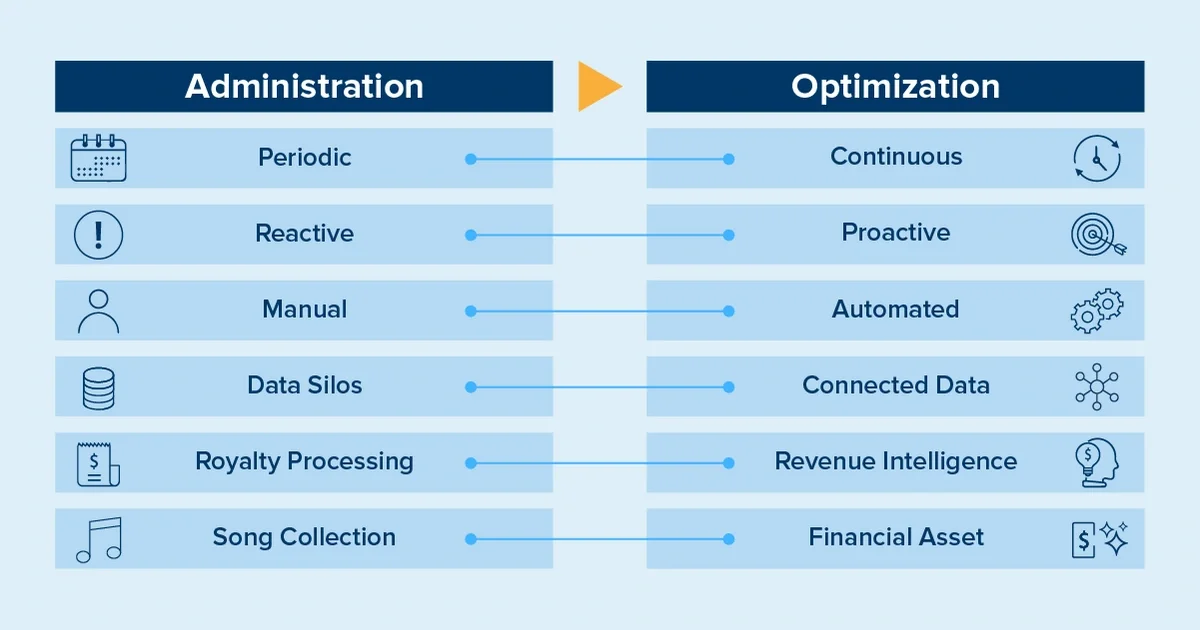
Today’s most successful music companies treat catalogs as dynamic financial assets to be continuously optimized across rights, royalties, metadata, licensing, and capital allocation.
The difference between those two operating models is measurable in revenue and in valuation. Administration is periodic and reactive. Optimization is ongoing and anticipatory. A catalog yield engine is the discipline that makes continuous optimization operational rather than aspirational.
What will separate tomorrow’s winning music catalogs from everyone else?
Tomorrow’s competitive advantage in the music business will come from understanding existing catalogs more completely than anyone else in the room.
The companies that lead will be the ones that have connected their metadata, rights, royalties, sync intelligence, and financial reporting into a single operational view of what their catalog is actually worth and where it is underperforming. Not once, as part of an acquisition process, but as an ongoing discipline that runs continuously in the background.
Vistex extends core ERP systems with exactly that foundation, giving music publishers and rights holders integrated rights and royalty management, real-time usage tracking, and contract-to-cash visibility across complex, multi-platform distribution environments. The result is a single operational view of the catalog: one that recovers more earned revenue, accelerates decision-making on sync and licensing opportunities, and improves valuation confidence when it matters most.
The music catalogs that generate the best returns over the next decade will be the ones whose owners treat catalog management as a proactive business discipline rather than a passive administrative function, and who have built the infrastructure to act on what that discipline reveals.
The next dollar is already in your music catalog. The question is whether your systems can find it.
Explore more related resources


Get the latest news, updates, and exclusive insights from Vistex delivered straight to your inbox. Don’t miss out—opt in now and be the first to know!