
Why the infrastructure beneath streaming revenue is failing rights holders, and what it takes to fix it
Streaming now generates more than two-thirds of total recorded music revenue worldwide. That’s not a projection; it’s the current state of the music business. And yet the music royalty management infrastructure underneath all that revenue, which calculates, matches, and distributes earnings across rights holders, territories, and contract types, was designed for a world that no longer exists.
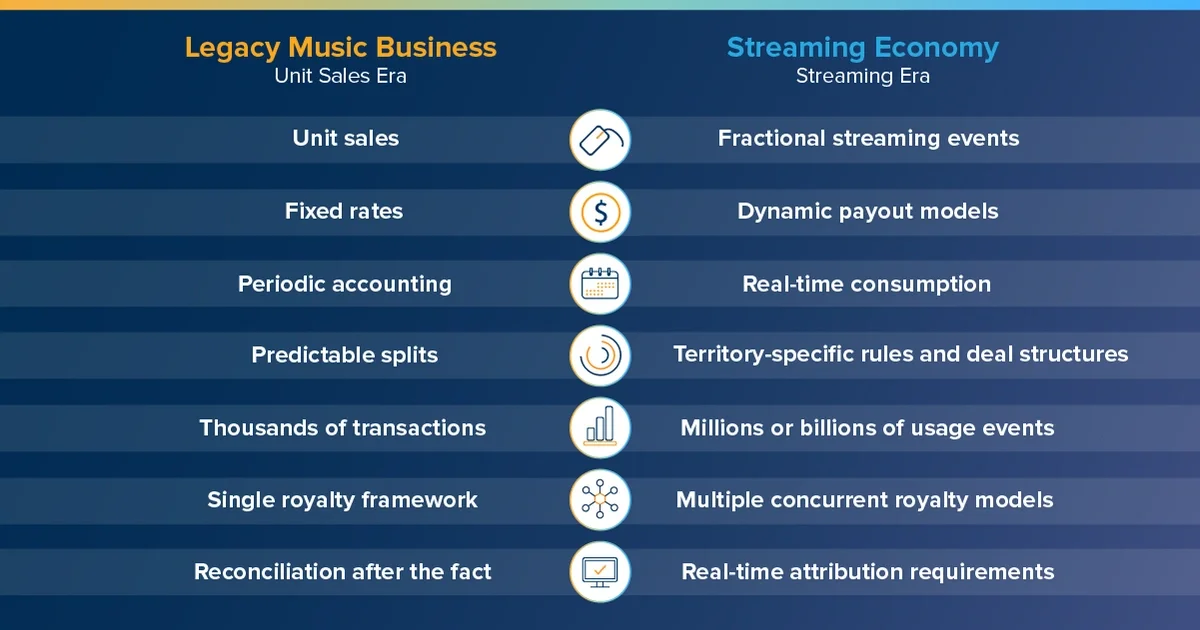
Music royalty management was built for unit sales: vinyl, CDs and digital downloads. Fixed rates, periodic accounting, predictable splits. Streaming replaced that entire logic with micro-interactions, billions of fractional usage events generated simultaneously across platforms, geographies, and deal structures. The business model snapped into a new era almost overnight. The royalty systems did not.
The consequence isn’t theoretical. Rights holders absorb the cost of that mismatch in every reporting cycle: delayed distributions, unmatched revenue sitting in black box pools, and catalog value that can’t be accurately quantified because the infrastructure measuring it was never designed for this environment.
Why music royalty systems break at streaming scale
Music royalty systems are the processes and technologies used to calculate, track, and distribute revenue across rights holders, contracts, and territories. They didn’t break because of bad technology; they broke because the business model outgrew the assumptions on which they were built.
The mismatch is structural. Legacy royalty models were designed for a world of unit sales with fixed rates, periodic accounting, and predictable revenue splits.
In practice, teams wait weeks or months to reconcile revenue that is generated in seconds. A stream happens instantly; the royalty tied to it may not be fully calculated, matched, and distributed until the next reporting cycle, or later. At streaming scale, music royalty management accuracy and speed are structural revenue problems, not accounting problems. The cost of not solving them compounds every reporting cycle.
How streaming changed music royalty models
Streaming didn’t just change pricing; it changed the unit of value from a sale to a signal. Where a label once processed a single album sale, it now processes thousands of fractional streaming events to generate equivalent revenue. And the pro-rata royalty model streaming platforms use to govern most payouts compounds the problem by rewarding catalog concentration and streaming velocity over per-listener value.
The industry didn’t gradually evolve into streaming economics; it snapped into them, and royalty models are still catching up.
From $10 albums to fractional pennies at scale
Each stream is a fractional revenue event. Billions of events require royalty processing at speeds and volumes legacy systems were never designed to handle.
Where a label once processed thousands of transactions per month, it now processes millions or billions of individual usage events. The math of streaming velocity amplifies winner-takes-most dynamics. High-frequency catalog and superstar tracks capture a disproportionate share of streaming revenue, not because of their intrinsic value to any individual listener, but because of aggregate consumption volume.
One song, multiple payout logics running simultaneously
The same track can generate revenue under different royalty models depending on whether it’s streamed via a premium subscription, an ad-supported tier, or a regional licensing agreement. A stream on a subscription tier in the U.S. and an ad-supported tier in another market may trigger entirely different royalty rate calculations simultaneously. Territory-specific rates, direct licensing versus collective licensing rules by market, and platform-specific deal structures that vary by digital streaming platform and content type further complicate matters, none of which were anticipated in contracts written for a download or physical distribution era.
The pro-rata royalty model strains at scale
Under the pro-rata royalty model, aggregate subscription fees are pooled and distributed based on each artist’s total share of streams. That structure rewards scale and catalog concentration, not per-listener value. Pro-rata advantages major labels and large catalogs that command playlist curation and algorithmic favor. Independent rights holders and mid-catalog publishers see negligible per-stream returns at the same subscription base.
Curated playlists and recommendation algorithms drive a disproportionate share of streams, reinforcing visibility loops that compound pro-rata concentration quarter over quarter. The problem isn’t streaming volume; it’s that the royalty model distributing that volume was designed for a different kind of scarcity.
The coexistence breaking point
The challenge isn’t complexity in isolation; it’s coexistence: multiple royalty models, such as pro-rata, user-centric, ad-supported, tiered subscription, applying to the same usage event simultaneously, under contracts not written to handle that simultaneity. When systems can’t resolve that coexistence in real time, revenue gets delayed, becomes untraceable, or sits unallocated. Most legacy systems were never designed for this.
Ways streaming revenue goes unclaimed
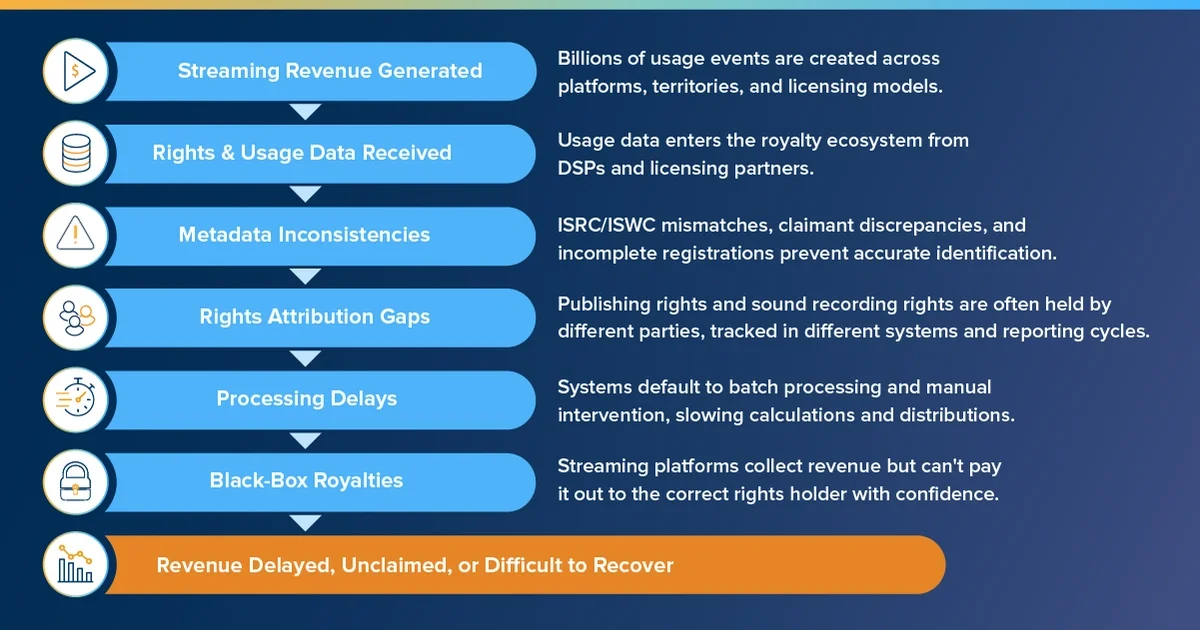
Unmatched royalties are earned revenue that can’t be claimed. They exist because streaming platforms collect fees they can’t accurately attribute to a rights holder due to missing metadata, inconsistent identifiers, or fragmented rights records. Every percentage point of unmatched data is a direct tax on your catalog’s value. Even a low single-digit mismatch rate across a large catalog can translate into millions in delayed or unclaimed income.
What causes streaming royalty attribution errors?
The sources of streaming royalty attribution errors are well understood and consistently underinvested. Metadata inconsistencies across streaming platforms mean the same track may appear under ISRC (International Standard Recording Code) or ISWC (International Standard Musical Work Code) mismatches, preventing systems from recognizing it as the same work and leading to unmatched usage that accumulates in black box revenue pools.
Sound recording rights and publishing rights are often held by different parties, tracked in different systems, and reported on different cycles, creating attribution gaps at every seam. DSP reporting inconsistencies compound this: territory rights mean that a stream in one market may trigger different rights holders, royalty rates, and reporting obligations than the same stream in another market. The system must resolve all of those simultaneously.
Black box royalties are the industry’s quietest revenue sink
When metadata failures prevent accurate attribution, streaming platforms collect revenue but can’t pay it out to the correct rights holder with confidence. At scale, this is a persistent, systemic gap. Unmatched amounts accumulate in black box royalties, sometimes for years.
Responsibility for resolving unmatched royalties has traditionally fallen on rights holders. Collecting societies argue that works were not correctly registered; streaming platforms argue they only relay metadata handed to them. The rights holder is left to determine whether the recovery effort is genuinely worth the cost. In practice, an employee might spend hours at a double-digit hourly rate pursuing micro-pennies of royalties per unmatched stream. The math of that calculation doesn’t always favor recovery.
Processing delays that compound revenue leakage
When a royalty model can’t be cleanly applied to streaming-scale usage data, systems default to batch processing: aggregating usage, deferring calculations, and recognizing revenue after the fact. An error introduced in one reporting period may not be identified until the next cycle, compounding discrepancies over time. The downstream consequence affects how catalog assets are valued, licensed, and monetized. Auditability suffers as well: a batch-based system can’t reconstruct the chain of attribution for any individual stream, creating exposure in artist audits and DSP reconciliations.
Why user-centric royalty models don't fix the data infrastructure problem
Changing how money is split doesn’t fix a system that can’t accurately track where it should go. User-centric payments address the fairness critique of pro-rata distribution but leave the operational infrastructure problem entirely intact. Most industry debates focus on equity; they ignore the data architecture required to deliver it.
User-centric payments are sound in principle, but incomplete in practice
Under user-centric models, a subscriber’s fee is allocated only to artists the subscriber actually listened to, rather than being pooled and distributed based on total stream share. This addresses the pro-rata cross-subsidy problem, in theory. But the general debate misses something important: even after a model change, DSPs still aggregate and control the underlying data on time of day, length of play, subscriber initiation, and so on. User-centric is supposed to be a more transparent way to compensate artists. In practice, the transparency remains on the DSP’s side of the wall.
User-centric models also don’t address visibility bias introduced by curated playlists and algorithmic recommendations. The concentration problem persists, just with a different distribution mechanism on top of the same infrastructure. And implementation complexity introduces new costs: more granular attribution requires more granular data, which many smaller streaming platforms and independent rights holders lack the infrastructure to handle. The operational burden can disadvantage the same creators the model was designed to help.
The data problem alternative models can't escape
Fan micropayment and artist-centric models are conceptually sound but currently lack the scale and operational simplicity to replace subscription economics at the catalog level. More fundamentally, any alternative royalty model, regardless of its equity logic, still depends on accurate metadata, rights matching, and contract-to-system rule propagation to correctly allocate revenue. None of the proposed models resolves the underlying problem of reconciling music rights data or the coexistence challenge between royalty frameworks.
The real fix isn’t model reform alone; it’s infrastructure capable of running multiple royalty frameworks simultaneously on the same usage data, at streaming scale, with real-time accuracy.
Without that foundation, fairness models are aspirational at best.
Why legacy music royalty management systems can’t keep up
The core issue is legacy, batch-based royalty architecture colliding with real-time streaming consumption. Legacy systems reconcile after the fact. Streaming-ready systems validate as revenue is generated. If the problem is structural, the solution can’t be incremental.
‘We’ll catch it next cycle’ doesn’t work anymore
Delayed royalty calculations mean delayed revenue recognition: cash earned but not yet calculated, attributed, or distributed. At low streaming volumes, the delay is manageable. At a streaming scale, it creates a compounding problem that most organizations silently absorb, quarter over quarter, without ever fully quantifying the cost.
If you can’t match it, you can’t monetize it
Garbage in, garbage out. If incorrect information is entered into the system at the point of work registration, downstream results make it difficult to identify and monetize the utilization of that work. Executives recognize this later as catalog underperformance, but by then the revenue impact has already accumulated across multiple reporting cycles.
Teams often rely on offline adjustments and manual checks to compensate for system limitations, slowing down the entire reporting cycle and introducing reconciliation errors that compound at scale.
Poor matching rates aren’t a data quality backlog; they’re a direct mechanism for revenue suppression.
The capability gap most organizations are operating with
The symptoms are consistent across the industry:
- Spreadsheet dependencies for royalty calculations involving multiple models or non-standard deal structures
- Batch-based processing pipelines that cannot be accelerated without fundamental rearchitecting
- Siloed rights and finance systems requiring manual reconciliation at every reporting cycle
- Contract terms living in offline documents, requiring manual interpretation before calculations can begin
What a modern music royalty management system looks like
A streaming-ready royalty system isn’t a technology upgrade; it’s a redefinition of how revenue is calculated, attributed, and realized. Three capabilities define readiness:
- Simultaneous multi-model royalty processing
- High-accuracy rights matching
- Audit-ready attribution traceability from stream to payment
Simultaneous royalty model support across pro-rata, user-centric, and ad-supported tiers
The system must run multiple streaming royalty models (pro-rata, user-centric, ad-supported, and tiered subscription) simultaneously on the same usage data, without manual intervention during model switches. When a streaming platform changes its payout methodology, the system must adapt in days, not quarters. Rights holders that cannot match that pace absorb the cost of the lag in every affected reporting cycle.
High-accuracy rights matching and catalog intelligence
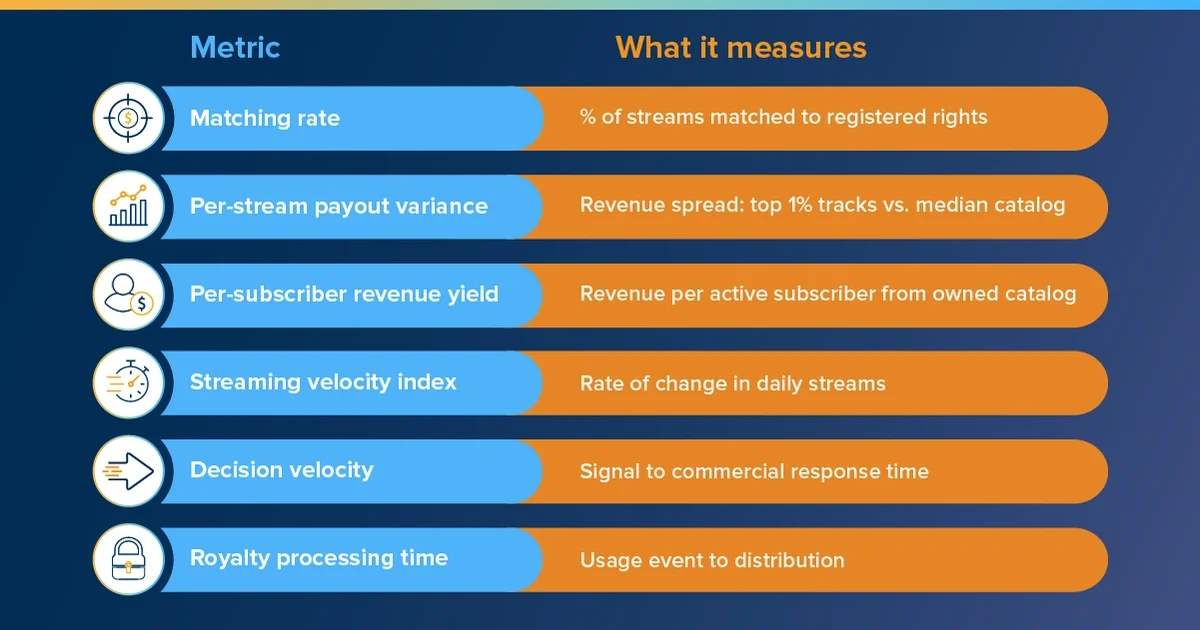
Matching can’t be a post-processing step in reconciliation. Unmatched royalty revenue isn’t a data quality backlog to be resolved later; it’s revenue not being paid to the people who earned it. Metadata hygiene is a prerequisite: ISRC/ISWC cleanup, claimant reconciliation, and publisher mapping must be treated as ongoing operational disciplines, not one-time projects.
The catalog intelligence (tracking streaming velocity, playlist exposure, and per-listener revenue at the asset level) that music publishing teams are increasingly using enables rights holders to identify where matching failures are most costly and prioritize recovery accordingly. It’ll be interesting to see how AI-driven catalog intelligence reshapes this prioritization over the next few years, particularly in emerging markets where rights registration infrastructure is still maturing.
Audit-ready attribution traceability from stream to payment
Every royalty calculation must trace back from the usage event to the payment. When an artist, publisher, or streaming platform challenges a royalty statement, the system must trace the chain of attribution with sufficient granularity to resolve the dispute without manual investigation. This means moving from end-of-cycle reconciliation to continuous, event-level processing and validation, a meaningful architectural shift for most organizations currently operating with spreadsheet-based adjustments, offline contract logic, or batch reconciliation cycles.
How to close the royalty gap using a tiered action roadmap
Royalty infrastructure modernization stalls most often because organizations can’t measure the cost of what their current system is missing. The roadmap below is structured in three horizons. The starting point is making the revenue gap visible, because an internal investment case can’t be made for a problem that hasn’t been quantified.
Short-term (0-12 months)
- Stop treating metadata as cleanup; treat it as revenue recovery. Launch a metadata hygiene program prioritizing ISRC/ISWC cleanup, claimant reconciliation, and publisher mappings. A focused effort can immediately unlock previously unmatched revenue sitting in the system.
- Run a rights-led audit to quantify unmatched royalties and black box income. Even a directional estimate of unmatched revenue as a share of total provides the evidence base for an internal modernization investment case.
- Build catalog intelligence dashboards tracking streaming velocity, playlist exposure, and per-listener revenue at the asset level. Capital-allocation decisions can’t be made on unmeasured catalog assets.
- Audit contract-to-system rule propagation: how many active deal structures require manual updates when payout methodologies change? How long is that lag currently running?
Mid-term (12-24 months)
- Connect rights, contracts, and finance systems that have historically operated in isolation. This is the single most common source of errors in royalty model coexistence calculations, and the most consistently underestimated modernization dependency.
- Pilot alternative royalty model processing at scale with partner streaming platforms, using clear KPIs measuring both fairness impact and operational cost.
- Negotiate clearer license terms that require standardized platform reporting and faster settlement windows, reducing the manual reconciliation burden at every reporting cycle.
Long-term (24+ months)
- Invest in royalty system architecture capable of processing usage at the event level, not in batch cycles. This is the prerequisite for audit-ready traceability at streaming scale.
- Deploy AI-driven catalog intelligence to align marketing spend and capital allocation to high-opportunity catalog assets. Streaming velocity data is a strategic input to the music business, not a byproduct of reporting.
- Engage with industry coordination efforts on standardized data exchange formats and performing rights organization (PRO) reporting standards. These are complements to internal infrastructure investment, not substitutes for it.
The metrics that reveal revenue leakage
Track these six KPIs across the modernization roadmap to make progress measurable and the investment case defensible:
Royalty systems are now revenue systems
Streaming scale continues to accelerate. The music royalty management problem (simultaneous frameworks, territorial complexity, and dynamic deal structures) is an intensifying structural condition, not a temporary gap. The complexity is not going away. The music companies that win will be the ones that operationalize it.
Most organizations are still operating with systems that were never designed for this environment, absorbing the revenue cost in every reporting cycle. That gap is wider than most executives recognize. Not because the technology doesn’t exist to close it, but because the problem has been framed as an accounting issue rather than a balance sheet issue.
Vistex extends core ERP systems with integrated rights and royalties management, real-time usage tracking, and contract-to-cash visibility, giving music publishers and rights holders a single source of truth across multi-platform distribution environments, so streaming revenue is calculated accurately and distributed without delay.
The companies that lead won’t be the ones with the largest catalogs; they’ll be the ones with royalty infrastructure capable of accurately calculating, attributing, and distributing catalog value at streaming scale, and catalog intelligence to act on what that infrastructure reveals. At this scale, you’re no longer managing a royalty system; you’re managing whether streaming revenue is captured or lost.
Explore more related resources

Get the latest news, updates, and exclusive insights from Vistex delivered straight to your inbox. Don’t miss out—opt in now and be the first to know!