
What is dynamic pricing in retail?
Dynamic pricing is a pricing method used by retailers to adjust product prices in response to changing business and market conditions. Customer demand can change quickly. Competitors alter their prices. Inventory disappears at different speeds. Supplier costs and funding levels also change, and shoppers can now compare prices across retailers and marketplaces in seconds.
Dynamic pricing gives retailers a more strategic way to respond to these changes. Rather than relying on fixed markups or a pre-arranged promotional calendar, they can use data and predefined business rules to adjust prices based on current market conditions.
When implemented properly, dynamic pricing can help retailers improve competitiveness, optimize inventory levels, meet demand, and protect margins. It does not simply involve changing prices more frequently. Effective strategies require reliable data, clear pricing rules, appropriate technology, and human oversight. Once you understand best practices in retail dynamic pricing, you can gain the benefits of more responsive pricing without unnecessary risks to margins, operations, or customers.
How is dynamic pricing applied in the retail sector?
Dynamic pricing usually involves data, pricing rules, and technology, and retailers gather internal and external information because it can affect the right price for a product.
Factors That Can Influence Price Adjustments:
- Customer demand
- Competitor prices
- Inventory levels
- Product availability
- Historical sales
- Seasonality
- Supplier costs
- Promotional activity
- Marketplace conditions
- Margin targets
Instead of maintaining one price until someone manually changes it, dynamic pricing allows retailers to synthesize relevant data and determine when a different price may better support business objectives. The important distinction is that dynamic does not have to mean constant. A retailer might adjust some prices multiple times a day while changing others weekly, seasonally, or only when predetermined conditions are met.
The analytics or pricing algorithms compare the signals from products, categories, and channels with the retailer's business objectives and pricing rules, after which they can recommend a price or, where appropriate, automatically implement an approved price change.
For instance, a retailer might find that a seasonal product has more inventory than expected when the season comes to an end, while at the same time demand is falling and the competitors have begun to reduce their prices. The dynamic pricing system could then identify these circumstances and suggest a price change aimed at increasing the amount of the product sold while still respecting the retailer's minimum margin requirements. On the other hand, if the inventory is low and demand stays high, the system would conclude that a discount is not needed.
What distinguishes dynamic pricing from merely following competitors is that it aims to set the right price based on multiple business conditions, not just one external signal.
Why is dynamic pricing important for retailers?
Dynamic pricing is influenced by market insights, changes in competitors' prices, and buyer behavior across different channels and marketplace platforms. When used with demand forecasting and inventory data, retailers can make pricing decisions that better align with current conditions. The aim is not just to sell more products; instead, retailers must balance multiple objectives, such as revenue, margin, inventory levels, competitive position, and customer expectations.
Retailers operate in an environment where many of the variables affecting profitability can change quickly. Competitors can change prices overnight. Marketplace sellers can introduce aggressive discounts. Inventory can move faster or slower than forecast. Consumer demand can shift because of trends, weather, economic conditions or seasonality.
What are the benefits of dynamic pricing in retail?
A well-designed dynamic pricing strategy can help retailers improve several areas of performance:
- Greater responsiveness to changes in demand:, retailers can react more quickly when there is an increase or decrease in customer demand.
- Better control of inventory: Prices can be used strategically to speed up the sale of slow-moving or seasonal stock without having to offer unnecessary discounts on items that are already selling well.
- Better margin management: Dynamic pricing models can include margin thresholds and other financial safeguards so that competitive pricing decisions may not automatically result in a loss of profitability.
- Improved competitive visibility: By using competitor monitoring, pricing teams are given a clearer understanding of how their products are positioned in the market.
- More informed pricing decisions: Rather than mainly depending on intuition, retailers can use historical performance, demand forecasts, inventory levels, and market intelligence to aid their pricing decisions.
The extent to which these advantages are achieved largely depends on the quality of the retailer's data and the rules governing how that data is used.
Dynamic pricing retail best practices
While technology can speed up pricing, faster pricing does not mean better-quality pricing; retailers need a framework that ensures their pricing decisions support their broader commercial objectives.
#1 Dynamic Pricing Best Practice – Start With Clear Pricing Objectives
Before you introduce dynamic pricing, clarify your objectives—such as increasing revenue, protecting your margin, improving sell-through, reducing excess inventory, remaining competitive on key products, or enhancing the effectiveness of your promotions.
Because objectives differ, pricing recommendations can vary widely. Once you establish the objectives, it becomes easier to decide which data, rules, and KPIs should guide the strategy.
#2 Dynamic Pricing Best Practice – Building Dynamic Pricing Around Reliable Data
The effectiveness of dynamic pricing depends entirely on the data that underpins it. Although retailers may have access to vast quantities of information, pricing recommendations based on inaccurate, outdated, or incomplete data will not match the real market conditions.
Start by identifying the data that significantly affects pricing decisions. This might include historical sales, current inventory levels, demand forecasts, competitor prices, promotional activities, supplier costs, rebates, supplier funding, and product-level performance.
It is just as crucial to make sure that those inputs are accurate, consistent, and up to date; a competitor's price might be lower since they are clearing stock, running a temporary promotion, or offering a slightly different product configuration and it could result in unnecessary discounting if you react automatically without understanding the situation.
Before relying on data for automated pricing decisions, retailers should establish processes to validate inputs, identify anomalies, and determine how often different data sources need to be refreshed. Pricing teams should also know where the data originates and have visibility into which inputs influenced a recommendation.
#3 Dynamic Pricing Best Practice – Don’t Treat Competitor Pricing as the Only Signal
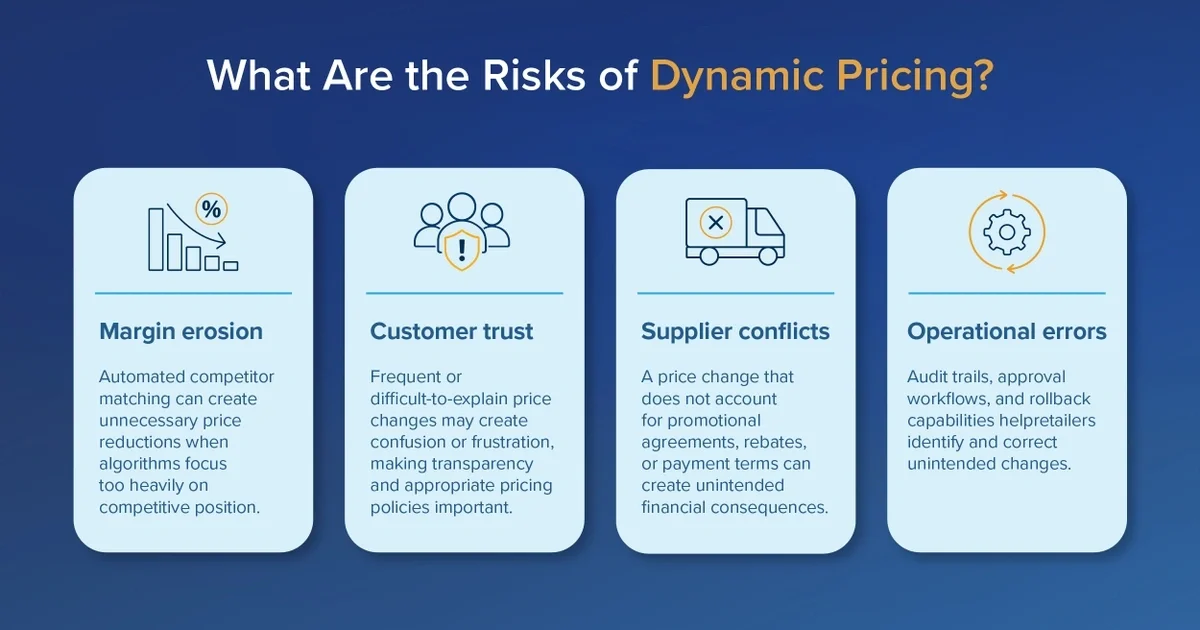
Competitor prices matter, but automatically matching the lowest price can quickly create problems. If multiple retailers continually respond to one another by reducing prices, the result can be a race to the bottom that erodes margins without creating a sustainable competitive advantage.
Instead, to optimize retail pricing, consider competitor pricing alongside demand, inventory, margin requirements, and other relevant commercial factors. The objective isn’t necessarily to offer the lowest price; it’s to determine the most appropriate price for your circumstances.
#4 Dynamic Pricing Best Practice – Establish Pricing Guardrails
Algorithms must function based on clearly defined business rules.
Retailers may establish guardrails around:
- Minimum margin
- Maximum or minimum price
- Frequency of price changes
- Size of individual price movements
- Competitive price ranges
- Promotional commitments
- Products requiring manual approval
Guardrails are intended to stop an automated recommendation from leading to an outcome that conflicts with the retailer's financial, contractual, or customer objectives, and large or unusual deviations can be sent to pricing managers for review before implementation.
#5 Dynamic Pricing Best Practice – Connect Pricing With Inventory Without Removing Human Judgment
Pricing and inventory management must not work in silos; inventory levels matter for pricing decisions, especially when retailers manage seasonal products, excess stock, or limited availability of high-demand items.
Linking pricing systems with inventory data can help determine when price changes might drive sell-through, reduce excess stock, or prevent unnecessary markdowns. Automation can examine these signals across a large number of items and detect opportunities or exceptions that would be hard for teams to handle manually.
Automation should support, not replace, human judgment. Pricing managers understand category strategy, customer expectations, vendor relationships, and other factors the data does not fully cover.
A robust dynamic pricing model uses technology to flag when action may be needed while still allowing the pricing team to supervise riskier decisions; the system identifies opportunities, but a human must decide whether the suggested action fits the business.
#6 Dynamic Pricing Best Practice – Account for Supplier Funding and Agreements
The shelf price by itself does not give the whole picture of profitability. Retailers may receive rebates, promotional money, discounts or other incentives from suppliers. Pricing changes can affect these agreements and, in some cases, a retailer's eligibility for supplier funding. As a result, a price that seems profitable when viewed solely in terms of gross margin can look very different when you account for all supplier-related income and expenses.
Before changing prices, you should understand the potential effect on supplier agreements, rebates, payment terms, and promotional commitments. This becomes especially important when agreements include volume thresholds, performance tiers, promotional requirements, or other conditions that determine how much funding your business ultimately earns.
Coordinating activities across pricing, merchandising, procurement, and finance is just as important. Each of the teams will have a different part of the profitability picture. When supplier agreements and funding information are incorporated into the pricing process, the people making decisions are given a more complete understanding of how a suggested price change could impact revenue, margin, and supplier income.
#7 Dynamic Pricing Best Practice – Test Before Scaling
Retailers don’t need to introduce dynamic pricing across the entire assortment at once. Start with a category where the business has strong data and a clearly defined objective. Establish baseline performance, implement the strategy, and measure the results.
The pilot will help identify issues with the data, algorithms, workflows, and governance before extending dynamic pricing to other categories. A step-by-step approach can make implementation easier. First, evaluate existing pricing procedures and data; then pilot dynamic pricing in a small area, set up the necessary governance and safeguards, and expand the strategy once you know the pilot results and lessons learned.
How Vistex helps you build a more responsive retail pricing strategy
Dynamic pricing becomes more powerful when retailers can see the financial conditions surrounding the price, not just the price itself.
Vistex AI-driven business software helps retailers manage complex pricing, promotions, rebates, and other commercial programs while gaining greater visibility into the factors that affect net revenue and profitability. By connecting pricing decisions with relevant financial and program data, retailers can better understand the impact of pricing actions before those decisions affect margin.
Greater visibility in this area can enable pricing, merchandising, finance, and other teams to make more informed decisions without compromising the controls required to manage increasingly complex retail environments.
Dynamic Pricing Frequently Asked Questions (FAQs)
Q: Is dynamic pricing the same as competitor price matching?
A: No. Competitor pricing may be one input into a dynamic pricing strategy, but dynamic pricing can also consider customer demand, inventory, costs, margin requirements, supplier agreements, and other factors. Automatically matching competitors can create unnecessary price reductions.
Q: How often do dynamic retail prices change?
A: There is no universal frequency. Prices may change multiple times a day, weekly, seasonally, or only when predetermined conditions occur. The appropriate frequency depends on the product, category, channel, and retailer’s business rules.
Q: Can dynamic pricing help retailers manage inventory?
A: Yes. Retailers can incorporate inventory levels into pricing decisions so that they can respond differently to excess inventory, slow-moving merchandise, or limited availability.
Q: How can retailers avoid losing margin with dynamic pricing?
A: Retailers can establish guardrails such as minimum margin thresholds, limits on price changes, and approval requirements for significant deviations. They should also consider supplier funding, rebates, and other factors affecting the true economics of a transaction.
Explore more related resources

Dynamic Pricing Strategy: How Retailers Can Optimize Prices Without Sacrificing Profitability

How to Set the Right Price, Every Time, With These Retail Pricing Optimization Strategies
Get the latest news, updates, and exclusive insights from Vistex delivered straight to your inbox. Don’t miss out—opt in now and be the first to know!