

What is revenue management in retail?
Revenue management in retail is the process of managing the pricing, incentives, discounts, rebates, promotions, and other conditions that ultimately determine a retailer’s net revenue and profitability.
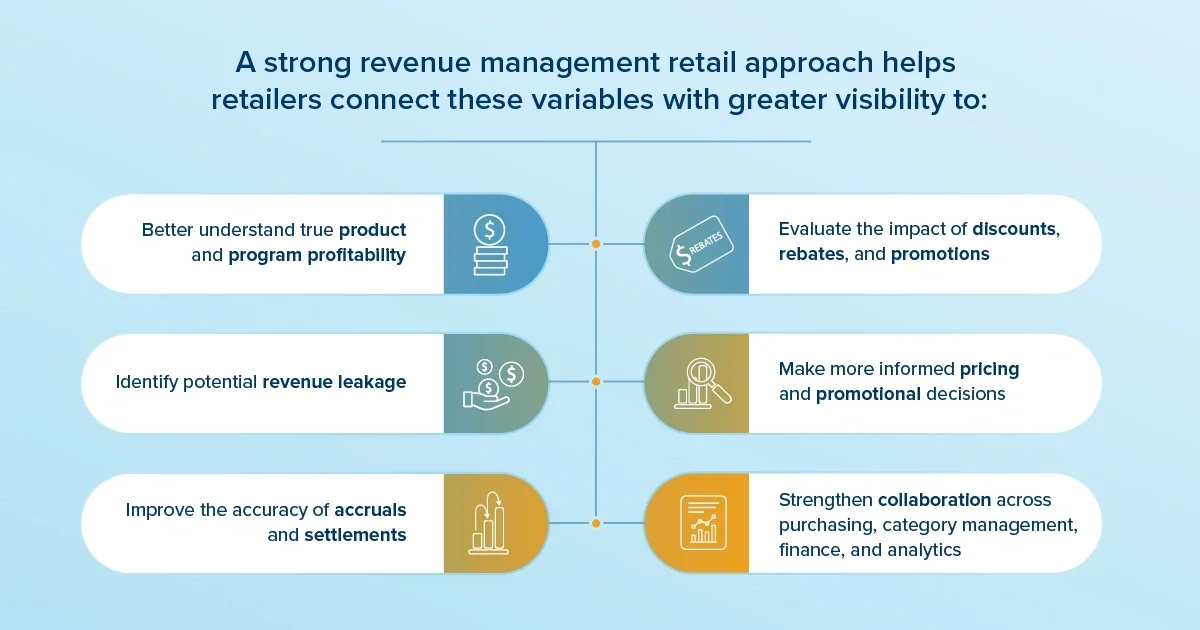
Rather than evaluating each element in isolation, revenue management integrates the financial and commercial conditions affecting products, suppliers, and customers. This gives retailers greater visibility into what they’re earning, what they’re spending, and where opportunities or revenue leakage may exist.
For retailers managing thousands of SKUs, suppliers and transactions, that visibility becomes increasingly important as the business grows more complex.
Understanding the tetrimino of revenue management in retail
Managing personal expenses can feel overwhelming at times — there are bills, subscriptions, insurance and everyday purchases to juggle. But imagine scaling that complexity to the level of a national retail company. With thousands of products, numerous suppliers and countless customers, the challenge of managing costs in retail is magnified exponentially. For retailers like you, calculating profit margins involves far more than simply subtracting the cost of goods sold from the sales price. Each product carries its own unique pricing elements, discounts, terms and conditions that must be carefully managed.
In a retail organization, departments like purchasing, category management, finance and analytics all play a critical role in revenue management. Each department faces different challenges, but they are interconnected, and inefficiencies in one area can ripple across the organization.
For example, the purchasing department doesn’t just negotiate product costs — they also have to manage discounts, which might come in the form of on-invoice or off-invoice discounts, prompt payment discounts, or other negotiated conditions. These discounts could be calculated based on various factors like amounts, percentages, volumes or growth targets. The complexity of managing these variables grows as the number of products and suppliers increases.
Meanwhile, category managers are constantly balancing a range of factors to maximize profitability. They need to consider the MSRP, competitor pricing and whether a promotion should be run on a particular brand. Promotions require funding, and decisions must be made about stock levels, the cost of running a clearance, and how much inventory is too much. Seasonal products add another layer of complexity, as timing becomes crucial in managing stock and pricing.
The finance department needs visibility into all negotiated terms, including rebates, off-invoice conditions and promotional funds. Accurate and timely accruals are essential to ensure that revenue and expenses are properly accounted for. Finance teams must also reconcile payments and claims, which can be complicated by the sheer volume of transactions and the varying terms for each product or supplier. Missing or inaccurate data can lead to significant financial discrepancies.
Finally, analytics teams rely on real-time data to conduct profitability analyses. They must understand the full range of conditions that impact each SKU in every product category, including prices, discounts, funds, rebates and marketing activities. The complexity of retail data makes it challenging to draw meaningful insights without a system that can aggregate and analyze all of these variables.
One of the biggest challenges in retail revenue management is that the terms and conditions associated with products often have different periodicities. Some discounts or rebates are immediate and transactional, while others might be applied monthly, quarterly, or even annually. Tracking and managing these varying timelines adds another layer of difficulty to an already complex system — it’s like constantly playing a game of Tetris.
How can retail revenue management help bring everything together?
Given the complexities described above, how can retail companies manage costs and revenue effectively without oversimplifying their business processes? I believe the solution lies in implementing a comprehensive revenue management system that integrates both upstream and downstream processes. This system should seamlessly connect with logistics and financial systems, ensuring that all stakeholders have access to the information they need in real time.
A robust revenue management system can provide 6 key benefits:
1. Real-Time Visibility: Business users should have access to all terms, conditions and performance metrics in real time. This includes information about suppliers, distributors, customers and products. By having immediate access to accurate data, business users can make informed decisions and respond quickly to changes in the market.
2. Simulate, Analyze and Track: A modern revenue management system allows companies to simulate potential outcomes before committing to a course of action. They can analyze the performance of their incentive and discount programs, track the true cost of each product and calculate the actual profitability of each sale. This helps eliminate inefficiencies and identify opportunities for cost savings.
3. Error Reduction: Manual processes are prone to errors, and in a retail environment, even a small mistake can have significant financial consequences. Automating revenue management processes reduces the risk of manual errors and ensures that data is accurately recorded and analyzed.
4. Enhanced Collaboration: A comprehensive system fosters better collaboration across departments as well as your supplier network. For example, purchasing can easily share data with category managers, who can then work with finance to ensure that all terms and conditions are properly accounted for. By breaking down silos and improving communication, companies can streamline their operations and improve overall efficiency.
5. End-to-end Integration: The system should provide end-to-end visibility into revenue, Gross-to-Net profit and program effectiveness. This enables business users to track money leaks, exploit opportunities and understand the complexity of their business across all partners, categories, articles and conditions.
6. Consolidated Reporting: With all data centralized in one system, companies can generate both standard and ad-hoc reports, giving them a comprehensive view of their operations. Consolidated reporting helps businesses identify trends, track performance and make data-driven decisions that improve profitability.
What are the core components of retail revenue management?
An effective revenue management strategy connects the commercial and financial processes that influence retail profitability. It’s about giving business users the ability to see the whole picture—to understand where the money is going, where it’s being wasted, and where it can be saved.
The core components of retail revenue management include:
- Pricing and margin visibility: Understand how pricing decisions and negotiated conditions affect net revenue and Gross-to-Net profit
- Supplier terms and discounts: Manage on-invoice and off-invoice discounts, payment terms, and other negotiated conditions across suppliers and products
- Rebates and incentives: Track program requirements, performance, and payments so earned revenue is accurately captured
- Promotion management: Understand promotional funding and evaluate whether programs deliver the expected financial results
- Accruals and settlements: Accurately account for expected revenue and expenses and reconcile claims and payments against agreed-upon terms
- Analytics and reporting: Bring relevant financial and commercial data together so teams can analyze profitability and identify opportunities for improvement
How can automation improve revenue management in retail?
The sheer number of products, suppliers, agreements, and transactions involved in retail makes manual revenue management increasingly difficult.
Automation can help retailers consistently apply complex business rules, calculate incentives and rebates, manage accruals, reconcile transactions, and provide stakeholders with more timely information. Instead of spending time assembling information from disconnected systems and spreadsheets, teams can focus on analyzing performance and making better-informed decisions. Technology can also improve collaboration by providing purchasing, category management, finance, and analytics teams with a more consistent view of revenue management information.
How Vistex helps simplify retail revenue management
Vistex AI-driven business software helps retailers bring the many moving pieces of revenue management together in a connected environment. By providing greater visibility into pricing, discounts, rebates, promotions, and other financial conditions, Vistex helps teams better understand how each element impacts net revenue and profitability.
Just like Tetris, success comes from seeing how all the pieces fit together. With the right processes, visibility and technology, retailers can turn complexity into a more complete picture of their business and make more informed decisions about what comes next.
Explore more related resources

Get the latest news, updates, and exclusive insights from Vistex delivered straight to your inbox. Don’t miss out—opt in now and be the first to know!