
Why chargeback management has become a critical profit protection strategy for wholesale distributors
If you’re a chargeback manager, finance lead, or operations manager, you know that chargeback management in wholesale distribution doesn’t wait for a slow quarter. Distributor chargebacks appear in the middle of everything else, tucked into dozens of vendor agreements, each with its own rules, deadlines, and documentation requirements. Miss one detail on one claim, and you’ve either left money on the table or opened yourself up to a penalty you didn’t see coming.
Are chargebacks basically free money, or are they just a cost of doing business you have to expense as a loss? Neither answer is right. Chargebacks are a mirror. What you see reflected depends entirely on how disciplined your process is. Manage chargebacks well, and they become a real cost recovery mechanism. Manage them poorly, and they quietly drain your margin, claim by claim, quarter after quarter.
This blog walks through four things: what chargeback management actually means in the distribution industry, the most common causes, how to handle chargeback disputes and recover revenue that’s rightfully yours, and what automation and analytics make possible once you’re ready to operate at scale.
What are chargebacks, and why do they cut both ways?
Before you can manage chargebacks well, you need a clear-eyed view of what you’re actually dealing with. That starts with knowing which kind of chargeback is in front of you.
Vendor chargebacks vs. supply chain compliance chargebacks
Direction of flow matters here, and it’s the first thing to check when a claim crosses your desk. A vendor chargeback flows from the manufacturer to the wholesale distributor; the vendor owes you money based on pricing terms you both agreed to.
A supply chain compliance chargeback runs the opposite direction: the retailer penalizes the distributor for a fulfillment or documentation failure. Both are worlds apart from a customer or card-payment chargeback, which is a different animal entirely and not what this blog focuses on.
The six primary chargeback types
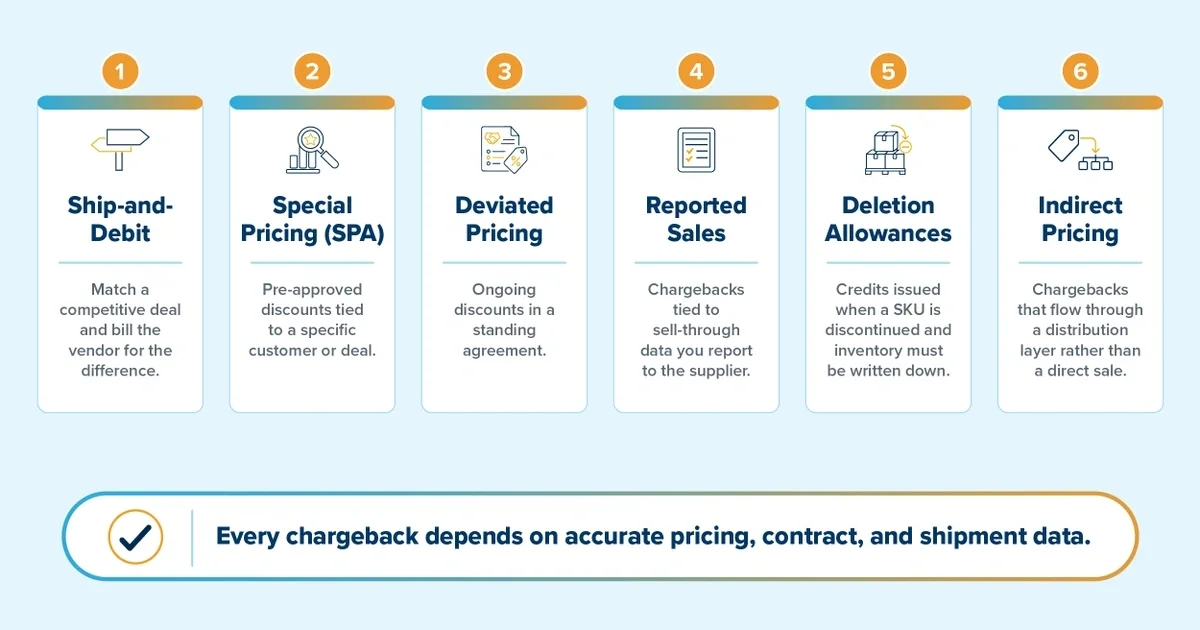
As a wholesale distributor, you need to get fluent in these six chargeback types:
- Ship-and-debit, where you sell below list price to match a competitive deal, then bill the vendor for the difference
- Special pricing authorizations (SPAs), pre-approved discounts tied to a specific customer or deal
- Deviated pricing, ongoing discounts baked into a standing agreement rather than a one-time deal
- Reported sales, chargebacks tied to sell-through data you report back to the supplier
- Deletion allowances, credits issued when a SKU is discontinued, and inventory has to be written down
- Indirect pricing, chargebacks that flow through a distribution layer rather than a direct sale
Ship-and-debit and deviated pricing cause the most trouble, and for the same reason: both depend on pricing data staying in sync between your ERP and the vendor’s approval records in real time. The moment those two systems drift even a little, you’re either underbilling yourself or setting up a dispute you’re going to lose.
The double-edged margin effect
Managed well; chargebacks are a cost-recovery mechanism. You’re capturing revenue the vendor already owes you from deviated pricing, SPAs, and ship-and-debit activity. That revenue is rightfully yours if you can document it. Managed poorly, unresolved claims, missed deduction windows, and disputed penalties compound quietly across hundreds of vendor and supplier agreements until they show up as a margin problem nobody can quite explain.
The tipping point isn’t a single bad quarter. It’s the moment your team stops being able to name which chargebacks are recoverable and which aren’t confidently. Once you’re guessing instead of tracking, the program has already flipped from asset to liability; you just haven’t seen it on the P&L yet.
How the chargeback process works
Every chargeback, whether it results in a recovery win or a write-off, follows the same basic chargeback process. Knowing that process cold is what separates a reactive team from a proactive one.
The claim lifecycle from agreement to settlement
The flow is straightforward on paper and requires five steps:
- A vendor agreement is established
- A sale is executed against it
- A claim is submitted
- The manufacturer validates the claim
- Settlement is made in the form of a check, a credit, or a direct fund withdrawal.
The discipline is to make sure every step is documented well enough to withstand scrutiny at the last one.
Reason codes and why classification matters
Reason codes are assigned when a claim is submitted, and that single data-entry decision carries more weight than most teams realize. Accurate classification determines whether a claim is eligible for dispute later and how quickly chargeback processing moves toward recovery.
Get the code wrong upfront, and you’re fighting an uphill battle you created yourself.
Where ERP, invoicing, and supply chain data intersect
This is where the most damage happens, quietly. ERP, invoicing, and supply chain systems all touch the claim process at different points. When those systems don’t talk to each other with real transparency, you get discrepancies and missed claim windows that nobody notices until the deadline’s already passed.
The process breaks down first at the system handoff, more often than at submission or classification. A team can submit a clean claim and classify it correctly and still lose the recovery because the underlying ERP data didn’t match what invoicing or supply chain had on record. Fix the handoff, and many of the downstream problems will solve themselves.
Common triggers and root causes
If you want to stop chasing the same chargebacks quarter after quarter, you have to stop treating the symptoms and start diagnosing where they actually originate.
Pricing and contract governance failures
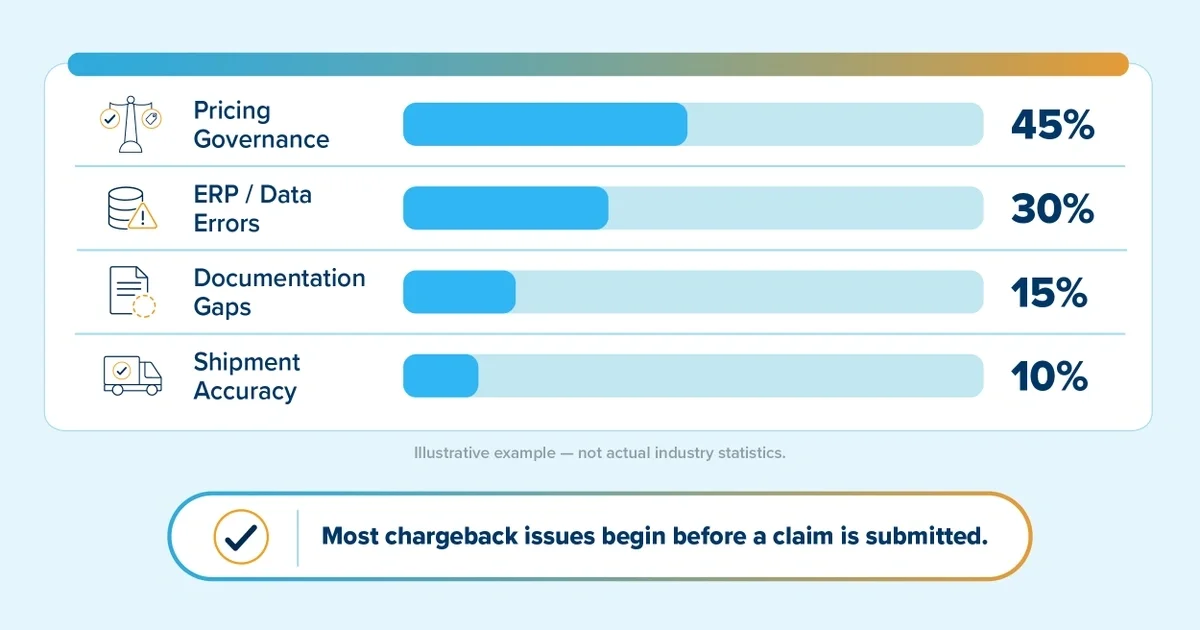
Pricing exceptions and SPA approvals that aren’t tracked against active agreements are one of the most common root causes. Add in contract lifecycle gaps, outdated agreements, missed renewal windows, negotiated rates and discounts that never reconcile with ERP master data, and you’ve got a governance problem masquerading as a chargeback problem.
Loose governance is also where fraud prevention gets overlooked. Untracked pricing exceptions are exactly the gap that lets fraudulent claims slip through alongside legitimate ones.
Fulfillment and documentation breakdowns
Shipment accuracy failures between order confirmation and dock departure create real, avoidable exposure. So do documentation gaps and weak audit trails that only surface once a dispute is already filed, which is exactly the wrong moment to discover you don’t have the paperwork.
Data and systems gaps
ERP master data errors sitting upstream of claim submission cause more downstream trouble than anyone budgets for. The same goes for communication gaps between sales, finance, and operations. They delay claims, distort accuracy, and turn what should be a routine reconciliation into a scramble.
Weak pricing governance is the primary cause of chargebacks for wholesale distributors. While fulfillment and data gaps play a role, most avoidable chargebacks stem from untracked pricing exceptions that stray from approved terms.
What is the real cost of poor chargeback management?
Chargebacks aren’t inherently good or bad for your business. They’re a mirror, and what you see in it depends entirely on how disciplined your process is.
Cost recovery, margin protection, and COGS discipline when chargebacks are managed well
A well-run chargeback management program recaptures vendor-owed revenue that would otherwise be written off and forgotten. Every recovered dollar directly improves the unit economics of what you sold. In my opinion, that makes chargeback discipline effectively COGS discipline, even though most finance teams don’t file it under that heading.
The financial exposure of poorly managed chargebacks
Unrecovered deductions add up fast, and they’re joined by rebate leakage, administrative overhead spent chasing claims that should’ve been clean the first time, and compliance or service-failure penalties that compound the damage.
The operational drag of poorly managed chargebacks
Beyond the dollars, there’s a real operational tax: manual reconciliation burden, cross-functional friction between the teams who all touch a claim, and slow dispute response that costs you the recovery window entirely.
The relationship and reputational risk of poorly managed chargebacks
Repeated compliance failures strain vendor and supplier relationships in ways that don’t show up on a balance sheet until they do. Left unaddressed, unresolved chargebacks normalize operational breakdowns over time, and that normalization is the real danger. It becomes "just how things work" instead of a fixable problem.
Finance leadership tends to understand chargeback management as a revenue-recovery function first, and that framing under-resources it. Once you position it as a COGS discipline instead, tied directly to unit economics, it gets budgeted, staffed, and prioritized the way it should be.
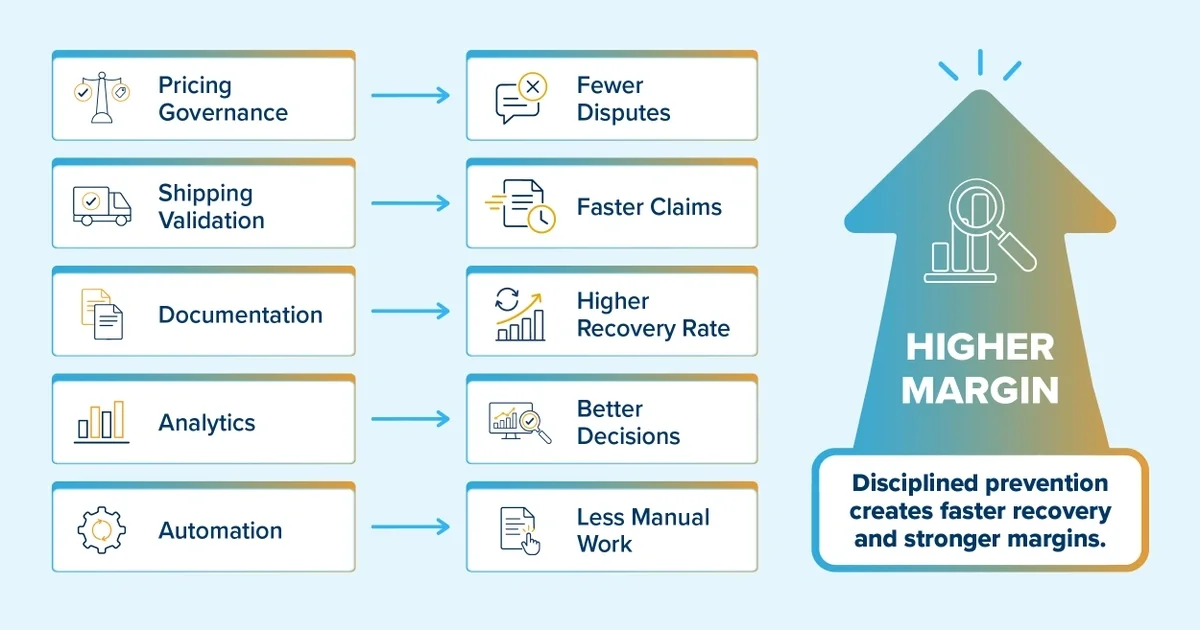
Five tactics to prevent chargebacks before they happen
The best chargeback strategy is the one you never have to use, so here’s where to focus if prevention is your priority.
1. Strengthen pricing governance
Standardize SPA approvals, renewal workflows, and contract-to-invoice alignment. Monitor discounts and rebates against approved terms before claims are ever submitted, not after. Real transparency between what’s approved and what’s invoiced is what makes this work.
2. Validate shipment accuracy before the dock
Confirm order accuracy, inventory precision, packaging, labeling, and delivery confirmation before shipments leave the building. Use quality checks to catch exceptions while they’re still fixable, not after they’ve become penalties.
3. Build compliance feedback loops with vendors
Assign clear owners for compliance improvements and build faster feedback loops with suppliers and retail partners. If it takes weeks to close, it isn’t really a feedback loop.
4. Use analytics to get ahead of patterns
Track chargeback frequency by vendor, SKU, and region, then use predictive analytics to anticipate high-risk exceptions before they turn into claims.
5. Standardize documentation at every handoff
Build the audit trail in real time, not after a dispute lands on your desk. Standardize workflows so evidence is organized, and your response is fast when it counts.
Pricing governance delivers the fastest ROI. It’s mostly a process and accountability fix, and you’ll see the impact within a quarter or two. Analytics-driven pattern recognition takes the longest to pay off, not because it isn’t worth it, but because it needs clean, consistent data flowing in before the predictions are worth trusting.
Best practices for disputing chargebacks and improving recovery
Not every chargeback deserves a fight, but the ones that do deserve a process, not a scramble.
When to dispute vs. when to accept
Every claim needs a real evaluation: is it valid, partially valid, or genuinely disputable? Accepting every claim without review is a recoverable margin loss you’re choosing not to recover.
Building your evidence package
A strong chargeback dispute rests on:
- Proof of shipment and delivery
- Approved pricing terms and signed agreements
- An audit trail of communication and timeline
Missing any one of the three weakens the case as a whole.
A repeatable dispute workflow
Receive the claim, review the reason code, collect your evidence, rebut within the deadline, and track the outcome. That last step matters more than people give it credit for, because tracking which chargebacks get disputed and won is how you improve your win rate over time instead of relearning the same lessons on every dispute.
Recovery rate as a performance KPI
A strong recovery rate signals real chargeback success, and the data behind it should feed straight back into refining your prevention and documentation practices. Managing disputes and preventing chargebacks aren’t separate workstreams. They’re the same discipline pointed in two directions.
The most common mistake is accepting too quickly. Teams under time pressure default to paying a claim to clear it off the list, and that habit costs more over a year than most people realize until they add it up.
How automation and analytics change the equation
At some point, spreadsheets stop being tools and become bottlenecks. That’s usually where automation earns its keep.
Automating the claim and reconciliation workflow
Automated matching of invoices, claims, and shipment records reduces significant manual effort. Automated calculation and retroactive processing, combined with exception routing, mean your team spends time on the claims that actually require judgment rather than those that don’t.
Analytics for pattern recognition and risk prediction
Recurring discrepancies across vendors, SKUs, and regions are easier to catch when analytics surface patterns for you instead of burying them in a spreadsheet. Track recovery performance and win-rate over time, and use predictive risk flagging to catch problems, including potential fraud, before claims are even filed.
Connected visibility across systems
End-to-end visibility into master data, pricing, and financial data across ERP, CRM, procurement, and finance is the foundation for everything else. Without it, automation moves the same disconnected data around faster.
What to look for in a platform
Look for automated tracking and workflow routing, real ERP and supplier integration, dispute documentation and audit trail support, and the ability to handle retroactive terms processing without a manual workaround.
What’s changed the most in the last few years is sophistication, not adoption speed. Wholesale distributors have had access to automation tools for a while now. What’s different is that the tools finally handle the messy, retroactive, exception-heavy reality of chargeback processing instead of forcing it into a clean template that never quite fits.
Governance, accountability, and the metrics that matter
None of this works without clear ownership. Let’s talk about who should own what and how you’ll know it’s working.
Cross-functional ownership
Pricing, fulfillment, dispute resolution, and vendor compliance each need a named owner, along with a clear escalation path for recurring issues. Ambiguous ownership is where chargebacks go to become permanent.
The KPIs that drive continuous improvement
- Track chargeback rate by vendor, customer, and SKU.
- Track dispute win rate and recovery percentage.
- Track cycle time from claim to resolution, recurrence rate, and rebate status.
Together, these numbers tell you whether your chargeback management program is improving or just keeping you busy.
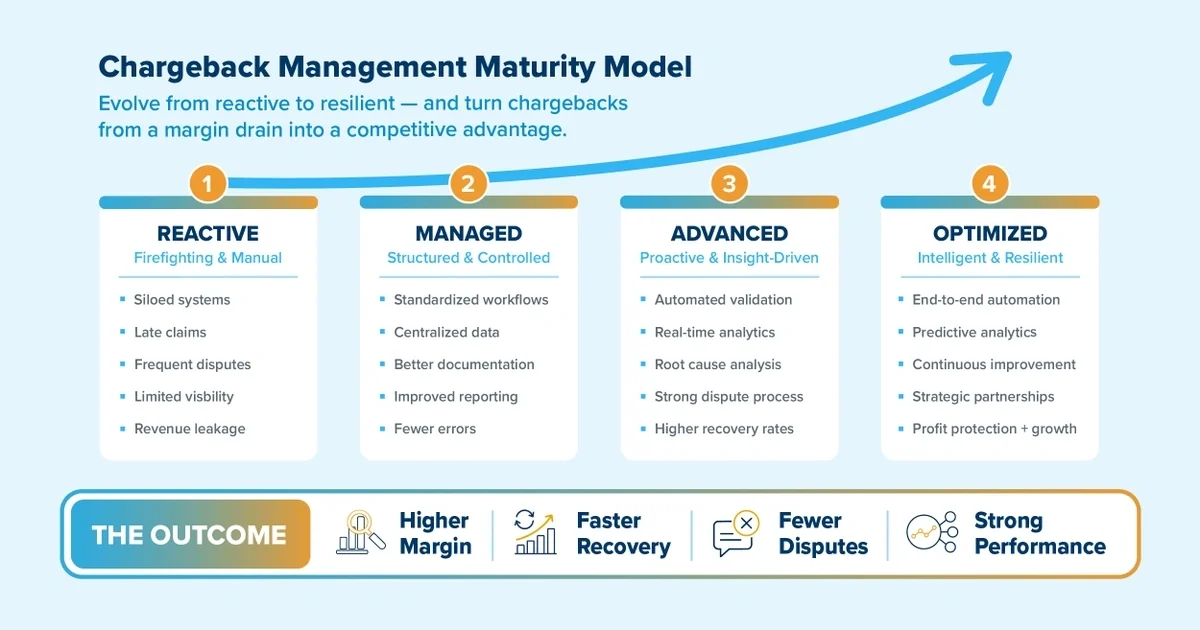
Every wholesale distributor manages chargebacks, but not every company does so with the same level of discipline. The maturity of your processes ultimately determines how much revenue you recover, how quickly you resolve disputes, and how effectively you prevent recurring issues.
If a wholesale distributor could track only one metric starting tomorrow, it should be the recurrence rate. A high recovery rate on chargebacks that keep coming back means you’re treating symptoms, not causes. Recurrence rate tells you whether prevention is actually working.
The future of chargeback management in distribution
Where chargeback management is headed next tells you a lot about where you should be investing now.
AI and machine learning are moving into anomaly detection and pattern recognition, with predictive modeling flagging high-risk transactions, including likely fraud, before claims are even filed. Real-time visibility across invoices, shipments, and deductions is becoming table stakes rather than a differentiator in the distribution industry. Shared data platforms are improving transparency between distributors and vendors, and standardized reason codes are becoming a genuine data governance priority rather than an afterthought.
Looking two to three years out, process discipline will matter more than the technology itself. The tools are getting genuinely good. The wholesale distributors who win will be the ones who pair their platform with the pricing governance and documentation discipline required to actually use it well.
Chargeback management is a choice, not a cost of doing business
At the end of the day, how you treat chargebacks says a lot about how you run your business, and that’s a choice you get to make.
Distributor chargebacks signal where pricing, fulfillment, and documentation are breaking down. But signals are only useful if someone’s listening.
Wholesale distributors who treat chargeback management as a strategic control function, not a back-office cleanup task, protect margin and vendor relationships at scale. The ones who don’t end up managing the same problems every quarter, wondering why margin keeps slipping.
Put chargeback discipline to work
Vistex’s vendor chargebacks solution brings pricing governance, automated reconciliation, and dispute tracking into one workflow, so your team spends less time chasing claims and more time capturing revenue that’s already yours.
For finance leaders who still treat chargeback management as an unavoidable cost of doing business, stop budgeting for write-offs and start budgeting for recovery. The revenue is already yours. Discipline is just how you get it.
Explore more related resources
Get the latest news, updates, and exclusive insights from Vistex delivered straight to your inbox. Don’t miss out—opt in now and be the first to know!