
The benchmark that changes the wholesale distribution profit margin conversation
Anyone who has worked in wholesale distribution long enough knows this feeling: inventory that shows available in the system but is missing on the warehouse floor. On paper, everything looks fine, but operationally, the disconnect quietly drives delays, workarounds, and customer frustration. It's one of the most persistent threats to wholesale distribution profit margin, and the same dynamic plays out every day in pricing, discounting, and rebate management. Erosion works the same way: the system shows one number, and the business keeps another.
Revenue continues to grow, and orders keep moving. But beneath the surface, delayed price updates, unmanaged discounting, missed rebates, and weak visibility chip away at profitability until leadership realizes the business is working harder for a lower return. A supplier cost increase sits unaddressed for weeks. A rebate program gets earned but is never claimed. A sales rep discounts aggressively to close before the quarter ends. A customer relationship evolves while pricing discipline stays frozen.
None of these moments looks catastrophic in isolation. Together, they create the margin gap: the invisible space between expected profitability and realized profitability. In an industry already operating on thin margins, even small amounts of leakage put significant pressure on cash flow, inventory management, operational alignment, and long-term growth.
Most distributors don’t have a pricing strategy problem. They have a visibility and process discipline problem.
Once visibility disappears, precision usually disappears with it. And when precision slips, margin erosion is rarely far behind.
Revenue growth may signal momentum, but realized margin determines whether the business is actually getting healthier.
Why the margin gap matters more right now
Wholesale distribution has always operated under margin pressure, but today, margin erosion in wholesale distribution is accelerating faster than many organizations can respond.
Tariff volatility, supplier cost swings, freight instability, supply chain disruption, and competitive pressure have compressed the time distributors have to respond to changing market conditions. A delay of even a few weeks between a supplier cost increase and a corresponding price adjustment can materially impact gross margin.
For a $100 million distributor, even 1-3% margin leakage can represent $1-$3 million in lost annual profit.
At the same time, inventory imbalances, stockouts, expedited freight, and inconsistent discounting continue putting additional strain on working capital.
Speed of response is the new competitive advantage
The distributors protecting profit most effectively right now aren’t necessarily the ones with the most aggressive pricing strategies. They are the ones with the best operational visibility, the clearest governance, and the fastest feedback loops between cost changes and pricing action.
Five root causes of margin erosion
Margin erosion rarely comes from one catastrophic decision; it’s usually death by a thousand cuts.
1. Cost increases are not reflected in prices quickly enough
Supplier prices, freight costs, tariffs, and vendor agreements change constantly. But many pricing systems still operate on monthly or quarterly update cycles. When supplier costs move faster than pricing workflows can react, distributors absorb the difference.
Every day of lag is a day when the distributor effectively funds customer margin with its own. The same risk appears in reverse with supplier rebates and incentive programs. If earned rebates are not tracked accurately and reconciled on time, distributors lose margin that was already available to them.
2. Discounting happens without visibility or governance
Most sales teams are trying to win business, not intentionally erode profitability. The problem emerges when discounting lacks structure.
Without clear approval workflows and defined authority levels, pricing decisions become inconsistent across reps, regions, and accounts. Multiply that across thousands of SKUs and dozens of sellers, and the organization ends up with a pricing strategy that exists only on paper.
Strong discount governance isn’t about restricting the sales team; it’s about giving sellers clarity so they can negotiate confidently within defined guardrails.
3. Customer segmentation is too simplistic
Many distributors still segment customers primarily by revenue or purchase volume, which creates blind spots.
An effective pricing strategy for distributors requires a broader view of profitability, including:
- Total cost to serve
- Freight and logistics expense
- Order frequency
- Returns and support requirements
- SKU-level margin contribution
- Market pricing by geography and channel
When distributors price every customer with the same logic, they lose the ability to optimize margin intelligently. Pricing becomes a blunt instrument where a scalpel is needed.
4. Manual price maintenance creates quiet failure points
Spreadsheets, emails, disconnected systems, and local price lists still dominate pricing operations across many distribution organizations. The danger is silent inconsistency.
Version drift, missed updates, delayed communication, and disconnected workflows create small inaccuracies that compound over time. When pricing lives everywhere, control lives nowhere.
5. Margin visibility arrives too late
You can’t protect what you can’t measure. If leadership teams can’t quickly pull margin performance by customer, SKU, product category, or sales rep, they’re managing profitability reactively rather than proactively.
The distributors experiencing the fastest margin erosion are usually the ones treating visibility as an operational discipline, not just a reporting exercise.
The benchmark that changes the conversation
One of the most important shifts distribution leaders can make is recognizing the bottom-line impact pricing execution actually has.
From my experience working with distributors, a 1% improvement in price realization can deliver a bottom-line impact three to four times greater than a comparable reduction in operating costs. That matters because many organizations continue to focus heavily on operational cost reduction while overlooking the margin already available through pricing discipline, supplier incentives, and discount governance.
Key metrics should include:
- Realized gross margin by customer, SKU, and channel
- Margin leakage percentage
- Discount-to-list variance
- Manual price override frequency
- Rebate capture rate
- Contract compliance performance
- Inventory turns and expedited freight spend
The organizations that consistently improve profit margins are the ones that measure leakage before it becomes systemic.
What margin leakage looks like in practice
Consider a common scenario: A regional industrial distributor reports 7% year-over-year revenue growth. Leadership initially views the quarter positively. But a deeper analysis reveals that gross margin declined by more than 2 points during the same period.
The underlying causes are familiar:
- Delayed price updates during supplier cost inflation
- Unapproved discounts across multiple sales teams
- Poor customer segmentation
- Missed rebate opportunities
- Limited visibility into realized margin performance
Taken as a whole, these issues materially reshape profitability. Distributors who move quickly on the highest-impact areas, such as cost-to-price automation and discount governance, typically see meaningful recovery within two to three quarters. In the scenario above, 1.8 points of gross margin were recovered within 12 months.
A practical path to closing the margin gap
If there’s one mistake I see distributors make repeatedly, it’s trying to address margin erosion through isolated initiatives such as new pricing tools, one-time price increases, finance-led reporting exercises, or tighter approval policies. Those efforts can help temporarily, but margin protection becomes sustainable only when pricing, sales, finance, procurement, and operations start operating from the same visibility foundation.
In my opinion, that’s the real difference between reactive distributors and proactive ones. Reactive organizations chase margin after it disappears. Proactive organizations build systems, guidance, and execution discipline to prevent leakage in the first place.
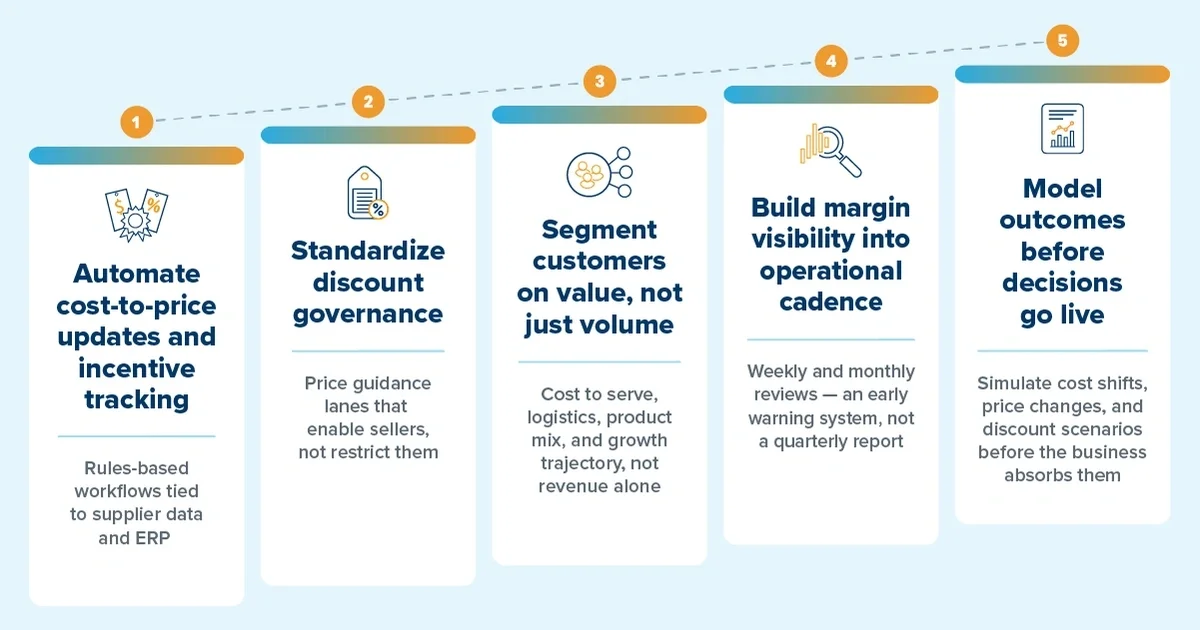
The five-pillar framework
The distributors making the strongest progress right now usually focus on five pillars.
Pillar 1: Automate cost-to-price updates and incentive tracking
Best-in-class distributors don’t manually evaluate every supplier cost change. Instead, they establish rules-based workflows tied directly to supplier data and ERP systems. When costs move beyond a defined threshold, pricing teams receive automated alerts, proposed pricing actions, and approval routing.
This shortens response time dramatically while reducing spreadsheet-driven maintenance work.
The same precision improves rebate management. Incentive accruals are tracked in real time, helping distributors accurately and consistently claim earned vendor rebates.
Pillar 2: Standardize discount governance
One of the biggest misconceptions in wholesale distribution is that sales teams resist pricing discipline. Most sales teams don’t resist pricing discipline nearly as much as they resist ambiguity.
When discount rules are inconsistent, approval paths change constantly, or pricing expectations are unclear, reps lose confidence and start negotiating internally before they can negotiate externally. That slows decision-making and weakens alignment.
High-performing distributors solve this with price guidance lanes. Sales reps operate confidently within a defined range. Larger exceptions route automatically for review. Leadership maintains visibility without creating bottlenecks.
That structure matters because good pricing governance should feel like enablement, not restriction.
Clear rules reduce friction. Clear visibility improves consistency. And consistent execution protects margin without undermining customer relationships.
Pillar 3: Segment customers on value, not just volume
Not all revenue contributes equally to profitability. Customer segmentation models should reflect:
- Total cost to serve
- Loyalty and growth trajectory
- Logistics complexity
- Product mix
- Strategic account value
The goal isn’t to punish lower-volume customers; it’s to align pricing strategy with operational reality.
When distributors combine ERP data, analytics, and profitability modeling, pricing becomes significantly more precise.
Pillar 4: Build margin visibility into operational cadence
Margin visibility can’t live exclusively inside quarterly finance reviews. Leading distributors integrate margin analysis directly into weekly and monthly operational conversations.
That includes reviewing profitability trends by customer, product category, sales rep, channel, and region. Visibility becomes an early warning system instead of a retrospective report.
Pillar 5: Model outcomes before decisions go live
Leading distributors increasingly use simulation tools to test pricing and cost decisions before implementation. Before launching a price increase or changing discount structures, they model questions such as:
- What happens if supplier costs increase by another 8%?
- Which customer segments are most price sensitive?
- What revenue impact follows tighter discount governance?
- Which SKUs carry the highest margin risk?
The difference between proactive margin management and reactive margin recovery often comes down to one capability: modeling outcomes before the business absorbs the consequences.
The technology stack that makes margin protection sustainable
Technology alone doesn’t solve margin erosion; disconnected technology certainly makes it worse.
Distributors that have sustained margin improvements over time are building operational visibility directly into workflow execution rather than relying on after-the-fact reporting.
What an integrated margin stack actually looks like
From my perspective, distributors rarely lose margin because they lack technology. More often, they lose margin because disconnected systems create disconnected decisions. The distributors improving visibility and protecting margin most effectively usually have:
- ERP systems with clean master data
- Pricing optimization and CPQ capabilities
- Analytics and forecasting platforms
- Rebate management automation
- Contract compliance workflows
- Warehouse and transportation visibility
- Integration across ERP, CRM, pricing, and incentive systems
The important distinction is integration.
When pricing workflows, supplier incentives, discount approvals, analytics, and ERP data operate together, distributors gain visibility into where margin is being created and where it is leaking away.
That’s where organizations move from reactive firefighting to proactive margin management.
Quick wins distribution leaders can start this quarter
One thing I always encourage distribution leaders to remember: you don’t have to solve everything at once. Trying to overhaul pricing, incentives, governance, analytics, ERP integration, and sales behavior simultaneously usually creates organizational fatigue before momentum has a chance to build.
Continuous improvement works better. Start with visibility. Build precision. Expand from there.
Five practical places to begin
- Audit the top 20 customers and top 20 SKUs for realized margin leakage.
- Measure discount frequency and override patterns by sales rep.
- Automate rebate reconciliation for your largest supplier agreements.
- Introduce simple margin-by-deal visibility for the sales team.
- Pilot margin-based incentives in one territory or business unit.
Those kinds of focused wins create something important beyond financial improvement. They create organizational alignment.
Teams begin trusting the data. Sales sees the guidance working. Finance gains visibility faster. Leadership sees measurable progress instead of another long transformation roadmap.
That momentum becomes the foundation for broader operational improvement later.
Governance locks in the gains
But quick wins only hold if governance turns them into repeatable behavior.
The distributors who are consistently improving their margins aren’t relying solely on instinct; they’re building repeatable governance around visibility, pricing execution, and operational accountability. That includes:
- Cross-functional margin reviews involving Sales, Finance, Pricing, and Operations
- Clear exception workflows and approval structures
- Ongoing coaching around margin-protective selling behavior
- Shared KPI visibility across leadership teams
- Continuous monitoring of realized gross margin performance
Margin protection becomes sustainable when accountability exists across the organization rather than living exclusively in Finance.
Stop reacting to margin erosion. Start building the discipline to prevent it.
The distributors gaining margin right now aren’t necessarily the ones with the most aggressive pricing strategy; they’re the ones who finally closed the gap between what the system shows and what the business actually keeps. They understand where profit is created, where it leaks away, and which operational behaviors shape the outcome long before the P&L closes.
That requires more than technology. It requires alignment between Pricing, Procurement, Sales, and Finance. And alignment between supplier agreements, execution workflows, operational decisions, and profitability outcomes.
The old playbook was reactive:
- Review margin after the quarter closes.
- Chase down exceptions manually.
- Absorb cost increases temporarily.
- Treat pricing discipline like a sales constraint.
- Manage rebates after the fact.
The new playbook is proactive:
- Build visibility directly into workflow execution.
- Create guidance instead of ambiguity.
- Automate pricing precision where possible.
- Model outcomes before decisions go live.
- Treat margin protection as a continuous operational discipline.
That shift changes profitability and confidence. Sales operates with clearer guidance, Finance gains faster visibility, and Leadership makes decisions with greater precision. The organization stops fighting fires transaction by transaction.
This is where Vistex enterprise software helps distributors close the gap between expected margin and realized margin by connecting pricing, rebates, incentives, contract compliance, and analytics into a unified operational visibility and execution framework that reduces leakage before it reaches the P&L.
You don’t need perfection to begin; you need visibility into where the margin gap exists, so you can start deliberately closing it.
Ultimately, distributors will face a choice: either continue reacting to margin erosion once it reaches the financials, or build the operational discipline, visibility, and alignment to prevent it upstream while decisions are still controllable.
That choice will determine which distributors prioritize profitability over the next several years and which continue to wonder why revenue growth never fully translates into stronger margins.
Can your organization identify realized gross margin by customer and SKU within 48 hours? If the answer is no, the margin gap is already costing more than you think.
Explore more related resources


Get the latest news, updates, and exclusive insights from Vistex delivered straight to your inbox. Don’t miss out—opt in now and be the first to know!