
Distributors risk losing supplier rebate income
Wholesale distribution rebate programs are a significant source of earned income for distributors, but most of that value never reaches the bottom line. With better data, automation, analytics, and AI-enabled capabilities, companies are moving from processing rebates after the fact to managing rebate income as part of their revenue-management strategy.
The value of wholesale distribution rebate programs depends on whether the distributor understands the agreement, tracks performance in real time, calculates what’s owed, and collects it before it slips through the cracks in a spreadsheet.
When rebate programs are managed through disconnected systems, spreadsheets, and manual processes, revenue often leaks out. Distributors managing rebates as a commercial discipline capture more of what they’ve earned.
Meaningful earned income can be generated from such supplier programs as:
- Volume incentives
- Growth rebates
- Performance rebates
- Market development funds
What is a wholesale distribution rebate program?
A wholesale distribution rebate program is an incentive agreement between a distributor and supplier in which the distributor earns a financial benefit for meeting defined conditions. These conditions may include:
- Purchasing a specified volume or dollar amount
- Achieving growth targets
- Meeting market share or product-mix objectives
- Purchasing specific products or product categories
- Reaching quarterly/annual thresholds
- Meeting performance or promotional requirements
- Participating in supplier programs or marketing initiatives
In distribution, rebates flow from suppliers to distributors or from distributors to customers. Knowing the difference is essential because each type affects profitability and commercial decisions differently.
Buy-side rebates
With buy-side rebates, the financial incentive comes from a supplier and is based on the distributor’s purchases or performance.
Sell-side rebates
With sell-side rebates, the distributor provides an incentive to their customer based on that customer’s purchases or performance.
While both buy-side and sell-side rebates are important, supplier rebates deserve particular attention because they represent earned income that can directly affect gross margin and profitability. Both types can exist simultaneously for the same customer and material combination, so commercial teams should understand both sides when evaluating the full cost to serve.
What are the benefits of rebates for distributors?
Rebates don’t just show up as a line item at quarter close. When rebates are managed well, they touch almost every part of the business, from what you charge for a product to how strong your supplier relationships will be next year.
In my experience, many distributors see rebates as found money rather than earned income. That mindset changes how you manage the process. Treating rebates as earned income means holding suppliers accountable for what’s owed while acknowledging and correcting mistakes on the distributor’s side. It’s that level of transparency that builds trust and gives the distributor confidence in the amounts it states are owed during the claim process.
When rebates are managed as a commercial discipline, not a bonus, the company can protect its interests, shore up supplier relationships, and capture the income it has earned.
Rebates strengthen margin and revenue
Supplier rebates make up a considerable share of total profitability, sometimes more than teams realize until they break it out. A product that looks average on gross margin looks different after factoring in what you’re earning back from the supplier. If you don't include rebate income in your profitability evaluation, you’re not seeing the full picture.
Rebates influence purchasing decisions
Volume-based incentives reward your purchasing decisions. When suppliers offer better terms for larger or more consistent orders, that invites you to align your purchasing strategy with demand and cost. You get paid for staying stocked for customer demand.
Rebates strengthen supplier relationships
I’ve known suppliers who have offered distributors more flexibility, which makes the relationship easier to manage. A well-managed rebate program shows your suppliers that you’re a partner worth investing in. Consistent performance, clean reporting, and reliable claims build the trust that leads to better terms.
Rebates provide visibility into future income
The part I think often gets missed is that a rebate program is about what money comes in and what you can see coming. With a clear view of earned, accrued, and paid income, you can forecast more precisely and spot problems before they become write-offs.
When you manage rebates like a discipline rather than a bonus, you get paid back.
Why distributors lose supplier rebate income
The challenge lies in managing everything required to turn the rebate agreement into cash, because the transactional data needed to determine eligibility may reside across ERP, pricing, purchasing, sales, and other systems. Disconnected data across these systems is a persistent source of leakage because it can result in incorrect claim calculations before anyone sees the problem.
Supplier agreements can contain complex elements, including:
- Eligibility requirements
- Tier structures
- Effective dates
- Product exclusions
- Customer or location requirements
- Volume thresholds
What is rebate leakage?
Rebate leakage is the gap between the supplier incentive income a distributor is entitled to earn and the amount it actually realizes. Rebate leakage is particularly challenging because it’s often difficult to see. A distributor may know how much it received from a supplier, but it may not know how much it should have received.
I see that distinction as the biggest blind spot in rebate management. Most teams can tell you what they received; few can tell you what they were owed. Leakage can occur when a distributor:
- Fails to identify an eligible rebate
- Misinterprets an agreement
- Misses a performance threshold
- Uses incomplete or inaccurate transactional data
- Fails to submit a claim
- Submits an incorrect claim
- Doesn’t reconcile supplier payments
- Fails to update expired or amended agreements
- Can’t identify discrepancies between expected and actual payments
The goal of effective rebate management should be to process payments accurately and provide confidence that the company is identifying, earning, claiming, and collecting the income it is entitled to.
Complex agreements are difficult to translate into actionable rules
A supplier agreement may make perfect sense when it is negotiated, but someone still needs to translate its terms into the systems and processes used to calculate earned income.
If different teams interpret agreement terms differently, or key conditions aren't captured correctly, the distributor may not receive the full benefit earned.
Disconnected data makes performance difficult to see
A rebate is only as reliable as the data used to calculate it. If purchasing, sales, product, supplier, and agreement data are disconnected, teams may struggle to determine whether they’re on track to earn a rebate or whether data gaps are miscalculating the claim amount.
Do manual processes create errors and delays?
Spreadsheets may work for a small number of straightforward programs, but they become difficult to manage as the number and complexity of supplier agreements grow. Manual processes often lead to:
- Incorrect calculations
- Missed eligibility
- Outdated agreement terms
- Delays in accruals
- Missed claims
- Duplicate claims
- Difficulty reconciling supplier payments
- Limited visibility into outstanding income
Why rebates are often managed after the fact
The biggest issue may be that distributors frequently treat rebates as an accounting exercise rather than a commercial opportunity. This shift separates reactive rebate programs from strategic ones. Rebates are something you manage while there’s still time to act on them.
If teams only look at rebates when it’s time to reconcile or submit a claim, they may miss opportunities to influence purchasing behavior, negotiate better agreements, or address a performance gap before missing an earnings threshold.
What’s the difference between earned, accrued, claimed and paid rebates?
These terms are often used interchangeably, but they represent different points in the rebate lifecycle:
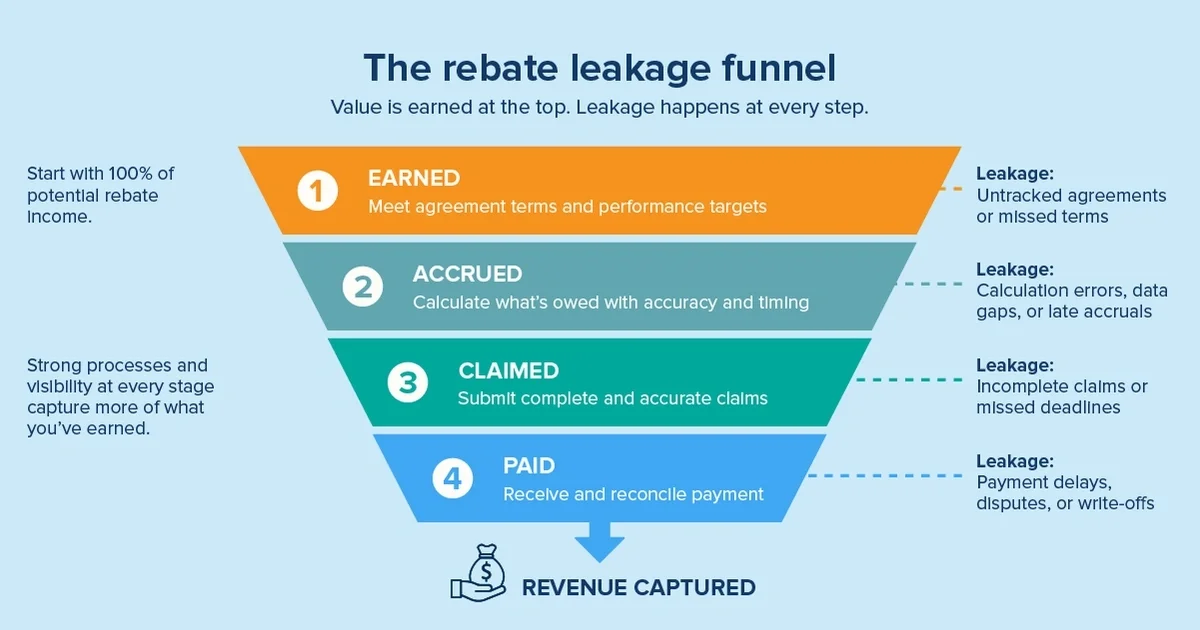
- Earned rebates mean the distributor met the conditions of the supplier agreement and is entitled to the incentive.
- Accrued rebates mean the distributor recognized an estimated amount of rebate income based on its expected earnings, even though the final claim or payment may not have occurred yet.
- Claimed rebates mean the distributor submitted a request to the supplier for the rebate it believes it has earned.
- Paid rebates mean the supplier settled the claim, and the distributor has received the financial benefit.
Understanding these distinctions provides a much clearer picture of rebate performance.
For example, a distributor may have significant accrued rebate income but little paid income. That could indicate normal timing, or it could point to unresolved claims, supplier disputes, missing documentation, or other leakage.
Seeing the entire lifecycle helps finance and commercial teams understand:
- Where money is earned
- Where money is sitting
- Where action may be required
What are the best practices for managing distributor rebate programs?
Effective rebate management requires automation combined with strategy, data, governance, and technology. I would prioritize the following 6 best practices.
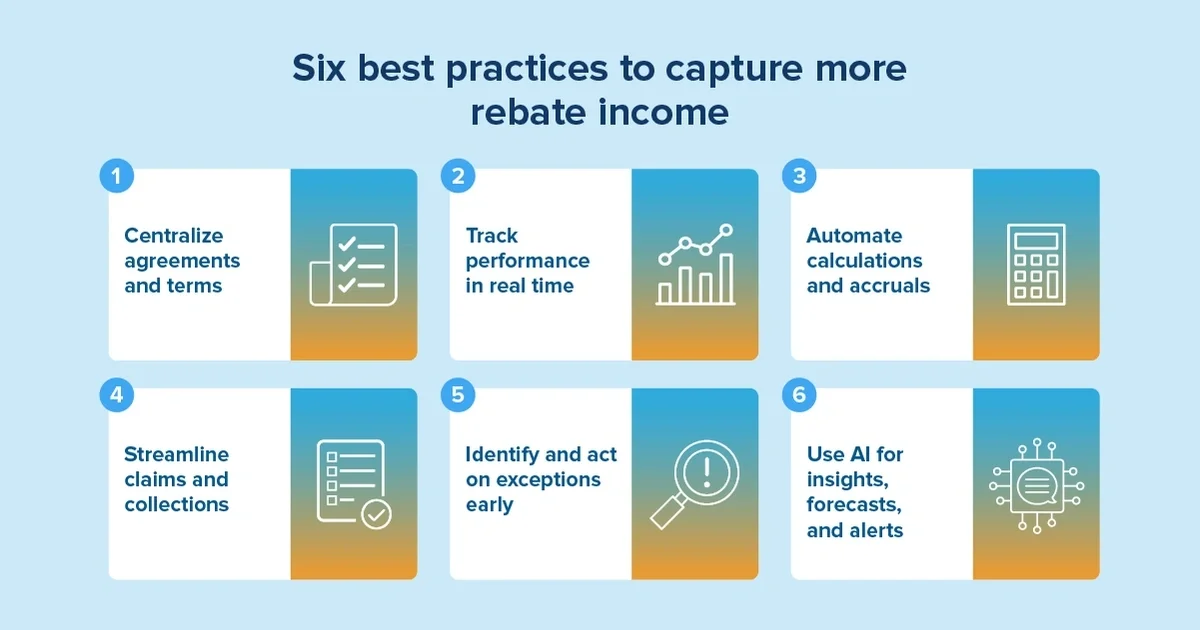
1. Treat supplier rebates as a strategic revenue-management opportunity
Start by understanding the role rebates play in the broader profitability strategy:
- Which supplier programs generate the most income?
- Which agreements have the greatest growth potential?
- Where are thresholds being missed?
- Which suppliers have recurring discrepancies?
Next, establish KPIs around rebate performance and make them visible to the teams responsible for purchasing, pricing, finance, and supplier management. Potential KPIs include:
- Total rebate income earned
- Accrued versus paid income
- Claim recovery rate
- Percentage of claims paid in full
- Unclaimed or disputed income
- Rebate income by supplier or product
- Progress toward volume or growth thresholds
- Time from earning to payment
- Rebate leakage identified and recovered
2. Turn complex agreements into actionable rules
A supplier agreement should not live only as a PDF or spreadsheet. Capture these important terms in a structured way that can be applied to transactional data:
- Eligibility
- Products
- Thresholds
- Rates
- Dates
- Performance requirements
This creates a single source of truth and reduces the risk of teams misinterpreting the same agreement.
3. Automate rebate calculations, accruals and claims
Automation can significantly reduce the administrative burden associated with manual rebate management. Instead of manually gathering data and calculating every program, distributors can automate:
- Eligibility determination
- Expected-earnings calculations
- Accrual generation
- Claim preparation
- Settlement reconciliation.
This results in fewer spreadsheets, faster visibility into earned income, and fewer opportunities for leakage.
4. Monitor performance before the rebate period ends
A major opportunity in modern rebate management is moving from historical reporting to proactive management. Rather than discovering after the quarter or year closes that a distributor missed a supplier threshold, teams should see progress throughout the rebate period.
For example: “You’re at 87% of the annual purchase threshold. Current purchasing patterns put you below the next rebate tier.” Delivering this insight mid-period, instead of after close, gives commercial teams ample time to act.
Before the opportunity disappears, the company may be able to:
- Adjust purchasing
- Negotiate with the supplier
- Address a product gap
- Make another informed decision before the opportunity disappears
5. Connect rebate management to pricing and margin
Don’t manage supplier rebates in isolation from pricing. A product's effective economics can change when you consider supplier incentives.
A distributor may view product profitability differently depending on whether the analysis includes an expected supplier rebate. Connecting cost, pricing, margin, and rebate information gives distributors a more complete view of profitability. This can help answer questions such as:
- What’s our true net cost after earned supplier incentives?
- Which products have the greatest rebate opportunity?
- Are we pricing products based on their full economics?
- Which supplier programs are improving margin?
- Where are we generating revenue but losing profitability?
6. Use AI to identify opportunities and exceptions, not to replace business judgment
AI is useful in rebate management, especially as distributors work with larger volumes of transactional and agreement data. It can help teams:
- Forecast expected rebate earnings
- Identify underperforming programs
- Identify unusual changes in purchasing or rebate performance
- Detect discrepancies between expected and actual payments
- Prioritize exceptions requiring human review
For example, AI-driven applications could flag: “Supplier rebate income is tracking 12% below forecast, concentrated in three product categories.” That’s a helpful flag, but it’s not a decision.
People who understand the supplier agreement, its terms, and the supplier’s policies should validate those discrepancies before pushing the information to pricing or commercial teams. A human-in-the-loop approach matters as distributors build trust in AI and adopt more autonomous processes. AI helps identify where to look and which exceptions deserve attention. Business judgment is needed to determine what action, if any, should follow.
I believe this is where AI earns its keep in rebate management: by helping the right people make the right call faster.
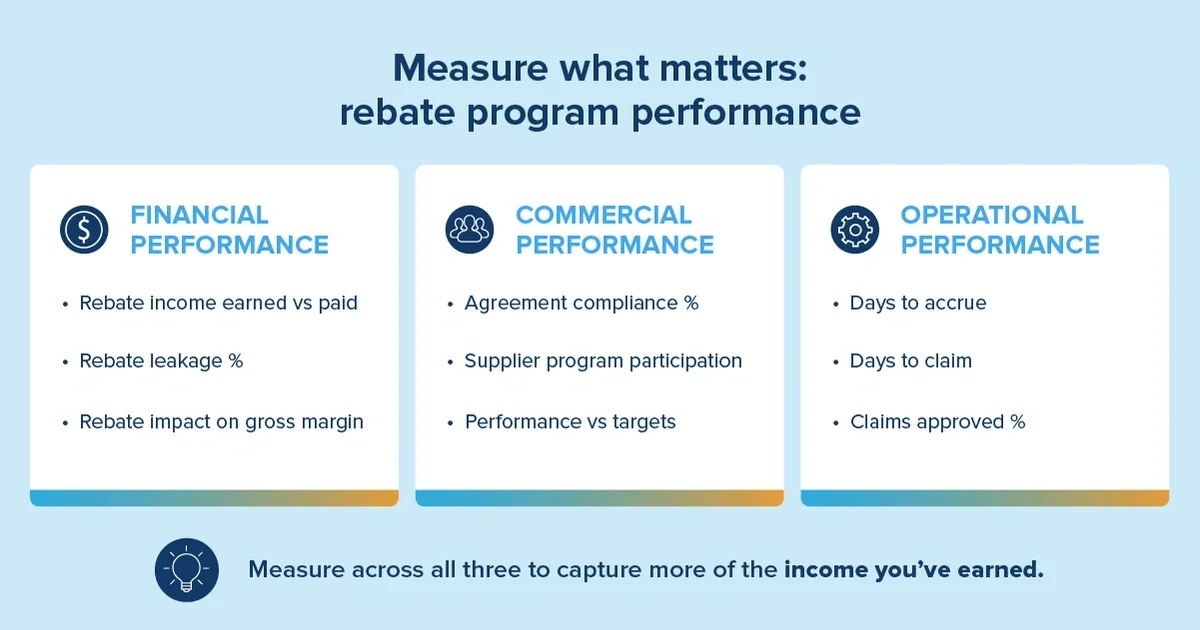
How should distributors measure rebate-program performance?
A mature rebate management strategy should measure more than the amount of money received. It should also measure how much was earned, how much was collected, and where money is being left on the table.
Distributors should consider the entire rebate lifecycle, not just the dollar amount received.
Leakage and recovery
Measure whether the company is identifying and recovering earned income
- Missed claims identified
- Unclaimed income
- Underpayments
- Recovered income
The objective is to move beyond “How much did we receive?” to a more valuable question: “How much did we earn, how much did we collect, and where are we leaving money on the table?”
Financial performance
Track how much rebate income the company earns, accrues, and collects.
- Total earned income
- Accrued vs paid income
- Expected vs actual income
- Income by supplier/product/program
Commercial performance
Identify whether rebate programs support growth and profitability.
- Progress toward supplier thresholds
- Growth vs prior periods
- Rebate income generated by product category
- Impact on gross margin
Operational performance
Determine how efficiently the company manages the rebate process from claim through resolution.
- Time required to process claims
- Number of exceptions
- Number of disputed claims
- Time to resolve discrepancies
The future of wholesale distribution rebate management
Wholesale distributors manage increasingly complex supplier relationships, product portfolios, and transactional data. At the same time, margin pressure prioritizes every source of earned income, making rebate management a strategic component of revenue management.
The most effective companies will move away from treating supplier rebates as a back-office process and toward managing them as an ongoing commercial capability that connects supplier agreements, purchasing, sales, pricing, cost, margin, and finance. Three capabilities make that shift possible:
- Automation reduces manual work
- Analytics improves visibility
- AI helps teams identify patterns, forecast earnings, and prioritize exceptions
But technology only amplifies what’s working; it doesn’t replace it. The foundation remains the same:
- Clean data
- Accurate agreement management
- Clear ownership
- Disciplined processes
Distributors who get this right will combine technology with disciplined fundamentals without treating technology as a replacement.
This is where Vistex fits into the equation, connecting distributor rebate management to the systems that make it actionable, and unifying supplier agreements, purchasing, pricing, and finance in one platform so earned income doesn’t get lost between teams.
When those pieces align, distributors can capture the supplier income they’ve earned, reduce rebate leakage, and make more informed decisions about pricing and profitability.
Explore more related resources

Get the latest news, updates, and exclusive insights from Vistex delivered straight to your inbox. Don’t miss out—opt in now and be the first to know!