
Are sales incentives and enablement the reason wholesale distribution margin keeps slipping?
The disconnect between sales incentives and enablement in wholesale distribution doesn’t announce itself. It shows up quietly, in margin erosion that’s hard to trace, in pricing decisions that made sense at the time, and in sales teams making rational choices that consistently work against the company’s profitability goals.
Sales leaders talk about profitable growth. Finance teams talk about margin protection. Executive teams discuss optimizing the product mix, reducing discount leakage, and improving customer profitability. Then they hand sales reps compensation plans that still reward volume first.
The result is predictable. A rep facing a competitive deal cuts the price to secure the order. A distributor prioritizes a familiar product line over a more profitable alternative. A quarter-end push focuses on revenue attainment rather than contribution margin.
These decisions are the behaviors the organization has made easiest to execute.
The uncomfortable reality is that many distributors face a sales-incentive problem masquerading as a pricing problem. Until those two functions are aligned, distributors will continue asking sales teams to protect margins while rewarding them to do the opposite.
Why does the profitability conversation start after the damage is done?
Many organizations attempt to manage margins after the sale is already underway.
Finance reviews results after the month closes. Sales analyze attainment reports after the quarter ends. Leadership evaluates profitability trends after performance has already been recorded.
By that point, the decision has already been made.
The moment margin is won or lost
In distribution, profitability is often determined long before an order reaches the ERP system. It happens when a sales rep chooses one product over another, when discounting comes into play, or when a customer requests a concession, and the rep decides whether to protect price or trade margin for certainty.
These moments occur hundreds or thousands of times every day across the organization. Yet many sales teams still lack visibility into the financial consequences of those decisions while they are being made.
That creates a disconnect between commercial strategy and frontline execution. Sales teams can’t consistently optimize for outcomes they can’t see.
How sales incentives drive profitable selling behavior
This is where sales enablement comes into play.
Too often, enablement and incentives are treated as separate initiatives. One team owns compensation. Another owns pricing. A third owns sales tools. Each function works independently, expecting the sales organization to connect the dots.
Why behavior change requires more than compensation
A sales compensation strategy can establish priorities, but it can’t create capability. If a distributor wants sales teams to protect margin, they need more than a commission structure tied to profitability. Sales reps need visibility into pricing guidance, deal profitability, target margins, and the financial impact of discounting before a quote is finalized. The plan sets the destination; enablement determines whether reps can actually get there.
Without that visibility, compensation becomes retrospective. The sales rep learns whether a decision was profitable weeks after it was made. By then, the opportunity to influence behavior has disappeared.
Distributors who see the strongest results understand a simple principle: Incentives tell people what matters, and sales enablement helps them act on it. When those two functions operate together, sales performance becomes far more predictable.
What is the hidden cost of volume-first incentive structures?
Volume-first incentive structures made sense when growth was the only game in town. That era is over. Revenue targets increased. Commission accelerators rewarded attainment. New business acquisition received the majority of management attention.
When volume wins and margin loses
Today, distributors face margin pressure from nearly every direction:
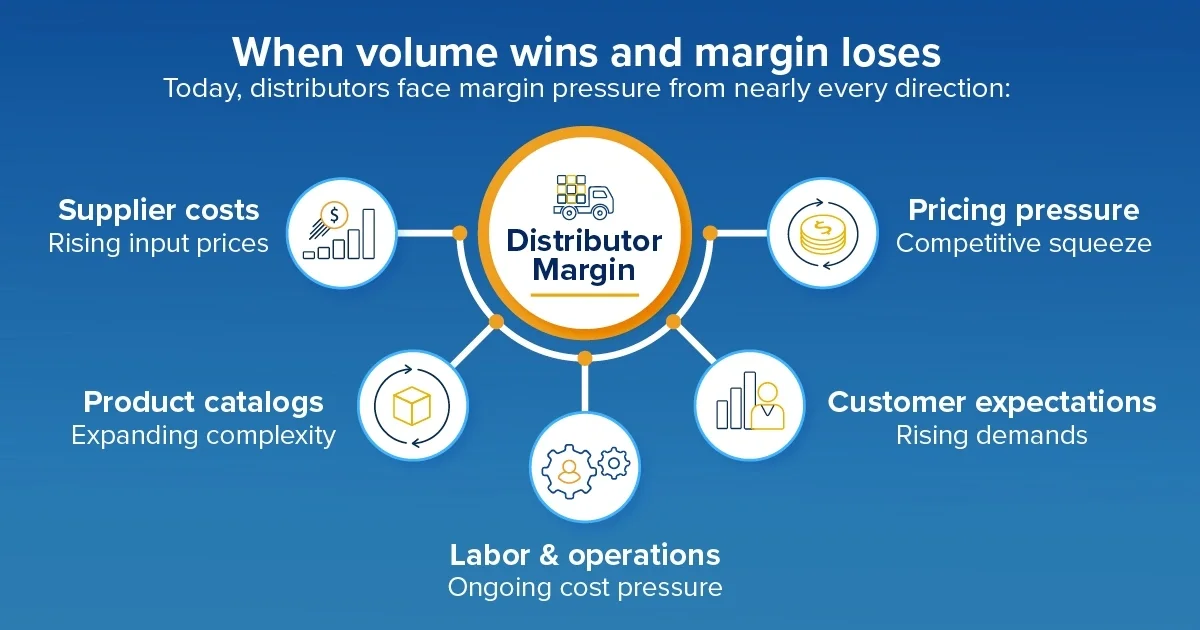
In this environment, every percentage point of margin matters, yet many distributors continue rewarding behaviors that encourage discounting while simultaneously asking sales teams to improve profitability. That contradiction creates confusion.
If sales reps earn more from closing a discounted deal than from protecting margin, the incentive system is functioning exactly as designed. The issue isn’t sales execution; it’s incentive architecture.
How the margin-to-commission bridge changes sales behavior in wholesale distribution
One concept that is gaining traction among leading distributors is the margin-to-commission bridge. The idea is straightforward. Every sales rep should be able to answer a simple question before submitting a quote: What happens to my commission if I lower the price?
Visibility changes behavior
Surprisingly few organizations give sales reps visibility into how their pricing decisions affect their own compensation. Instead, sales reps often operate with incomplete information. They understand revenue impact but not profitability impact. They know the customer value of a discount but not the personal earnings consequence.
When that happens, discounting becomes easier than defending the price.
Leading distributors are addressing this by showing reps the financial consequences of pricing decisions in real time. When a sales rep can immediately see how a 1% or 2% pricing concession affects both deal profitability and personal compensation, decision-making shifts.
Early results from one regional distributor’s pilot bear this out: after moving to transparent, automated commission statements with deal-level margin visibility, the company saw faster inventory reduction on targeted SKUs, greater penetration for promoted product lines, and a significant drop in payout disputes, all attributed to reps having better information before the deal closed.
The conversation shifts from volume at any cost to profitable growth. And the rep remains in control of the decision. They simply have better information.
Why spreadsheets are becoming a commercial risk
None of the visibility described above is possible when incentive management for distributors is still running on spreadsheets. It’s not just an efficiency problem; it’s a trust problem. When sales reps can’t verify their own commission statements, the incentive program stops functioning as a motivational tool and becomes a source of friction.
The trust gap nobody talks about
In organizations that rely on manual compensation processes, sales reps often struggle to understand how commissions are calculated.
Finance teams spend significant time reconciling data. Managers answer recurring payout questions. Sales operations teams become trapped in administrative work rather than performance optimization.
Over time, trust begins to erode. When sales teams can’t easily verify compensation, they stop viewing incentive programs as motivational tools and start viewing them as administrative mysteries. That shift has consequences: the organization loses one of its most powerful mechanisms for influencing behavior.
Transparency isn’t just an operational improvement; it’s a competitive advantage. Automating the calculation, tracking, and communication of commission statements gives sales reps the clarity they need to stay focused on the right behaviors and gives sales management the real-time analytics to see where incentive programs are driving results, and where they aren’t.
How profitability visibility improves wholesale margin protection
For years, incentive management for distributors was primarily focused on calculating payouts accurately. Today, distributors are asking a different question: How can incentive programs influence behavior before a deal is closed?
That shift is driving investments in real-time visibility, scenario modeling, and integrated decision support. The objective is no longer simply paying people correctly; it's helping people make better decisions before the sale is complete. That requires infrastructure and a willingness to treat incentive design as a commercial capability rather than a back-office function.
What separates margin leaders from everyone else
The distributors creating the strongest profitability outcomes have recognized that incentives are only effective when they influence decisions in the moment. That realization is driving three common investments:
- Aligning incentive programs with measurable business outcomes.
- Giving sales teams visibility into the profitability consequences of their decisions.
- Automating the operational processes necessary to build trust at scale.
Those capabilities reinforce one another.
When incentives, pricing strategy, and sales enablement operate from the same source of truth, distributors gain something increasingly difficult to achieve: consistency.
- Consistency in how incentives are calculated and communicated.
- Consistency in pricing decisions across the sales organization.
- Consistency in margin protection across territories, products, and accounts.
The result is more predictable profitability.

How sales incentives and enablement in wholesale distribution drive profitable selling behavior
Most distributors already know what outcomes they want: stronger margins, healthier product mix, improved retention, and profitable growth. The real question is whether their sales organization is equipped and incentivized to deliver those outcomes every day.
If incentives reward one behavior while leadership expects another, friction is inevitable.
But when sales compensation strategy, enablement, and profitability goals work together, margin protection in distribution stops being a finance initiative and becomes a sales performance outcome.
Vistex enterprise software provides the operational foundation for exactly this kind of alignment — connecting incentive management, pricing, and sales compensation into a single source of truth that makes profitable selling the default, not the exception.
The distributors who win on margin won’t be the ones with the best intentions; they’ll be the ones who treat sales incentives and enablement as a unified strategy, and build the infrastructure to make profitable selling the easiest choice.
Explore more related resources
Get the latest news, updates, and exclusive insights from Vistex delivered straight to your inbox. Don’t miss out—opt in now and be the first to know!