
Price waterfall analysis separates revenue earned from revenue kept
For many wholesale distributors, the price on a quote or invoice is only the beginning of the story. Between the quoted price and the actual profit earned on a transaction lies a series of discounts, rebates, freight costs, payment incentives, and commercial adjustments that quietly erode margin. These are the exact concessions a price waterfall analysis is built to trace. While each adjustment may seem reasonable on its own, its cumulative impact can significantly reduce profitability, often without anyone realizing it.
Rather than simply showing what you sold something for, a price waterfall reveals how you arrived at the final realized price and identifies every financial concession made along the way. It provides you with the visibility needed to understand where revenue is leaking, why margins differ between customers, and where opportunities exist to improve profitability.
In an environment of supplier cost volatility, tariffs, inflation, and increasingly complex customer agreements, understanding your price waterfall is more than a finance exercise; it’s a strategic business capability.
What is a price waterfall?
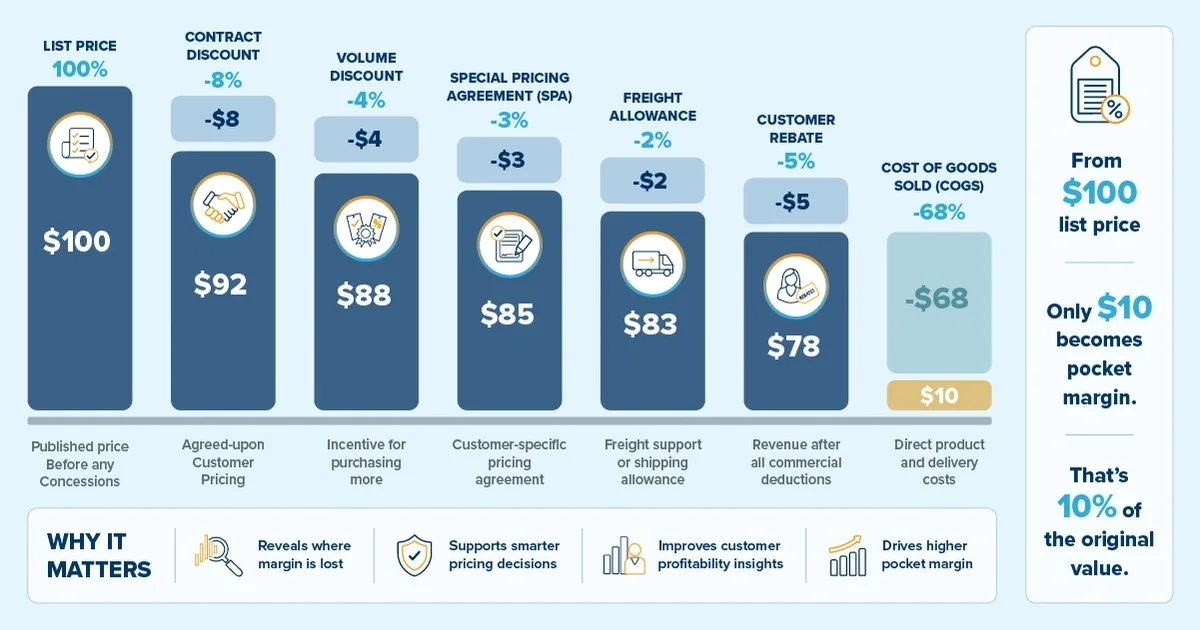
Think of a waterfall as the financial journey from list price to pocket margin. At each step, value “falls away” through commercial programs and operational costs until you arrive at the true profitability of a sale.
A typical wholesale distribution waterfall might look like this:
Why every distributor should understand their price waterfall
Many distributors evaluate success using:
- Gross margin
- Sales revenue
- Sales growth
While important, these metrics rarely tell the complete profitability story. Price waterfall analysis answers questions such as:
- Which discounts actually drive customer value?
- Which rebates generate incremental revenue?
- Which customers receive the largest pricing concessions?
- Which products consistently require excessive discounting?
- Which sales teams rely on price reductions to win business?
- Which supplier programs are truly profitable?
Without this knowledge, distributors often assume they have a pricing problem when they actually have a commercial process problem.
Revenue earned vs. revenue kept
Revenue earned is what appears on the invoice. Revenue kept is what’s left after every commercial concession and operational cost has been accounted for.
What are the stages of a price waterfall?
While every distributor structures pricing differently, most price waterfalls follow a similar progression:
List price
The list price represents the published or standard selling price before any customer-specific pricing or commercial agreements are applied. It establishes the baseline for measuring every subsequent concession.
Invoice price
After negotiated pricing, contract terms, and point-of-sale discounts are applied, the invoice price represents what the customer is billed. Many distributors stop their analysis here. Unfortunately, this is rarely where profitability ends.
Off-invoice deductions
Additional reductions often occur after the invoice is issued, including:
- Customer rebates
- Special pricing agreements (SPAs)
- Chargebacks
- Freight allowances
- Early payment discounts
- Warranty claims
- Promotional funding
- Marketing development funds (MDFs)
These programs are a common source of hidden margin erosion because they're managed across multiple departments and systems.
Net price vs. pocket price
These terms are frequently confused. Net price reflects the selling price after contractual and invoice-related discounts.
Pocket price is the amount remaining after all commercial deductions have been applied. It’s the closest representation of the revenue your organization actually keeps.
Pocket margin
Pocket margin takes the analysis one step further by subtracting the total cost of goods sold from the pocket price. This is the number that truly reflects profitability.
For many companies, pocket margin tells a very different story than gross margin.
Consider an example: a healthy 30% gross margin can shrink to a 12% realized margin once every
commercial cost is accounted for. The walkthrough below shows exactly how.
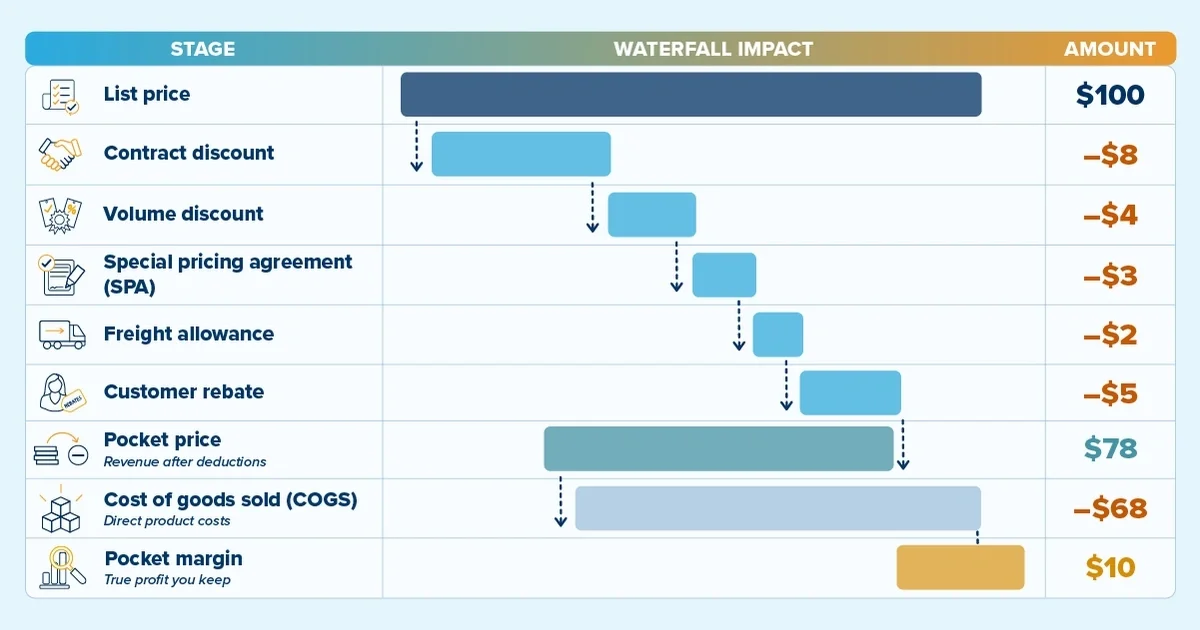
At first glance, the transaction appeared healthy. However, once every commercial adjustment was considered, only $10 remained as realized profit.
Multiply this across thousands of transactions, and even small pricing concessions become significant.
Why price waterfalls matter more than ever
Today’s distributors operate in an environment where costs and market conditions can change rapidly, making it a challenge to navigate the following:
- Supplier cost increases
- Tariffs and trade policy changes
- Commodity price fluctuations
- Transportation and freight volatility
- Inflationary pressures
- Customer demands for competitive pricing
Without visibility into the full pricing journey, it’s difficult to answer a critical question: Are cost increases actually making their way to the bottom line?
Price waterfall analysis provides that visibility, helping distributors determine whether pricing strategies are protecting margins or simply absorbing higher costs.
Where margin leakage hides in wholesale pricing
Margin rarely disappears due to a single major pricing mistake. Instead, it leaks away through dozens of small decisions made every day.
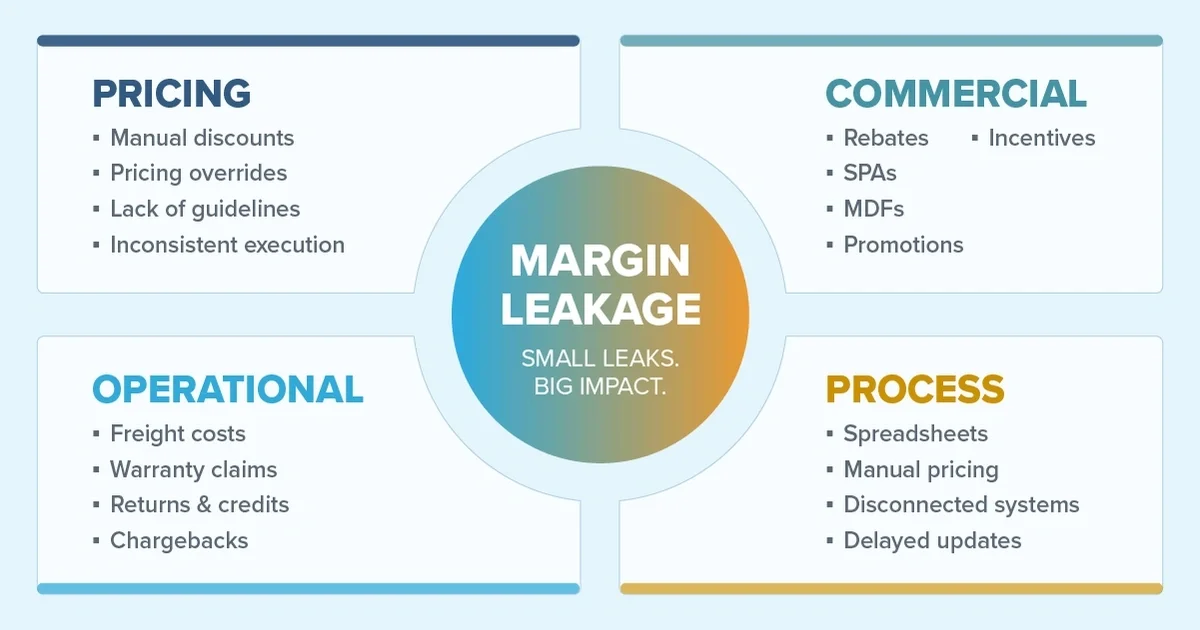
Common leakages include:
Pricing leakage
Leakage often starts at the point of sale, before a deal even reaches the books.
- Uncontrolled field discounts
- Manual price overrides
- Outdated pricing agreements
- Inconsistent pricing governance
Commercial leakage
Programs designed to win business can just as easily give margin away.
- Customer rebates
- Special pricing agreements
- Promotional allowances
- Marketing funds
Operational leakage
Costs incurred after the sale are rarely traced back to the transaction that generated them.
- Freight concessions
- Warranty claims
- Returns and credits
- Unrecovered supplier programs
Process leakage
The systems and habits behind pricing can leak as much margin as pricing decisions themselves.
- Manual pricing processes
- Disconnected systems
- Delayed cost updates
- Spreadsheet-driven pricing
A rep who overrides list price by 3% to close a deal, a rebate that auto-renews past its intended term, a freight concession no one revisits after the lane changes: none of these looks like a problem in isolation. Individually, each concession may seem reasonable. Collectively, they can erode profit by an order of magnitude: the same $2-$8 leakages shown above, repeated across every transaction, every day.
Why margin leakage stays hidden
Many distributors manage pricing across multiple disconnected systems. Pricing may live in ERP. Customer agreements may reside in CRM. Rebates may be tracked separately. Finance maintains deductions. Sales manages quotes elsewhere.
When commercial data is fragmented, companies naturally focus on metrics like list price or invoice price because they are the easiest to measure. Unfortunately, those numbers rarely reflect true profitability. A price waterfall brings these disconnected data points together to create a complete picture of price realization.
How to build a price waterfall analysis
Building an effective price waterfall doesn’t require starting with every transaction in your business. Begin with a focused scope and expand as your process matures.
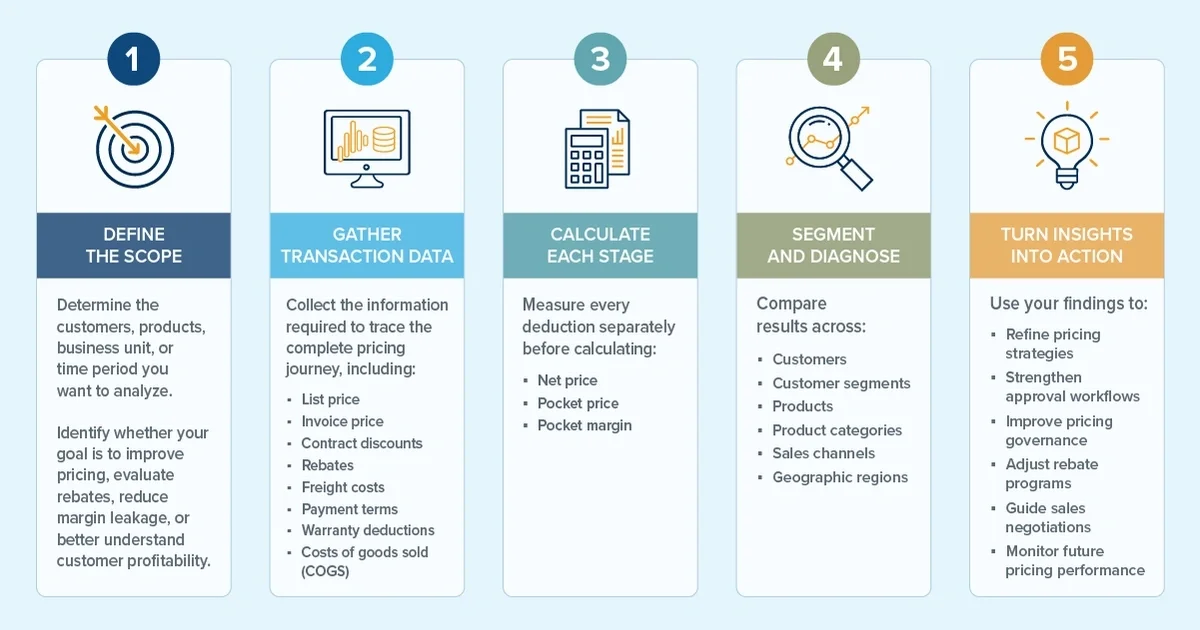
Step 1: Define the scope
Determine the customers, products, business unit, or time period you want to analyze. Identify whether your goal is to improve pricing, evaluate rebates, reduce margin leakage, or better understand customer profitability.
Step 2: Gather transaction data
Collect the information required to trace the complete pricing journey, including:
- List prices
- Invoice prices
- Contract discounts
- Rebates
- Freight costs
- Payment terms
- Warranty deductions
- Cost of goods sold
Validate the quality of this data before you begin.
Step 3: Calculate each stage
Measure every deduction separately before calculating:
- Net price
- Pocket price
- Pocket margin
Understanding each component individually makes it easier to identify where profit disappears.
Step 4: Segment and diagnose
Compare results across:
- Customers
- Customer segments
- Products
- Product categories
- Sales channels
- Geographic regions
Comparing results across these dimensions often reveals patterns and trends that aren't visible when analyzing each area in isolation.
Step 5: Turn insights into action
The value of a price waterfall lies in the decisions it enables or the behaviors it drives. Use your findings to:
- Refine pricing strategies
- Strengthen approval workflows
- Improve pricing governance
- Adjust rebate programs
- Guide sales negotiations
- Monitor future pricing performance
Common mistakes wholesale distributors make with price waterfall analysis
Even organizations that build a price waterfall often miss opportunities for improvement. There are several common mistakes.
Relying on cost-plus pricing alone
Cost-plus pricing ignores customer willingness to pay, competitive positioning, and hidden pricing concessions.
Ignoring off-invoice deductions
Rebates, freight, warranty claims, and promotional funding frequently represent the largest sources of margin leakage.
Failing to connect systems
Disconnected ERP, CRM, pricing, rebate, and finance systems prevent organizations from seeing the complete pricing picture.
Reviewing results too late
Quarterly reviews often identify problems months after they occur. Leading distributors continuously monitor pricing performance and intervene before margin erosion becomes systemic.
How Vistex turns insights into profitable growth
Every discount tells a story; every rebate serves a purpose; and every freight allowance reflects a business decision.
When distributors understand how each of these factors influences realized margin, pricing becomes a competitive advantage. The companies that consistently outperform their peers aren’t simply charging higher prices; they’re making informed decisions about every concession, agreement, and commercial investment.
Profitable growth isn’t measured by your top-line revenue alone; it’s measured by how much of that revenue you keep.
A mature price waterfall practice transforms pricing from a reactive function into a strategic growth engine, helping distributors improve pricing discipline, respond to market volatility with confidence, and connect daily commercial decisions to long-term profitability.
None of this happens through better instincts; it happens through better visibility. The distributors who move fastest aren't rebuilding their price waterfall in a spreadsheet every quarter; they've built it into the systems they already use to manage pricing, rebates, and deductions, so the full picture, from list price to pocket margin, is there in real time, not reconstructed after the fact.
That's the foundation Vistex helps distributors put in place: pricing, rebates, and deductions, all connected in one continuous view rather than stitched together after the quarter closes. That foundation is what turns a one-time waterfall exercise into an ongoing discipline, and margin from something you explain into something you manage.
How do you get started with price waterfall analysis?
Take a fresh look at your pricing process through the lens of a price waterfall analysis. By uncovering hidden margin leakage and understanding the full journey from list price to pocket margin, you can identify the fastest opportunities to improve profitability.
In today’s competitive wholesale distribution market, the question is whether you know where your pricing concessions are, and whether they’re delivering the value you expect
Explore more related resources


Get the latest news, updates, and exclusive insights from Vistex delivered straight to your inbox. Don’t miss out—opt in now and be the first to know!