Why Traditional Account Reviews Miss The Full Retailer Profitability Story
Many consumer products manufacturers approach retailer performance reviews with the same question: “How much did we sell?”
The problem is that shipment volume alone fails to tell the full story.
A retailer that generates significant sales may also require heavy promotional investments, produce excessive deductions, create forecasting volatility, or generate hidden margin erosion that ultimately reduces profitability. Meanwhile, a smaller account may consistently deliver stronger margins, better promotion execution, faster deduction resolution, and more predictable growth.
As planning for the next fiscal year begins, leading manufacturers are shifting from volume-based account evaluations to comprehensive retailer performance management frameworks that measure contribution, profitability, operational efficiency, and long-term growth potential.
The result is a more complete understanding of which retail relationships deserve additional investment and which require corrective action.
How Do Manufacturers Measure Retailer Profitability?
Retailer profitability is the measurement of the net financial value a retailer generates after accounting for trade spend, promotional investments, deductions, servicing costs, and other expenses required to support the account. Unlike revenue alone, retailer profitability reveals whether a retail relationship contributes meaningful margin and long-term business value.
It’s easy to see how the retail landscape continues to grow more complex. Manufacturers face:
- Rising promotional costs
- Margin pressure from inflation and pricing competition
- Growing retailer demands for funding and incentives
- Increased complexity in trade deductions
- Greater pressure to prove trade promotion ROI
- More volatile consumer purchasing behavior
Revenue growth is no longer enough. Sales leaders need to understand whether growth is profitable. Finance teams need confidence that trade investments are generating returns. Trade teams need visibility into whether promotional spending is being executed and reconciled correctly.
A retailer scorecard creates a common framework that aligns these objectives across the organization.
What Makes A Retail Customer Valuable?
The most valuable retail customers are not necessarily the largest. Instead, they create mutually beneficial growth while helping consumer products manufacturers improve revenue quality and operational efficiency.
Characteristics Of High-Performing Retail Customers
High-performing retailers create an environment where manufacturers can grow revenue while maintaining healthy margins. They view suppliers as strategic partners and are willing to collaborate on planning, promotions, category growth, and inventory management.
These retailers typically demonstrate:
- Consistent sales growth
- Healthy gross and net margins
- Strong promotion compliance
- Predictable demand patterns
- Fast deduction resolution
- High forecast accuracy
- Efficient inventory management
- Collaborative planning processes
- Category growth leadership
- Limited trade spend leakage
Any combination of these characteristics have a cumulative impact on profitability. A retailer that executes promotions as planned, shares reliable demand data, and resolves deductions quickly enables manufacturers to forecast more accurately, manage inventory more efficiently, and improve cash flow. Over time, these operational advantages create higher margins and lower cost-to-serve compared to accounts that require constant intervention.
As a result of this shared investment and accountability, both retailers and manufacturers experience stronger business outcomes.
Characteristics of Underperforming Retail Accounts
Conversely, some retail relationships consume disproportionate manufacturer resources while generating limited value.
Underperforming retailers may demonstrate:
- Excessive trade funding requirements
- Frequent unauthorized deductions
- Low promotion execution rates
- Persistent forecast inaccuracies
- Margin erosion
- Slow claim resolution
- Inventory instability
- High return volumes
- Poor category growth
Accounts with these traits may appear attractive from a top-line perspective while quietly destroying profitability.
A structured scorecard can reveal these issues for a more thorough profitability analysis.
The Retailer Scorecard Framework That Works
A retailer scorecard should provide a balanced view of financial performance, operational effectiveness, and strategic value. Its purpose is to help manufacturers understand which retail relationships generate sustainable, profitable growth and which may be consuming disproportionate resources. By evaluating retailers through multiple lenses, organizations make better decisions about where to invest trade dollars, allocate sales resources, and prioritize joint business planning efforts.
The most effective scorecards combine financial, operational, and strategic retail account performance indicators into a single framework. This dimensional tool allows leaders from cross-functional finance, sales, trade, and channel teams work from the same set of metrics and develop a shared understanding of account health. It also helps organizations move beyond retrospective reporting and identifying emerging opportunities or risks before they affect business performance.
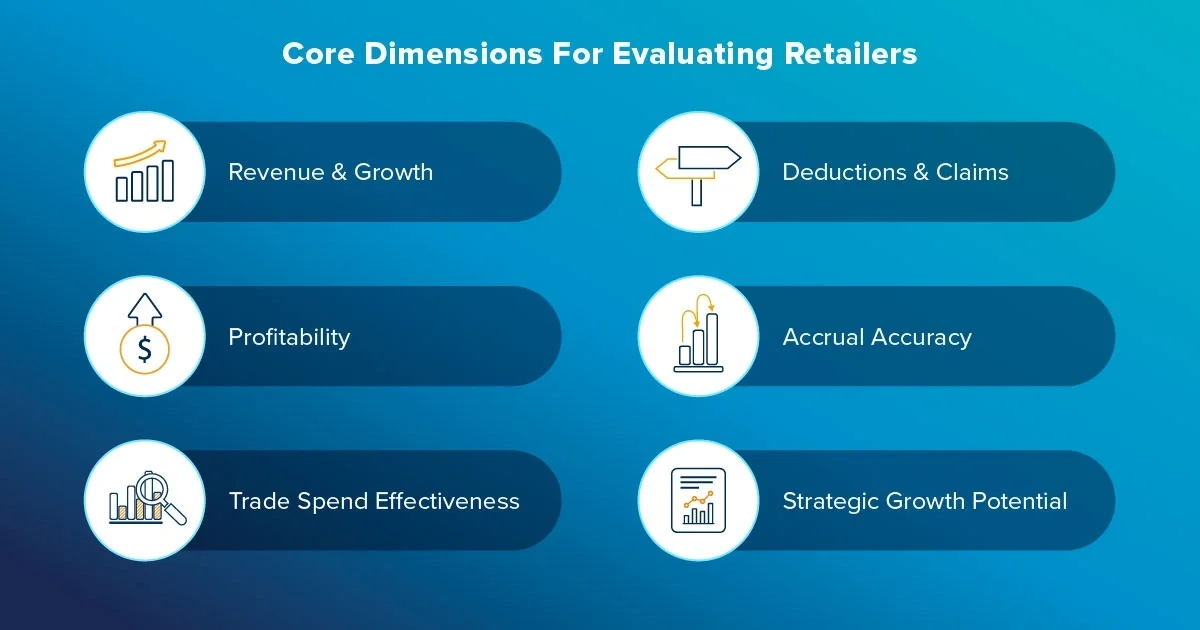
Exact KPIs may vary by company, however manufacturers should evaluate retail accounts across six core dimensions.
Revenue And Growth Metrics
Revenue remains an important measure of retailer performance, but it should be viewed as a starting point rather than a final verdict. Growth metrics help identify which accounts are expanding their businesses with manufacturer brands and contributing to broader commercial objectives. Measure:
- Net sales
- Year-over-year growth
- Category share growth
- Market share gains
- New product performance
These metrics help answer questions such as: Which retailers drive incremental growth? Where are new products gaining traction? Which accounts are helping expand category presence? Understanding growth trends provides important context, but the most successful manufacturers evaluate growth alongside profitability and investment requirements.
Profitability Metrics
Revenue can contribute unequally to the bottom line. A retailer generating significant sales may require extensive promotional support incur high servicing costs or create margin pressure that reduces overall profitability. Measure:
- Gross margin
- Net margin
- Contribution margin
- Cost-to-serve
- Revenue after trade spend
- Revenue after deductions
These account profitability metrics reveal the true economic value of each retail relationship. They help organizations identify which accounts generate profitable growth and which may require changes in pricing, trade strategy, or service models. For many manufacturers, profitability analysis uncovers significant differences between retailers that appear similarly successful when viewed only through a sales lens.
Trade Spend Effectiveness
Trade investments often represent one of the largest controllable expenses for consumer products manufacturers. Yet many organizations struggle to determine whether those investments are producing the expected returns. Measure:
- Trade spend as a percentage of sales
- Promotional ROI
- Incremental sales generated
- Lift versus baseline sales
- Trade budget utilization
- Promotional compliance rates
Evaluating trade effectiveness helps manufacturers understand where promotional dollars are generating value and where spending may be underperforming It also provides insight into which retailers consistently execute promotions as planned and which accounts may require greater oversight or support.
Deduction And Claims Performance
Deductions are often viewed as an operational issue. But they can have a significant impact on retailer profitability and cash flow. Persistent deduction challenges may indicate process breakdowns, compliance issues, or recurring disputes that increase the cost of doing business. Measure:
- Open deductions
- Aging deductions
- Deduction recovery rates
- Invalid deduction frequency
- Resolution cycle times
These metrics help manufacturers identify retailers that create excessive administrative burden or contribute to revenue leakage. They also provide a clearer picture of the resources required to support each account and the impact those activities have on overall profitability.
Accrual Accuracy
Accurate accrual management is essential for reliable financial planning and performance reporting. When trade accruals differ significantly from actual spending, organizations may struggle with budgeting, forecasting, and financial close processes. Measure:
- Accrual-to-actual variance
- Accrual aging
- Forecasted versus actual spend
- Reconciliation cycle times
Monitoring these metrics helps finance teams improve forecast accuracy, reduce surprises, and maintain greater confidence in retailer-level profitability calculations. It also supports more informed planning decisions by ensuring that expected trade obligations are accurately reflected in financial results.
Strategic Growth indicators
Some retailers may not be the most profitable today but possess characteristics that make them strategically important for future growth. A comprehensive scorecard should account for these longer-term opportunities. Measure:
- Category leadership
- Assortment expansion opportunities
- Omnichannel performance
- Retail media effectiveness
- Joint business planning participation
These indicators help manufacturers evaluate a retailer’s future potential and willingness to collaborate on growth initiatives. Retailers that actively engage in joint planning, support innovation, and invest in category development often become valuable long-term partners, even if their current financial contribution is still developing.
When viewed together, these six dimensions provide a balanced and actionable picture of retailer performance. Rather than relying on isolated metrics, manufacturers can evaluate the complete value of each account, identify opportunities for improvement, and make more informed decisions about trade investments, resource allocation, and growth strategies as they build plans for the next fiscal and beyond.
What Top Retailers Want From CPG Manufacturers
Retailer performance is a two-way relationship. Retailers are increasingly evaluating manufacturers using scorecards of their own. Top retailers typically prioritize suppliers that provide:
- Accurate forecasts
- Reliable fulfillment
- Category insights
- Effective promotional planning
- Fast issue resolution
- Data-driven recommendations
- Competitive product innovation
Manufacturers that help retailers improve category performance often receive greater support, stronger placement opportunities, and more collaborative planning relationships.
Common Retailer Performance Management Mistakes
While most CP manufacturers recognize the importance of measuring retail account performance, many still struggle to translate data into better decisions. This challenge is rarely a lack of information, but rather incomplete metrics, disconnected systems, or outdated evaluation processes that make it difficult to understand the true value of each retail relationship. Avoid these pitfalls:
Focusing exclusively on revenue: Revenue without profitability can create misleading conclusions. Manufacturers should always evaluate retailer contribution after trade spend, deductions, and servicing costs are considered.
Reviewing accounts too infrequently: Quarterly scorecard reviews help teams identify issues before they impact financial performance. Annual reviews often miss emerging problems.
Managing data in multiple systems: Fragmented data frequently leads to inconsistent decisions. If trade, sales, finance, deduction, and promotions are managed separately, teams struggle to develop a unified view of retailer performance.
Ignoring deduction trends: Deduction leakage can significantly reduce realized profitability.
How AI Is Transforming Retailer Performance Management
AI and machine learning help manufacturers move from reactive reporting to proactive decision-making.
AI-powered analytics can:
- Identify profitability risks earlier
- Predict deduction patterns
- Forecast trade spend overruns
- Detect promotion underperformance
- Recommend budget reallocations
- Surface growth opportunities
- Improve trade forecast accuracy
- Highlight retailer behaviors associated with future performance changes
As planning cycles become more dynamic, these capabilities become increasingly important.
Turning Retailer Data Into Actionable Insights With Vistex
One of the biggest obstacles to retailer performance management is fragmented data and information.
Sales teams often use one set of reports. Finance uses another. Trade promotion teams rely on separate systems. Deduction data may reside elsewhere entirely.
This fragmentation makes it difficult to understand the true profitability and performance of individual retail accounts.
Vistex helps manufacturers overcome these challenges by integrating trade spend management, pricing, deductions, accruals, and performance reporting into a unified platform.
With Vistex, organizations can:
- Analyze retailer profitability across multiple dimensions
- Track trade promotion effectiveness
- Monitor deduction trends and recovery performance
- Improve accrual accuracy and reconciliation processes
- Align finance, sales, and trade teams around shared metrics
- Gain real-time visibility into revenue and margin performance
- Support revenue growth management initiatives with integrated analytics
By connecting data across commercial processes, manufacturers using Vistex AI-driven revenue management solutions gain a more complete picture of retailer performance and can make more informed investment decisions.
How To Build Smarter Retail Partnerships Next Year
Successful manufacturers stop asking which retailers generated the most revenue and start asking which generated the most value.
A comprehensive retailer scorecard helps organizations evaluate profitability, promotion effectiveness, deduction performance, operational efficiency, and growth potential in a single framework.
Providing consumer products manufacturers with integrated performance management, advanced analytics, and AI-driven insights, Vistex moves them beyond retrospective reporting to a position of strength where smarter decisions can be made about where to invest future resources.
The result is stronger retailer relationships, more effective trade spending, improved profitability and a clearer path to sustainable growth.
FAQ About How Manufacturers Calculate Retailer Profitability
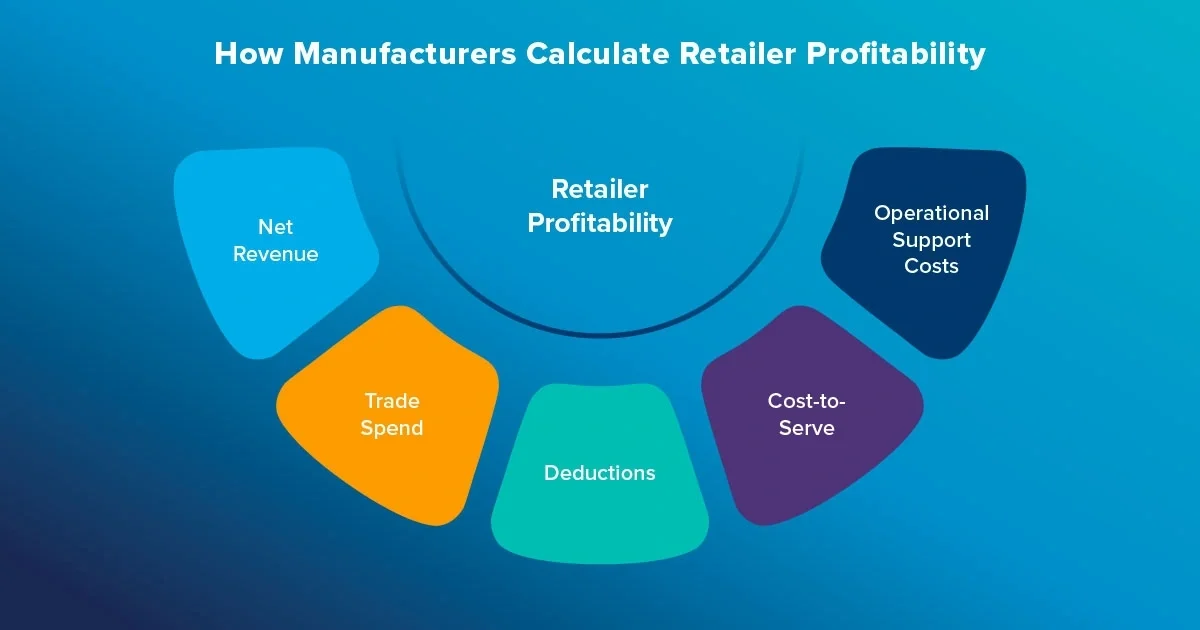
Retailer profitability is calculated by subtracting trade spend, deductions, cost-to-serve, and operational support costs from net revenue. Some helpful definitions include:
Net Revenue: The actual income manufacturers keep from selling their products after subtracting returns, allowances, and discounts from gross sales. It’s a top-line figure on the income statements and reflects the funds available to the company to use on costs, growth investments, and to generate profit.
Trade Spend: The money manufacturers invest directly into retail distribution channels to sell their products. It’s a strategic investment aimed at driving sales, securing shelf space in retailers, and building long-term retailer relationships.
Deductions: Reductions in the payment a retailer or distributer owes to a manufacturer, typically applied to invoices or checks. It’s essential they are managed well to avoid negative impact on cash flow.
Cost-to-Serve: The total, end-to-end cost of delivering a product to a specific customer, channel, or region, from order capture to final delivery and after-sales support. Includes production, logistics, service, and operational expenses tied to filling demand.
Support Costs: The indirect expenses necessary to keep production running smoothly, whether they are directly tied to a specific unit of output. These are part of factory overhead and include maintenance, quality assurance, etc.
Explore more related resources


How to Build an Effective Joint Business Planning Process Driving Alignment and Trade Promotion ROI