
How Fashion Brands Can Use AI for Competitor Price Monitoring
Price is one of the top drivers of purchase for online shoppers, and fashion is uniquely sensitive to price signals due to seasonal collections, size/color variants, and frequent promotions. Pricing has become significantly harder for fashion retailers in the last few years because market reactions are now faster than internal decision cycles. Inflation, supply chain volatility, and constant promotions have compressed margins and forced brands to adjust prices far more frequently than before.

What is competitor price monitoring in fashion?
Competitive price monitoring is the process of tracking competitor pricing, promotions, product availability, and assortment changes across eCommerce sites, marketplaces, and retail channels. Fashion brands use competitor price monitoring to understand market positioning, respond to pricing changes, protect margins, and maintain competitiveness in a rapidly changing retail environment.
Traditionally, retailers relied on manual checks, spreadsheets, or periodic market reviews to understand competitor pricing. Today, AI-powered monitoring solutions use AI to automate data collection and analysis, allowing brands to watch for pricing shifts of thousands of products across multiple channels in near real time. This gives pricing teams the visibility needed to make faster, more informed decisions while maintaining brand integrity and profitability.
What is competitive pricing intelligence in fashion?
Competitive pricing intelligence is the process of collecting, analyzing, and acting on competitor pricing, promotional activity, assortment changes, and market trends. In fashion retail, it helps brands make informed pricing decisions that balance competitiveness, margin protection, and brand positioning.
Unlike basic price monitoring, competitive pricing intelligence provides context around market conditions and consumer behavior. It helps fashion companies understand not only what competitors are charging, but also why pricing is changing and how those changes may impact demand, profitability, and market share.
Why is AI competitor price monitoring important for fashion brands?
Manual price monitoring is slow and error-prone; AI enables competitor price monitoring to become automated, accurate, and scalable, so you can:
- Protect margins by reacting to competitor promotions and marketplace dynamics in near real-time.
- Maintain brand positioning across channels (direct, marketplaces, wholesale).
- Optimize conversion by aligning price with demand, inventory and promotional calendars.
- Detect anomalies and counterfeit or unauthorized sellers that erode price integrity.

How do fashion brands monitor competitor pricing?
Modern fashion brands monitor competitors' pricing through a combination of AI-powered data collection, product-matching technology, pricing analytics, and market intelligence platforms. These systems continuously track competitor websites, marketplaces, promotional activity, inventory changes, and assortment shifts to provide a comprehensive view of market conditions.
Rather than manually reviewing competitor sites, pricing teams can use automated tools to detect changes in real time, enabling them to respond more quickly while maintaining pricing strategies that support profitability and brand goals.
Why is product matching so important for competitor price management?
The biggest challenge in competitor price monitoring is not collecting pricing data—it’s ensuring that products are matched correctly. Fashion retailers frequently sell similar products with different descriptions, imagery, color variations, size structures, and merchandising approaches.
Without accurate product matching, brands risk comparing products that are not alike and making pricing decisions based on misleading information. Effective competitor monitoring relies on sophisticated matching techniques that combine product attributes, imagery, SKU mapping, and machine learning to ensure accurate comparisons. Better matching leads to better insights, stronger pricing decisions, and more reliable competitive intelligence.
What does artificial intelligence (AI) competitor price monitoring include?
Most companies underestimate how difficult accurate product matching really is and overestimate the value of raw data. They often collect huge volumes of competitor prices, but without accuracy, context, and clear decision rules, that data cannot drive meaningful pricing actions.
The solution is a stack of price monitoring capabilities rather than a single monitoring tool. Key components include:
- Data collection: crawling and APIs that gather prices, promotions, availability, seller identities and contextual metadata across retailer sites, marketplaces, and social commerce.
- Product matching: algorithms (text similarity, SKU mapping, image recognition) that match your SKUs to competitor SKUs despite different titles, variant structures, or imagery.
- Normalization & enrichment: standardizing sizes, currencies, taxes, shipping costs and promotions so comparisons are apples-to-apples.
- Intelligent pricing models: machine learning models for price elasticity, demand forecasting, and dynamic pricing (including reinforcement learning in some advanced setups).
- Alerting & decision automation: rules, guardrails and workflows to trigger alerts, price updates, or manual review.
- Visualization & reporting: dashboards that show share-of-shelf, win-rate, margin impact, and competitive heatmaps.
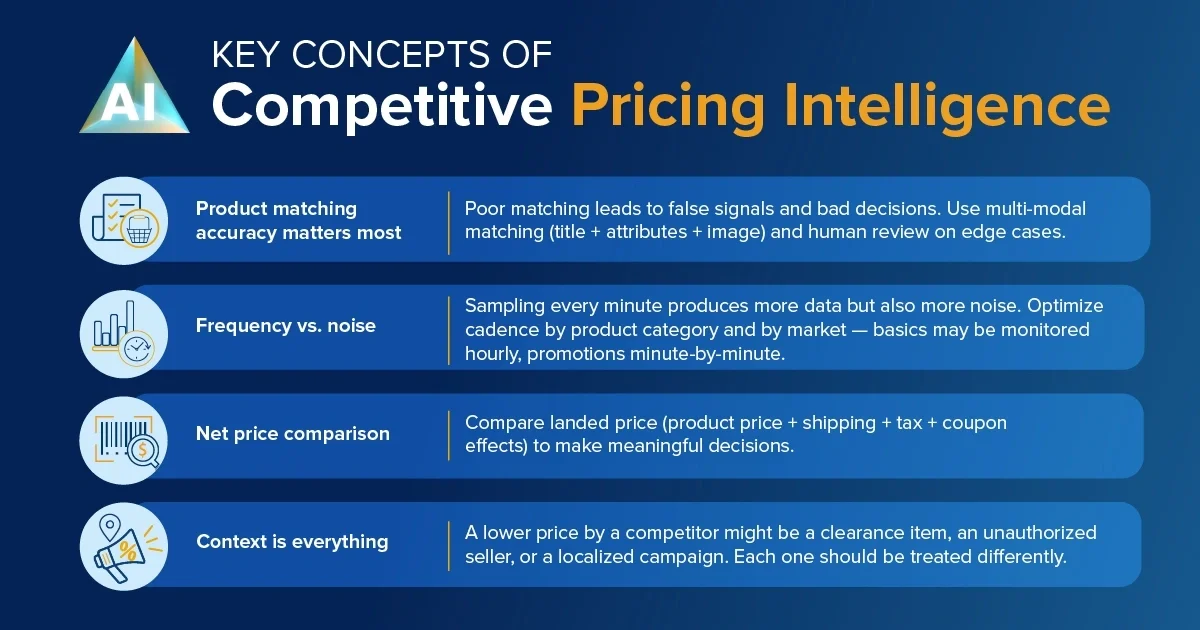
Fashion pricing data alone isn’t enough to stay competitive
Collecting competitor pricing data is only the first step. Fashion brands also need context around assortment, market positioning, promotional activity, pricing trends, and emerging competitive threats. Without broader market analysis, organizations risk making reactive pricing decisions based on incomplete information.
Vistex enables fashion brands to operationalize AI-driven insights by unifying competitor data, pricing strategies, and execution on a single platform. With solutions like VantageView, which combines pricing visibility with market analysis, brands can understand not only what competitors are charging but also why those prices are changing and how those changes impact overall market dynamics.
The most successful retailers use competitor pricing data as one input within a broader pricing and margin management strategy rather than treating it as a standalone decision-making tool.
Explore more related resources

Be Runway-Ready with AI-Powered Pricing for Fashion: Drive Maximum Impact with Modern Solutions
To meet the challenges of fast fashion, ecommerce and sustainability, fashion companies need dynamic, data-driven pricing strategies