
Channel data includes more than Point-of-Sale reporting.
Ask a group of channel professionals what channel data management means, and most will point straight to Point-of-Sale (POS) data. It is certainly one of the most visible pieces of data. But it is only one piece of a much bigger picture.
Channel data also tells you who your partners are, how they engage with your programs, and how well those relationships perform over time. Do you know which…
- Partners are the most engaged?
- Partners have earned access to your best resources and incentives?
- Partner relationships generate the greatest business value?
- Partners are quietly underperforming?
Getting to that level of visibility depends on treating channel data as a discipline with its own framework, not a byproduct of a CRM report or distributor file.
What does a 360-degree view of channel data include?
A 360-degree view connects the information you need to understand the full partner relationship. It brings together data about partner profiles, programs and resources, transactions, incentives, engagement, and performance rather than evaluating each data point in isolation.
That broader view helps high tech channel teams understand not only what happened, but also who the partner is, how the relationship is performing, and where action may be needed.
For example, a partner's POS transactions tell you what they sold. Combining that information with partner attributes, program participation, inventory, incentives, and engagement data can provide a much clearer picture of the partner's overall performance and value.
True 360-degree visibility, therefore, depends on more than just collecting more data. The data needs to be connected, accurate, governed, and maintained so teams can trust the picture it creates.
What are the five components of a channel data management framework?
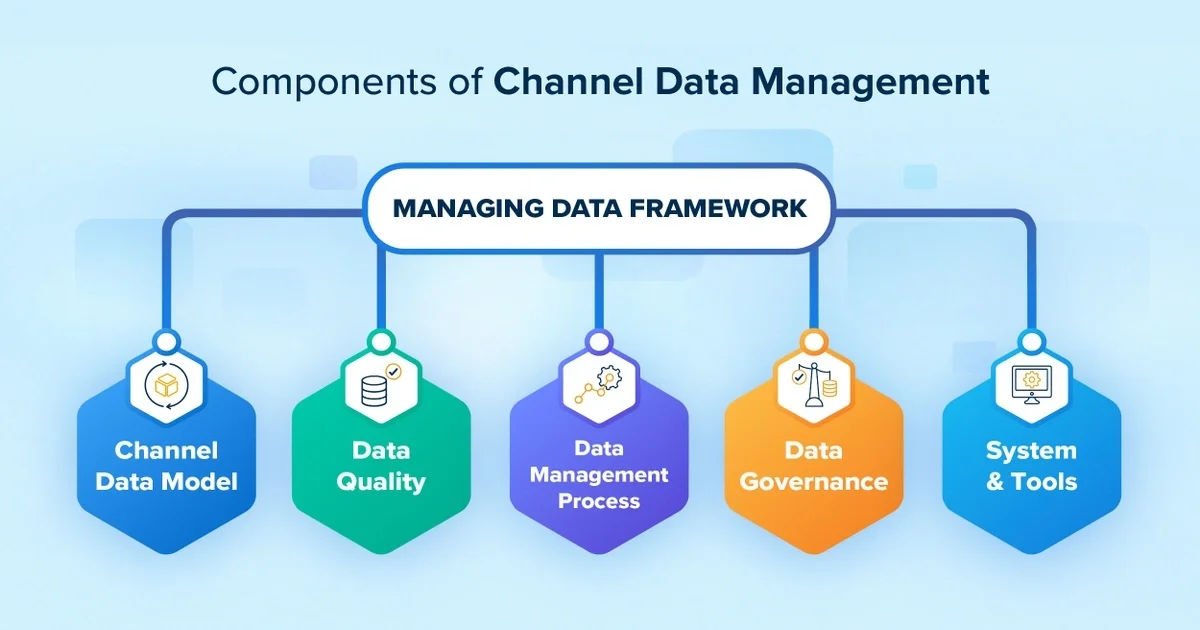
A complete data framework rests on five components, and each one shapes how much visibility and trust you get.
1. Channel data model: The foundation for a connected view
A channel data model defines the entities, attributes, and relationships that make up your channel: partners, programs, transactions, and incentives, along with the connections between them. Without a clear model, data from different sources rarely lines up, and a true 360-degree view stays out of reach.
2. How do you measure channel data quality?
Data quality measures how well your channel data reflects seven dimensions:
- Trust
- Accuracy
- Completeness
- Recency
- Conformity
- Uniqueness
- Frequency
A dashboard built on incomplete or outdated records can look confident while still leading teams astray. Poor data quality can affect partner segmentation, performance measurement, incentive decisions, forecasting, and other decisions that depend on a reliable view of the high tech channel.
The goal is not simply to have more channel data. It is to have data that teams can trust when making business decisions.
3. The processes behind reliable channel data
These are the day-to-day processes by which channel data is captured, validated, and maintained, from partner onboarding to POS ingestion to incentive claim reviews. Consistent processes keep data accurate as partner ecosystems grow and change.
As the number of partners, programs, data sources, and transactions increases, manual processes can make it increasingly difficult to maintain a consistent view. Well-defined processes provide the structure needed to keep channel data current and usable at scale.
4. Who owns channel data governance?
Governance defines who owns each type of channel data, what standards it must meet, and who is accountable when something breaks. Without governance, data quality erodes the moment you add a new partner, product, or region, and visibility goes with it.
Effective governance makes channel data management an ongoing business responsibility rather than a one-time cleanup exercise. It establishes the standards, controls, and accountability needed to maintain a trusted channel data environment as the business changes.
5. Which systems and tools support channel data management?
The technologies that capture, connect, and automate channel data determine how much time your team spends reconciling reports versus how much time they spend acting on trusted, visible insights.
Modern high tech channel ecosystems often bring together data from multiple sources, including partner systems, distributor files, POS transactions, inventory, claims, incentives, and revenue transactions. The right technology connects those sources, applies consistent data standards, and makes the resulting information available for analysis and action.
How does automation turn channel data into actionable intelligence?
A channel data framework only creates value when the processes behind it can operate consistently at scale. Automation can help collect, validate, standardize, and connect channel data across multiple sources without relying on teams to reconcile information manually.
Automation can help maintain:
- Maintain a current data model
- Monitor data quality continuously
- Apply consistent governance and validation
- Scale repeatable processes as the channel grows
- Accelerate access to trusted channel insights
When these capabilities work together, channel teams can spend less time confirming data reliability and more time using it to understand partner performance, manage programs, improve forecasts, and make revenue decisions.
Vistex channel solutions and Vistex Business AI help automate the collection and validation of channel data across the high tech ecosystem, including POS, inventory, claims, incentives, and partner data. This helps connect the components of the framework, enabling organizations to move from fragmented reporting to a more complete, trusted view of their channel.
A 360-degree view of channel data isn’t a single report or dashboard. It’s the outcome of a framework that turns fragmented reporting into real visibility across every partner relationship.
Get those five components right, and every partner conversation, incentive decision, and forecast rests on data you can trust.
Related Resources:

You Need To Walk Before You Can Run - Crawl, Walk, Run: Solving ECM Pricing and incentive challenges step-by-step
Get the latest news, updates, and exclusive insights from Vistex delivered straight to your inbox. Don’t miss out—opt in now and be the first to know!