

Agentic AI in Trade Promotion Management Moves Manufacturers from Prediction to Action
AI already shapes how consumer product manufacturers price, promote, and determine the ideal product assortment or mix across retail and foodservice channels. Most trade promotion management (TPM) platforms use predictive AI models that analyze historical data to estimate future outcomes. While knowing what might happen is useful, it’s better to know what to do about it. The gap between prediction and action represents a tremendous opportunity.
Agentic AI in trade promotion management does more than predict outcomes. It acts on them, orchestrating workflows and decisions across commercial teams.
For business leaders navigating margin pressure, promotion complexity, and fragmented data, this shift is significant. TPM moves from a management system to a key element of the revenue execution engine.
Billions are invested in trade promotions each year. Yet many manufacturers still rely on spreadsheets or antiquated systems that offer only basic planning and execution capabilities, telling them what might happen but not what to do about it. That gap between prediction and action leaks margin, complicates reconciliation, and leaves teams to react rather than take the initiative. Closing that gap requires understanding the types of AI in trade promotion management and why agentic AI matters now.
What are the 4 types of AI in Trade Promotion Management?
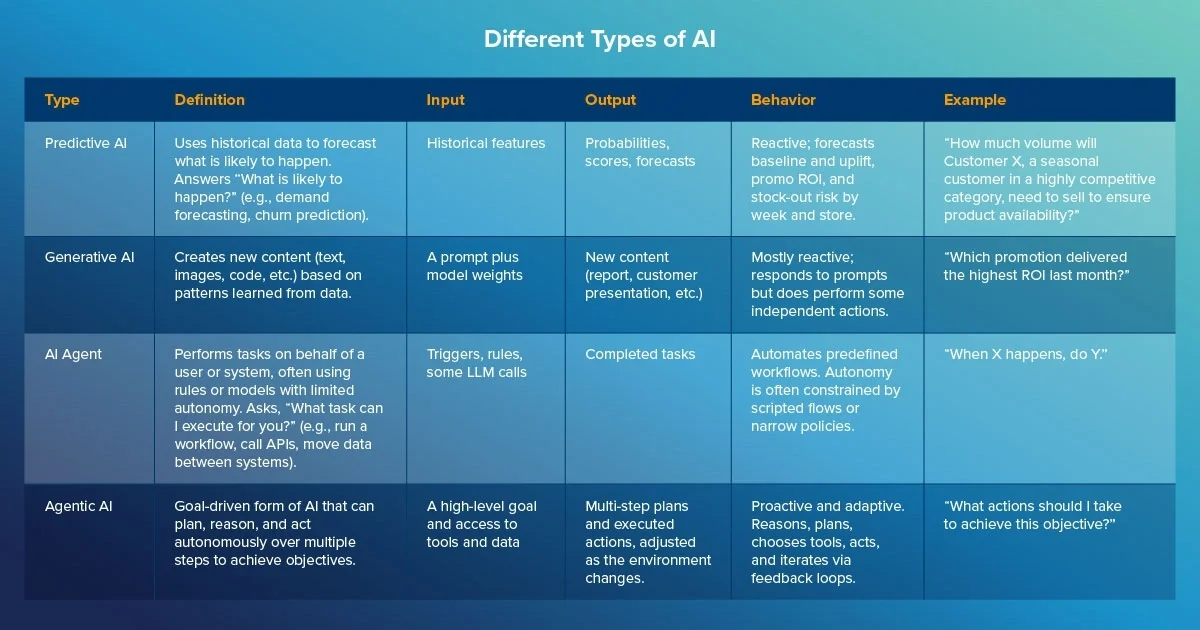
Different forms of AI support commercial operations today. Each plays a role, but they vary on the scale from insight to execution.
Predictive AI
Historical activity, current data, and trends help Predictive AI project future scenarios. In TPM, it models how promotions might perform before they reach the customer. The system estimates expected lift, projects demand by account and SKU, and calculates likely accruals and liabilities tied to trade spend. It also signals where investment may drift above or below the plan.
That foresight improves planning accuracy. But predictive AI still stops at awareness. It tells teams what may happen, then relies on people and processes to decide how to respond.
Rules-Based Automation
Rules-based systems follow fixed logic: if X happens, do Y. For example, if a promotion exceeds a spend threshold, trigger an approval workflow. This provides consistency and efficiency, especially for compliance.
What rules-based automation can’t do is adapt. It doesn’t learn from outcomes, handle variability well, or reason through changing conditions. It executes what humans predefine.
Generative AI
Focusing on interaction over forecasting, generative AI helps users explore what has already happened by making complex data easier to access and explain.
Using systems with generative AI, sales and finance users can ask, “Which retailer promotions delivered the highest ROI last month?” and receive a direct answer. Behind the scenes, the system summarizes performance, explains scenarios, and translates large datasets into usable insights, though it doesn’t make decisions.
Agentic AI
Agentic AI represents the shift from insight to action, combining reasoning, learning, and execution within defined guardrails. Instead of simply predicting that a promotion may miss volume, an agentic system can respond by automatically adjusting funding, recommending price changes, rerouting approvals, or flagging exceptions before margin leaks.
In TPM, agentic AI behaves like a digital revenue growth manager. It actively watches promotion performance, assesses risk and opportunity, and coordinates workflows across Sales, Finance, and Revenue Growth teams. As conditions change, the system adapts its decisions. Opportunities for improvement are not lost due to limitations associated with predictive AI.
Its effectiveness, though, is contingent on the quality of its data source and is further verified and enhanced by humans.
Where Does Agentic AI Appear in TPM?
Agentic AI is essential to shifting trade promotion management from a periodic planning process to continuous optimization. Here are some real-world applications:
Promotion Planning and Optimization
Predictive AI in traditional TPM can already optimize promotions against defined objectives. Planners set targets (volume, revenue, margin, or ROI) and the system models scenarios using historical performance and elasticity data to recommend a structure. The capability is strong, but the process is typically human-triggered and episodic.
Agentic AI changes the timing and continuity of optimization.
Instead of waiting for a planner to initiate a new scenario, the agent continuously monitors performance, funding, customer behavior, and financial impact. When conditions shift, it triggers re-optimization automatically, often in coordination with other agents managing pricing, forecasting, or trade spend.
Optimization no longer happens once during planning. It happens throughout the promotion lifecycle. As data changes, the promotion adapts. The move from human-initiated modeling to system-initiated, closed-loop adjustment is what turns TPM from a scenario tool into an always-on execution engine.
Funding and Budget Governance
Trade spend is one of the largest controllable investments in CPG. Yet many trade promotion management environments treat funding as a static allocation, reviewed after the promotion period.
In systems that use agentic AI, spending is monitored to assess its pace against plan and policy. If activity accelerates faster than expected, the agent identifies risk early and recommends adjustments before margin erodes.
In this way, budget governance becomes an ongoing process.
Accruals, Deductions, and Reconciliation
When promotions deviate from plan, or customers execute differently, reconciliation becomes painful for teams using purely predictive systems.
Agentic AI manages accruals in real time, comparing planned promotions to execution and financial signals and adjusting liabilities as performance shifts. If a retailer submits a deduction that doesn’t match contract terms, the system flags the mismatch and routes it for resolution before it distorts forecasts.
Cross-Functional Orchestration
In many organizations, trade promotion decisions are fragmented across Sales, Finance, Supply Chain, and Revenue Growth. One change in Sales creates downstream issues in forecast, inventory, or margin through a series of handoffs.
Agentic AI connects those functions through coordinated action. When a promotion changes, funding, forecasting, and approvals move together. Finance sees risk earlier, Sales gets faster responses, and teams aren’t surprised by disconnected decisions.
What does Agentic AI Mean for Sales, Finance, and Revenue Growth Teams?
Agentic AI changes how commercial teams operate. Instead of reacting to reports, each function operates inside a system that continuously evaluates performance and recommends actions.
Sales Teams Enjoy Smarter Deals and Faster Execution
Sales teams balance volume targets with margin protection. Traditional TPM faces limitations in manual scenarios and in delayed feedback.
With agentic AI, trade promotion management begins to behave like a selling partner. The system recommends promotion structures by customer and channel, flags margin risk before deals are approved, and dynamically adjusts funding.
For example, when planning a retailer promotion for a regional distributor, the agent evaluates similar deals, elasticity, and compliance behavior, then proposes a structure that balances volume and profitability. Sales reps enter customer conversations with intelligence rather than guesswork.
Finance Teams Gain Consistent Control
Finance cares about accuracy, control, and visibility. Traditional TPM leaves teams reconciling after the fact.
Agentic AI moves control upstream. It monitors liabilities in real time, adjusts accruals as execution changes, flags non-compliant deductions, and consistently enforces funding policies.
If a retailer breaches the agreed terms, the system updates the expected liability and routes the issue for resolution before the month-end. The result is tighter forecasts, fewer manual interventions, and better alignment between commercial activity and financial outcomes.
Revenue Growth Teams Experience Continuous Optimization at Scale
Revenue Growth leaders sit at the intersection of pricing, promotions, and strategy. Their challenge is scale.
Agentic AI acts like a revenue growth engine, continuously optimizing price and promotion mix, identifying underperforming investments early, and recommending reallocations to higher-return programs.
If retail promotions underperform while retailer demand accelerates, the agent can recommend shifting investment to higher ROI programs immediately.
Should CPG Manufacturers Evolve from Predictive to Agentic AI?
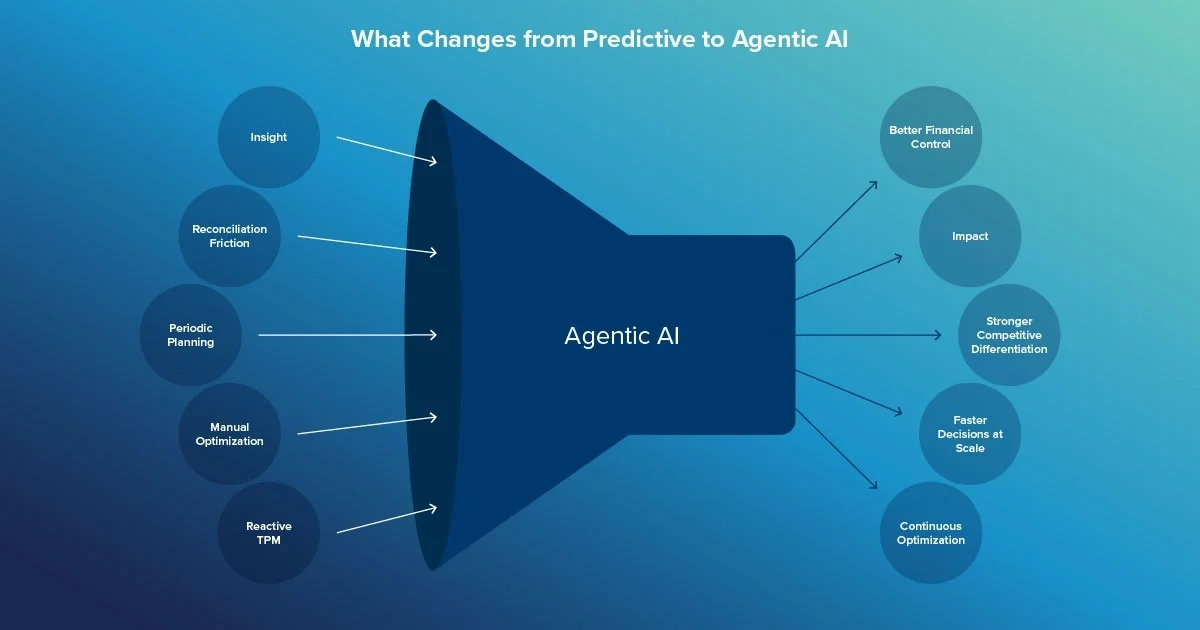
Consumer products teams manage thousands of promotions across customers, SKUs, and channels. Humans are challenged to act on results sustainably, but agentic AI can scale decision-making across accounts, time, and data sources continuously.
By monitoring liabilities in real time, agentic AI in trade promotion management prevents overspend, improves accrual accuracy, and reduces reconciliation friction. Sales and Finance operate from the same financial truth.
In TPM, agentic AI enables continual rather than cyclical improvement. As data changes, so do decisions. Promotions adapt while they’re running, not just in the next planning cycle, a critical achievement in volatile retail and foodservice environments.
Is Agentic AI the Future of Trade Promotion Management?
AI in TPM is evolving from reporting to reasoning, and from forecasting to acting.
For consumer products manufacturers selling into retail and foodservice, the evolution from predictive to agentic AI turns TPM into a strategic system of record and action. It protects margin, accelerates growth, and aligns commercial teams around smarter, faster decisions.
The future of TPM is a system that responds while promotions are active.
Find out more: Don’t miss part 2 of this 2-part series, where we discuss how to get started with agentic AI, outline the implementation stages, and common challenges consumer product manufacturers face when implementing the new model.
Get the latest news, updates, and exclusive insights from Vistex delivered straight to your inbox. Don’t miss out—opt in now and be the first to know!