

How to Implement Agentic AI in Trade Promotion Management
Implementing agentic AI in trade promotion management is becoming a priority for CPG manufacturers looking to move beyond static planning and into real-time execution. While many organizations have already invested in generative AI and predictive AI models, AI in trade promotion management implementation requires a broader shift—one that connects data, analytical decisions, and execution in a continuous loop.
Agentic AI changes how trade promotions are managed. Instead of relying on periodic analysis and manual intervention, it enables systems to monitor performance, trigger decisions, and adjust outcomes as conditions change. The result is a more responsive, controlled, and efficient approach to managing trade spend across retail and foodservice.
For Sales, Finance, and Revenue Growth teams, this shift changes the tools they use and also how decisions are made day to day.
What Are the Steps to Implement Agentic AI in Trade Promotion Management?
Agentic AI in trade promotion management is implemented through a phased approach that unifies data, builds predictive models, deploys agents, and enables continuous closed-loop optimization to improve trade spend efficiency and promotional performance.
Deploying AI in trade promotion management (TPM) at consumer products companies involves four steps:
- Assess and unify data foundations
- Develop predictive models and pilot agent capabilities
- Deploy real-time execution and automation
- Scale continuous, closed-loop optimization
Each phase of the workflow builds on the last, moving from data readiness to full operational integration. Rather than a single deployment, this is a staged transformation that allows organizations to validate impact, manage risk, and scale intelligently.
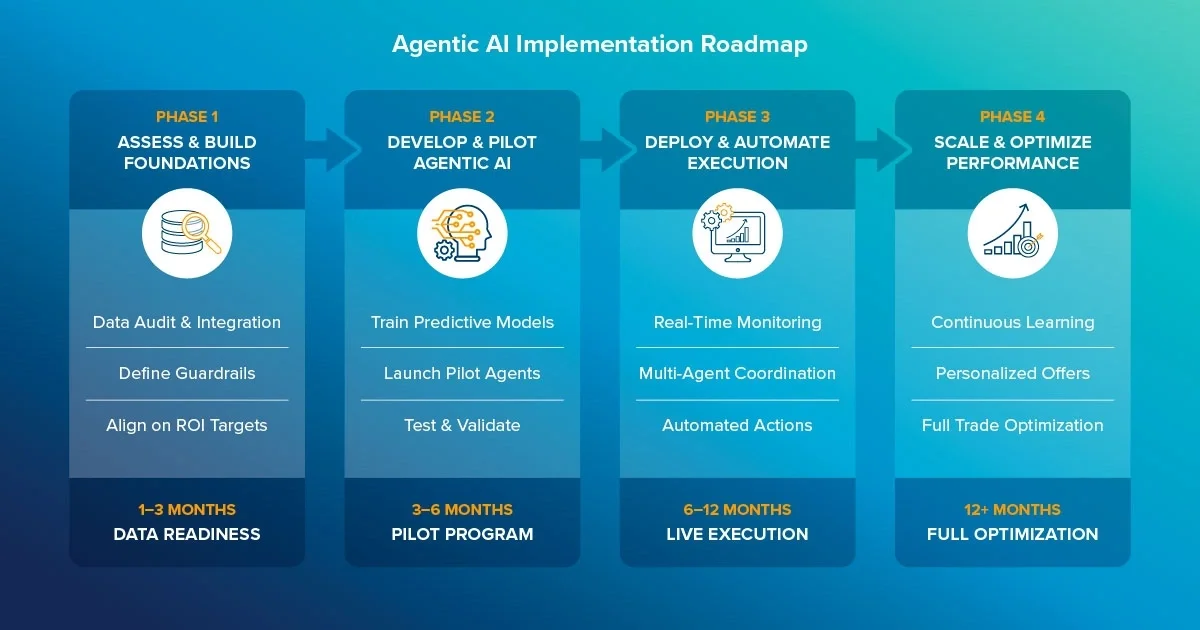
What is the Trade Promotion Management AI Implementation Roadmap?
For CP manufacturers, implementing agentic AI is not just a technology upgrade. It facilities a shift in how trade promotions are planned, executed, and optimized across Sales, Finance, and Revenue Growth teams.
Phase 1: Assess and Build the Foundation
Before any agent can act, it needs a reliable view of the business. Most TPM environments are challenged by fragmented or delayed data, or data inconsistently accessible across systems.
The first phase of the implementation roadmap focuses on creating the conditions for trustworthy decision-making.
Start with an AI readiness audit. Evaluate the quality, latency, and coverage of your core data sources, including market data, POS, shipments, inventory, customer agreements, and external signals like competitive activity. Gaps in granularity, especially at the SKU-store-week level, will limit what agents can do later.
From there, unify your data environment. Many organizations move toward a centralized data lake or similar architecture that brings together TPM, ERP, POS, and other external data. The goal is consolidation, harmonization, and enrichment. Data needs to be cleaned, aligned, and structured so models and agents find it usable can act on it consistently, creating an actionable data flow.
Equally important is defining guardrails. Agentic AI does not operate without constraints. Policies around spend caps, minimum margins, customer-specific agreements, and cannibalization thresholds must be codified upfront. These guardrails ensure that when agents act, they do so within acceptable business boundaries.
Finally, secure cross-functional buy-in. Sales, Finance, and Revenue Growth teams need alignment on what success metrics and use cases look like. That typically means defining target outcomes, such as a 20–30% improvement in promotion efficiency, and agreeing on pilot KPIs.
This phase, typically lasting 1-3 months, is less about AI and more about readiness. Without it, everything that follows becomes harder to scale.
What this means: Sales gains cleaner inputs for planning. Finance gets more reliable accrual foundations. Revenue Growth teams get consistent data to model performance across customers and channels.
Phase 2: Develop Core Models and Pilot the First Agent
With the foundation in place, the focus shifts to building intelligence and introducing early agent behavior.
Most CPG organizations already have some predictive capability, but it often needs refinement. This is the time to strengthen baseline models like forecasting demand, estimating promotional uplift, understanding cannibalization, and projecting ROI using historical trade data. These models remain essential until such time as they are replaced with new, improved predictive models. Agentic AI builds on predictive capabilities; it doesn’t replace them.
Next comes the introduction of your first agent.
Rather than attempting full automation, start with a contained scope. A typical progression begins with data collection, moves into analytics and insight generation , then into recommendation, and finally into limited execution optimization. At this stage, the agent is assisting human activity more than acting independently.
Pilot this capability in a controlled environment, such as one or two retail chains or product categories. The agent can analyze data, generate insights, and recommend optimized promotion structures or budget allocations. Compare performance against manual planning baselines for a clear, measurable proof point.
Governance is critical here. Introduce human-in-the-loop controls for decisions that exceed defined thresholds. For example, if an agent recommends a significant funding reallocation or pricing adjustment, it should require approval before execution. This ensures an important measure of control while building confidence in agent-driven recommendations.
This phase builds confidence incrementally over a 3-6 month period. It shows that agent-driven recommendations can outperform traditional workflows while keeping humans in control.
What this means: Sales start with stronger, data-backed promotion recommendations. Finance gains early visibility into projected spend and risk. Revenue Growth teams can test and validate use case strategies before scaling.
Phase 3: Deploy and Automate Execution
Once pilot results are validated, the CPG organization can begin shifting from assisted decision-making to active execution.
At this stage, agents move from periodic analysis to continuous monitoring. They track live signals such as POS data, inventory levels, and competitive activity, adjusting promotion structure, funding, or timing within predefined guardrails. Optimization becomes dynamic rather than episodic.
The real step-change comes with multi-agent orchestration. A promotion planning agent, for example, can coordinate with inventory and finance agents. If demand spikes, the system can simultaneously adjust promotional intensity, update forecasts, and reflect financial impact in real time without waiting for separate teams to intervene.
System integration becomes essential. Application Programming Interfaces (API) connect agents to TPM and enterprise resource planning (ERP) platforms, enabling automated updates to accruals, promotion calendars, and rebate calculations. This is where agentic AI starts to influence core business processes.
Rollout should remain targeted during this 6-12 month period. Many organizations expand to their top 20% of customers by volume, where the financial impact is greatest. At the same time, comparing agentic-driven promotions to traditional approaches helps quantify performance gains and build internal momentum.
What this means: Sales can adjust live promotions instead of waiting for post-event reviews. Finance gains real-time visibility into liabilities. Revenue Growth teams can rebalance spend while promotions are still running.
Phase 4: Scale and Optimize
With agentic workflows in place, the focus shifts to scale, learning, and refinement in a continuous system.
After each promotion, agents automatically ingest results, update response curves, and refine playbooks. Over time, the system improves its own recommendations based on real-world performance.
This creates the foundation for personalization at scale. Instead of broad promotional strategies, manufacturers can begin tailoring offers by store, shopper segment, or channel, something that is nearly impossible to manage manually.
At the same time, governance evolves. Organizations should monitor for model drift, ensure adherence to policies, and refine guardrails as business conditions change. Expansion should also continue, extending agentic capabilities across the full trade spend portfolio.
Success measurement becomes more comprehensive in this 12+ month stage. Leading indicators include improvements in net sales value (NSV), gross margin (GM), and trade spend efficiency. Operational metrics like cycle time reduction and faster decision-making also matter. Many organizations target 40–60% improvements in planning and execution speed.
What this means: Sales benefit from continuously improving promotion strategies across accounts. Finance operates with tighter control and fewer reconciliation surprises. Revenue Growth teams achieve always-on optimization at scale, without added manual effort.
How Does Agentic AI Implementation Transform Teams?
Implementing agentic AI in trade promotion management is not about flipping a switch. It’s a progression, from building data foundations to enabling continuous, closed-loop execution across commercial teams.
Each phase builds on the last:
- Foundation enables trust
- Models enable insight
- Agents enable action
- Scale enables transformation
Sales teams gain faster, data-backed promotion strategies and enter negotiations with stronger, continuously optimized plans.
Finance teams move from after-the-fact reconciliation to real-time visibility and control over trade spend and accruals.
Revenue Growth teams shift from periodic planning to continual improvement, balancing volume, margin, and investment across thousands of decisions.
Instead of working in silos, agentic AI helps all three functions operate from a shared system that continuously aligns performance and profitability.
Why Agentic AI is the Next Step in Trade Promotion Management
Implementing agentic AI in trade promotion management is not a one-time initiative. It’s a phased transformation that moves organizations from prediction to continuous execution.
Agentic AI operationalizes the insight predictive AI provides various teams:
- For Sales, it means walking into every customer negotiation with a plan that improves as it runs.
- For Finance, it means fewer surprises and tighter control over trade spend.
- For Revenue Growth, it means scaling decisions across thousands of promotions within losing precision.
The organizations that move first improve planning. They also fundamentally change how trade promotions are executed, capturing opportunities faster and reducing margin leakage.
Get the latest news, updates, and exclusive insights from Vistex delivered straight to your inbox. Don’t miss out—opt in now and be the first to know!