
How Do Category Managers Prepare For Annual Planning?
Many category teams enter annual planning with a focus on forecasts, retailer requests, and growth targets. The strongest category plans, however, begin with a disciplined review of what actually happened.
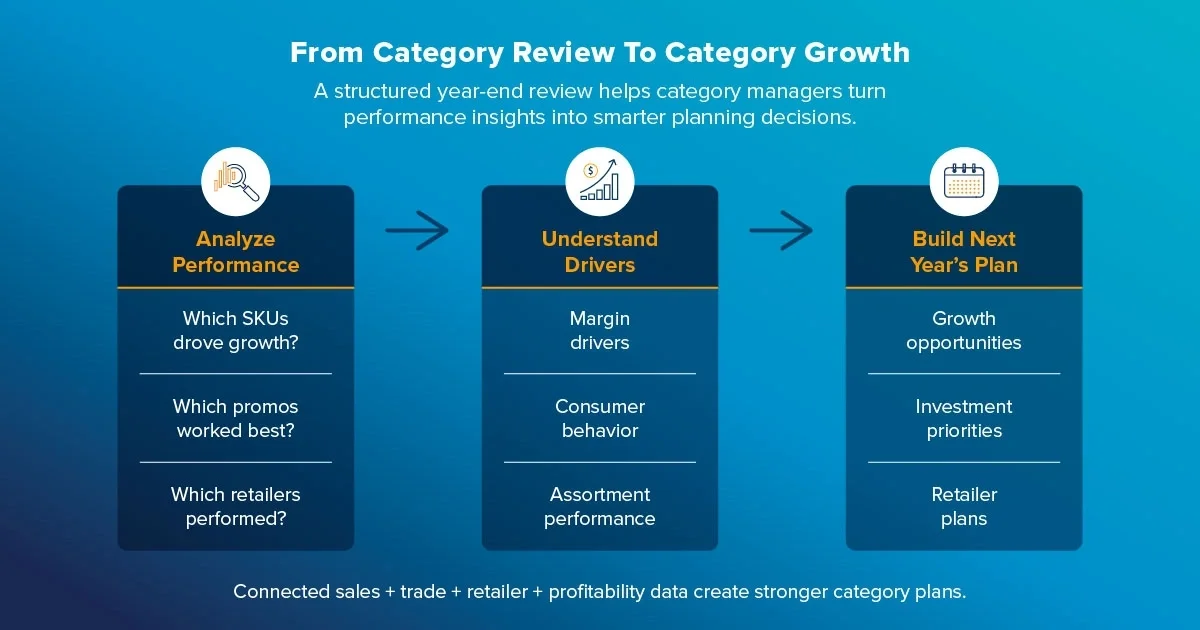
Before setting objectives for next year, category managers should evaluate which products drove growth, which promotions created incremental demand, which retailers improved category performance, and where margin and base volume erosion occurred.
The year-end review should be approached as a strategic exercise rather than a reporting exercise.
Ways To Deploy A Progressive Category Performance Review Process
Category management, a strategic approach to organizing and optimizing product categories (“snack foods,” etc.) as individual business units, involves grouping similar products into categories and executing tailored strategies to improve sales performance, profitability, and customer satisfaction.
Category plans must balance efficiency with differentiation, resilience with agility, and cost control with growth ambitions. Supply chain must adapt to these upstream decisions and integrate them into sourcing, production planning, and logistics.
The most successful category strategies are built on a clear understanding of what drove category growth, profitability, and share gains during the past year. A structured review can uncover opportunities that might otherwise be missed and help category teams make more sound decisions about pricing, promotions, assortment, and investments.
The following seven questions provide a framework for turning last year’s results into next year’s category strategy.
Which Products Drove Category Growth?
When assessing where growth originated, many consumer products manufacturers look at total revenue or volume performance. Trouble is, aggregate numbers often hide important details. A category may have achieved its growth objectives while relying heavily on a small subset of products, specific retailers, or temporary promotional activity. Similarly, some products may have consumed significant resources while contributing little to the category’s overall performance.
By analyzing revenue, volume, margin contribution, velocity, distribution gains, and category share at the product SKU level, category managers can identify which products genuinely expanded the business and which merely maintained existing demand.
This analysis establishes the foundation for the rest of the review. Once growth drivers have been identified, the next step is understanding what influenced that growth.
Which Promotions Generated Incremental Demand?
Promotions often generate impressive volume spikes, but volume alone doesn’t necessarily indicate success. Some promotions create genuine incremental demand, attracting new buyers or increasing household consumption. Others simply shift purchases forward, discount sales that would have occurred anyway, or cannibalize volume from other products within the portfolio.
Category managers should evaluate promotional performance by comparing baseline sales against promoted sales, assessing incremental lift, measuring margin impact, and examining post-promotion trends. Understanding whether growth was promotion-driven or naturally occurring provides valuable context for future investment decisions.
This analysis reveals that not all growth drivers are equally efficient. The next logical step is determining where those investments produced the strongest overall category outcomes.
Which Retailers Delivered the Best Category Outcomes?
Once product and promo performance are understood, attention should shift to the retail partners who generated those results.
Many consumer products manufacturers evaluate retailers primarily based on sales volume. Revenue is essential, however, volume alone paints an incomplete picture of account performance. Some retailers consistently deliver strong category growth, efficient promotional execution, and healthy margins. Others require significantly greater trade investment to achieve similar results.
Evaluating retailer performance through a broader lens, including category growth, promotion effectiveness, margin contribution, share gains, deduction activity, and trade spend efficiency, helps category managers identify where investments generated the greatest return.
Understanding which retailers created the most value allows organizations to strengthen successful partnerships while uncovering opportunities to improve performance elsewhere.
But even when growth and retailer performance appear strong, one critical question remains unanswered: was that growth profitable?
Where Did Margin And Base Volume Erode Throughout the Year?
Growth is good, but profitable growth should be the goal.
As category managers review product performance, promotional investments, and retailer results, they should simultaneously examine where margin pressure emerged throughout the year. Revenue gains can sometimes mask underlying profitability challenges that weaken long-term category performance.
Pricing decisions, promotional discounts, increased trade spending, unfavorable product mix shifts, rising costs, and customer deductions can all contribute to margin and base erosion. Without visibility into these factors, manufacturers risk repeating investments that drive volume at the expense of profitability.
This analysis often uncovers hidden opportunities to improve future performance, not necessarily by spending more, but by allocating investments differently. Understanding profitability dynamics also provides important context when evaluating changing consumer behavior.
Which Consumer Trends Changed Category Behavior?
Numbers may tell part of the story, but shopper behavior explains why those numbers changed.
Once category managers understand what grew, which promotions worked, which retailers performed best, and where profitability shifted, they can begin examining the broader market forces that influenced those outcomes.
Consumer preferences change rapidly. Shoppers may trade up to premium offerings, shift toward value-oriented products, purchase smaller pack sizes, explore alternative channels, or respond differently to promotions than they did in previous years.
Analyzing those behavioral changes helps distinguish temporary performance fluctuations from long-term market trends. More importantly, it helps category teams anticipate future demand patterns rather than simply react to historical results.
As consumer behavior changes, assortment decisions become increasingly important.
Did Assortment Decisions Strengthen or Weaken Performance?
With a clearer understanding of growth drivers, promotional effectiveness, retailer performance, profitability, and consumer trends, category managers can evaluate whether their assortment strategy supported (or limited) category success.
Throughout the year, consumer products manufacturers make numerous assortment decisions involving new product introductions, SKU rationalization efforts, distribution expansion, and retailer-specific portfolio adjustments. While these decisions are intended to improve performance, they don’t always deliver the expected results.
A year-end review should assess how changes in assortment influenced category growth, shelf productivity, inventory performance, retailer acceptance, and profitability. In many cases, organizations discover that a more focused assortment delivers stronger results than a larger, more complex portfolio.
These findings directly influence future planning decisions. Yet they also highlight another challenge: ensuring the organization has the right information to make those decisions with confidence.
Do We Have the Data Needed to Make Better Decisions Next Year?
The final question category managers should explore is whether they can consistently access and analyze the information required to answer the preceding questions accurately.
Many manufacturers still rely on disconnected spreadsheets, multiple reporting systems, and manual analysis processes. As a result, category reviews are time-consuming exercises in data gathering rather than strategic decision-making.
The most effective category planning processes connect sales performance, retailer results, trade investments, promotion outcomes, profitability metrics, and consumer insights into a unified view. This helps category teams to move beyond retrospective reporting and focus on identifying future growth opportunities.
Ultimately, the purpose of a year-end category review is not simply to explain what happened. It’s to provide the insight necessary to make better decisions moving forward.
How Vistex Provides Promo Effectiveness Analysis
Effective category planning depends on having visibility across sales performance, trade investments, retailer results, pricing, and profitability. Vistex helps consumer products manufacturers bring these insights together in a single view, enabling category managers to evaluate performance more comprehensively and make more informed planning decisions for the year ahead.
This angle positions Vistex beyond TPM and squarely within the broader category growth, profitability, and planning conversation that category managers are focused on during October–December planning cycles.
Turn Category Insights Into Better Planning Decisions
The best category plans are not built solely on forecasts and growth targets. They are built on a clear understanding of what worked, what did not, and where the greatest opportunities exist.
By answering these seven questions before annual planning begins, category managers can move beyond historical reporting and create strategies grounded in data, profitability, and consumer insight.
Vistex helps consumer products manufacturers bring together trade spending, promotional performance, retailer profitability, pricing, deductions, and revenue management data in a single environment. This enables category managers to move beyond historical reporting and gain the visibility necessary to make more informed planning and investment decisions.
Connecting commercial and financial insights, organizations can better evaluate category performance, strengthen retailer relationships, and build plans that support both growth and profitability while maintaining brand equity.
Explore more related resources
How to Build an Effective Joint Business Planning Process Driving Alignment and Trade Promotion ROI
Get the latest news, updates, and exclusive insights from Vistex delivered straight to your inbox. Don’t miss out—opt in now and be the first to know!