
Why Trade Spend Management Matters More Than Ever
For many consumer products manufacturers, trade spend is one of the largest line items on the income statement, often representing 15% to 25% of gross sales. Companies invest billions of dollars each year in retailer promotions, discounts, displays, advertising programs, and incentives designed to drive sales and strengthen customer relationships.
Despite its scale, trade spend remains one of the most difficult investments to manage effectively. Optimizing trade spend requires manufacturers to evaluate investments based on profitability rather than volume alone.
Sales teams are under pressure to grow volume and strengthen retailer partnerships. Finance teams are tasked with maintaining profitability and controlling budgets. Revenue growth management (RGM) leaders are expected to identify opportunities to improve return on investment. Meanwhile, market conditions, consumer demand, retailer expectations, and competitive activity continue to shift.
The result is a common challenge across the industry: manufacturers are investing significant trade dollars but often lack complete visibility into where those funds are going, which programs are delivering results, and where opportunities exist to improve performance.
Effective trade spend management is no longer simply about tracking spending. It’s about ensuring every trade dollar contributes to profitable growth, supports strategic objectives, and delivers measurable business value. In this way, trade spend management is closely connected to trade promotion management (TPM), revenue growth management (RGM), deduction management, trade accrual management, and promotion optimization.
What Is Trade Spend Management?
Trade spend management refers to the processes, systems, and strategies manufacturers use to plan, track, analyze, and optimize investments made with retail customers.
These investments typically include:
- Temporary price reductions (TPRs)
- Off-invoice discounts
- Display allowances
- Feature advertising programs
- Slotting fees
- Promotional incentives
- Shopper marketing investments
- Retail performance programs
Objectives For Managing Trade Spend
Trade spending exists to influence consumer demand and support sales growth, but successful trade spend management requires balancing multiple objectives simultaneously.
Manufacturers must:
- Increase sales volume
- Protect margins
- Improve retailer relationships
- Maintain budget discipline
- Support category growth
- Accurately forecast liabilities
Achieving all of these goals becomes increasingly difficult when data is fragmented across spreadsheets, ERP systems, retailer portals, promotion planning tools, and financial systems.
Without a coordinated approach, trade spending can become reactive rather than strategic, making it difficult to understand what’s working and where improvements are needed.
Why Has Trade Spend Management Become More Challenging?
Trade spend management has always been complex, but several market forces have intensified the challenge.
Rising Cost Pressures
Manufacturers continue to face pressure from fluctuating ingredient costs, transportation expenses, labor costs, and supply chain disruptions. Every trade investment must now withstand greater scrutiny because margins have become more difficult to maintain.
When costs rise, organizations can no longer afford promotional investments that fail to deliver measurable returns.
Increasing Promotional Complexity
Today’s promotional landscape is far more complex than it was even a decade ago.
Consumer products companies manage more:
- SKUs
- Retail channels
- Promotional tactics
- Customer-specific agreements
- Data sources
Each retailer may have unique promotional requirements, funding structures, reporting expectations, and performance metrics.
As complexity increases, so does the likelihood of errors, inconsistencies, and missed opportunities.
Limited Visibility Across Functions
In many organizations, sales, finance, category management, and RGM teams work from different data sources and performance reports.
Sales may focus on shipments and retailer relationships. Finance focus on accruals, liabilities, and budget performance. RGM teams evaluate promotional effectiveness and profitability.
When each group operates with a different view of trade spend performance, decision-making becomes slower and alignment becomes more difficult.
Greater Accountability For Results
Executive leadership increasingly expects trade investments to be supported by data rather than assumptions.
Questions that once required weeks of analysis now require near real-time answers:
- Which promotions generated incremental sales?
- Which retailers delivered the strongest return?
- Where are liabilities trending?
- Which programs should be repeated?
- Which investments should be discontinued?
Organizations that cannot answer these questions quickly risk making future investment decisions based on incomplete information.
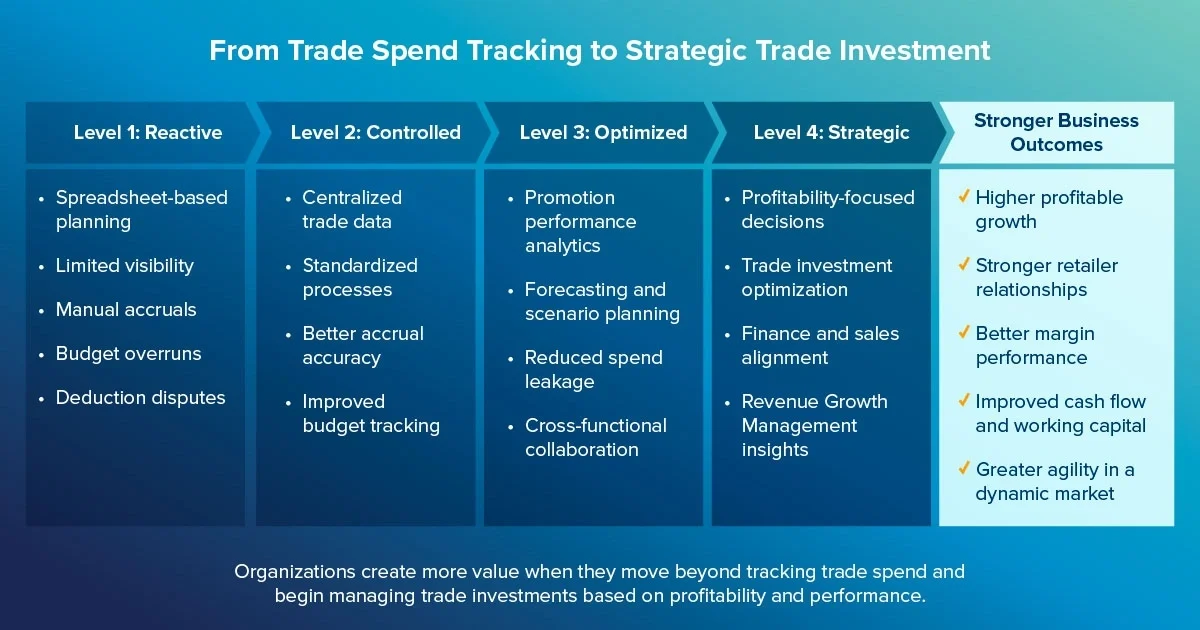
Five Trade Spend Management Strategies For Profitable Growth
Leading manufacturers recognize that better trade spend management requires more than tighter controls. It requires improved visibility, better data, and stronger decision-making processes.
1. Establish A Single Source of Truth For Trade Spend Data
Many trade spend challenges begin with fragmented information.
Promotion plans may reside in one system while deductions are managed in another. Financial data may be stored in ERP platforms while customer agreements are maintained in spreadsheets.
As a result, teams spend significant time reconciling trade data information rather than analyzing performance.
Creating a single source of truth with AI data flow allows organizations to consolidate:
- Planned trade investments
- Actual spending
- Promotion performance
- Deductions
- Accrual balances
- Customer agreements
When all stakeholders work from consistent information, collaboration improves and decision-making becomes more efficient. Instead of debating whose numbers are correct, teams can focus on identifying opportunities and taking action.
Vistex enables manufacturers to connect trade promotion management, pricing, deductions, and financial processes within a unified platform. This creates greater transparency across sales, finance, and operations while helping teams work from a common set of data and performance metrics.
2. Improve Forecast Accuracy Through Continuous Planning
Many organizations still rely heavily on annual planning processes to establish trade budgets. While annual planning remains important, market conditions rarely remain static throughout the year.
Consumer demand shifts. Competitors launch new products. Retailers change promotional calendars. Economic conditions evolve.
Organizations that wait until year-end to evaluate trade performance often discover problems after they have already affected financial results. A more effective approach involves continuous forecasting and ongoing performance reviews.
Leading manufacturers rarely update forecasts based on:
- Actual spending trends
- Promotion performance
- Customer demand changes
- Category performance
- Market conditions
This allows teams to identify risks and opportunities earlier while making adjustments before issues become larger problems. Continuous planning also improves confidence in accrual estimates and financial forecasts, helping finance teams reduce surprises and improve budget accuracy.
| Traditional Trade Spend Management | Modern Trade Spend Management |
|---|---|
| Spreadsheet-based planning | Integrated software platform |
| Annual forecasting | Continuous forecasting |
| Limited visibility | Real-time visibility |
| Manual accruals | Automated accrual management |
| Historical reporting | Predictive analytics |
| Deduction resolution after the fact | Proactive leakage prevention |
3. Evaluate Promotions Based On Profitability, Not Just Volume
One of the most common trade spend mistakes is measuring success primarily through sales volume.
A promotion that increases shipments may appear successful on the surface. However, the true business impact may be very different when margin performance is considered.
Manufacturers should evaluate promotions using metrics like:
- Incremental revenue
- Incremental profit
- Trade ROI
- Margin contribution
- Category growth impact
- Consumer lift
- Cannibalization effects
For example, a promotion that drives significant volume but erodes margins may ultimately create less value than a smaller promotion that delivers stronger profitability.
Similarly, a promotion that shifts purchases forward without generating incremental demand may create inventory distortions within improving long-term performance.
Advanced analytics help organizations distinguish between activity and effectiveness. The goal is not simply to promote more frequently. The goal is to invest in programs that deliver meaningful business outcomes.
4. Reduce Trade Spend Leakage
Even well-managed trade programs can lose value through leakage, which occurs when funds are lost through inefficiencies, errors, or unvalidated claims.
Common sources include:
- Unauthorized deductions
- Duplicate claims
- Manual processing errors
- Accrual inaccuracies
- Missed settlement opportunities
- Contract compliance issues
Because leakage often occurs across thousands of transactions, it can be difficult to detect. A seemingly small percentage of leakage can quickly translate into substantial financial impact.
For organizations managing hundreds of millions of dollars in annual trade spending, even modest improvements can generate significant savings.
Reducing leakage requires a combination of:
- Process discipline
- Strong controls
- Automated validation
- Improved visibility
Manufacturers that actively monitor claims, deductions, and accruals are often able to recover funds and improve overall trade efficiency.
Vistex provides deduction management and claims processing capabilities that help organizations automate validation processes, improve accuracy, reduce manual effort, and increase visibility into trade-related financial activities.
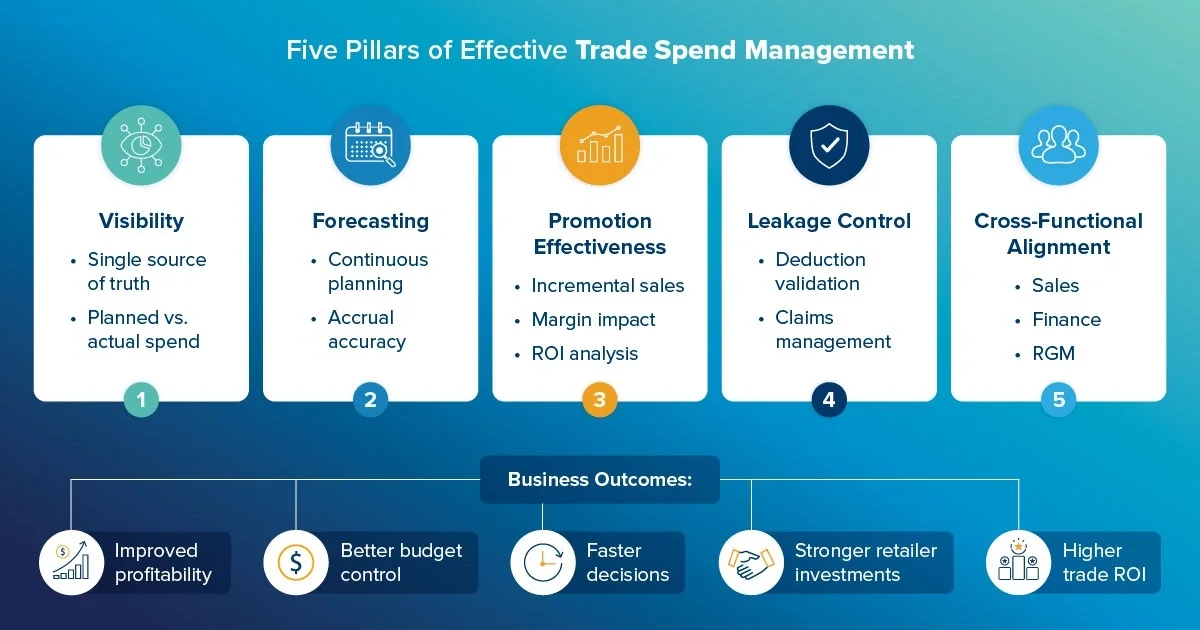
5. Align Sales, Finance, And Revenue Growth Management Teams
Trade spend management touches multiple functions across the organization. Unfortunately, these groups often have different priorities. Sales teams seek revenue growth and stronger customer relationships. Finance teams focus on profitability and financial control. RGM teams seek optimization opportunities and improved returns. When these groups operate independently, trade decisions can become fragmented. The most successful manufacturers establish shared objectives, common performance metrics, and consistent planning processes across functions.
Cross-functional alignment improves:
- Budget accountability
- Demand forecast accuracy
- Promotion planning
- Investment prioritization
- Decision-making speed
It also helps organizations balance short-term sales goals with long-term profitability objectives. When all stakeholders have access to the same data and insights, trade investment decisions become more strategic and effective.
Move Beyond Trade Spend Tracking To Strategic Trade Investment
Historically, trade spend management was viewed as a financial control function. The objective was to ensure spending stayed within budget and liabilities were accurately recorded. While these responsibilities remain critical, leading manufacturers are expanding their focus.
Today’s organizations are increasingly asking strategic questions like:
- Which customers generate the highest return on trade investment?
- Which promotional tactics deliver the strongest margin contribution?
- How should budgets be allocated across accounts and channels?
- Which investments support long-term growth objectives?
- How can pricing and promotion strategies work together more effectively?
Answering these questions satisfactorily goes beyond historical reporting. IT takes integrated data, advanced analytics, and a deeper understanding of promotion performance.
This shift requires the growing connection between trade spend management and broader revenue growth management initiatives. Organizations that can evaluate trade investments through both financial and commercial lenses are better positioned to make informed decisions and allocate resources effectively.
What’s The Role of Technology In Modern Trade Spend Management?
As trade environments become more complex, manual processes become increasingly difficult to sustain. Spreadsheets may support basic planning activities, but they often struggle to provide the visibility, scalability, and analytical capabilities required by today’s organizations.
Modern trade spend management solutions help consumer products manufacturers:
- Automate trade accruals
- Improve forecasting accuracy
- Manage deductions more efficiently
- Analyze promotion performance
- Track spending against budgets
- Identify optimization opportunities
- Support cross-functional collaboration
Technology enables faster access to information, allowing teams to move from retrospective reporting toward proactive decision-making.
Vistex helps consumer products manufacturers connect planning, execution, financial management, analytics and optimization processes across the trade spend lifecycle. By bringing together trade promotion management, deduction management, analytics, pricing, and revenue management capabilities, organizations gain greater visibility into promotional performance and financial outcomes.
How To Build A More Effective Trade Spend Strategy
Trade spending remains one of the most powerful tools available to consumer products manufacturers. It influences retailer relationships, market share, revenue growth, and profitability. Yet its effectiveness depends on how well organizations manage and evaluate those investments.
Manufacturers that continue to rely on fragmented data, manual processes, and retrospective reporting may struggle to identify opportunities for improvement and respond to changing market conditions.
The most effective trade spend management programs combine visibility, forecasting, accrual management, deduction control, promotion analytics, and cross-functional alignment. Together, these capabilities help manufacturers improve trade promotion ROI, reduce trade spend leakage, and make more confident investment decisions.
Explore more related resources
How to Build an Effective Joint Business Planning Process Driving Alignment and Trade Promotion ROI
Get the latest news, updates, and exclusive insights from Vistex delivered straight to your inbox. Don’t miss out—opt in now and be the first to know!