
What is AI training data licensing?
AI training data licensing lets developers use content—text, images, audio, or code—to train, refine, or ground models under agreed terms and compensation.
The commercial opportunity is growing. In 2025, the AI training data licensing market was estimated at roughly $4.8 billion, with projections suggesting it could exceed $22 billion by 2034. As this promising revenue stream develops, clear rights, pricing, and enforcement will be important.
AI training data licensing differs from traditional content licensing such as syndication, reprint rights, or stock licensing, because the content is either absorbed into the model’s weights or retrieved to answer queries. This changes the rights conversation entirely. Training rights, inference or retrieval-augmented generation (RAG) rights, and fine-tuning rights are not interchangeable. A license covering one doesn’t automatically extend to the others.
Before rights holders negotiate compensation, they must understand what they're licensing and how that use may differ from other forms of content access.
What counts as training data in AI development?
Training licenses let you ingest content to build or improve a model. Inference or RAG licenses work differently. They let models fetch real-time content, keeping it current and under the licensor’s control rather than permanently embedding it in model weights.
Rights-cleared datasets have secured permissions, including model releases and IP rights, giving developers confidence to use them. Licensing archived text for model training differs from licensing live content for real-time chatbot citations, so contracts must specify the use.
Why is licensing required for AI training data?
Licensing is a legal requirement grounded in copyright law, database rights, contractual restrictions, privacy obligations, and trade secret protection. Bypassing it carries consequences, including:
- Legal action
- Forced deletion of a trained model
- Costly retraining if data was found to be sourced unlawfully
Lawsuits over AI companies using unlicensed content have forced some developers to retrain models or negotiate settlements, outcomes that proper licensing could have prevented.
How do AI companies license and pay for training data?
As AI companies sign more licensing deals with creators and rights holders, the question is shifting from whether to pay them to how. Options include flat fees, usage-based payments, and revenue sharing.
Different content types and negotiating positions require distinct deal structures. Four licensing models cover most of what’s happening in today’s market:
- Transactional and subscription licensing models
- Usage- and performance-based licensing models
- Revenue share and royalty licensing models
- Collective or platform-based licensing models
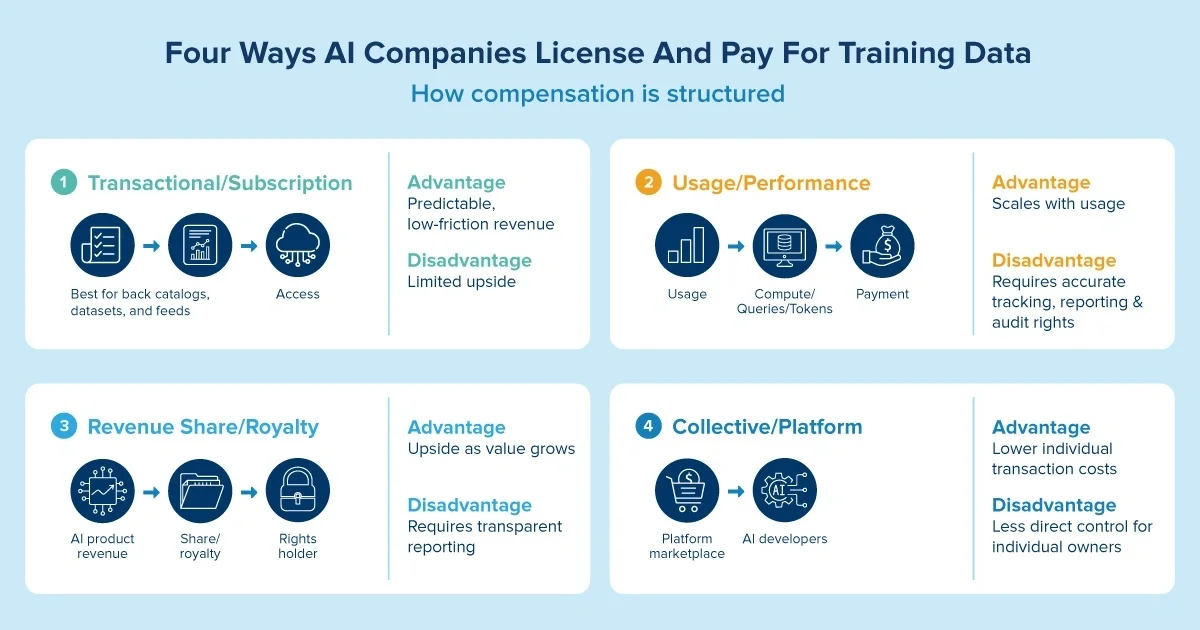
Each of these four models emphasizes predictability, upside measurement, and administrative effort to different degrees.
What are transactional and subscription licensing models?
Transactional and subscription models offer one-time access fees or recurring subscriptions. They’re a great fit for:
- Back catalogs
- One-off dataset purchases
- Continuously updated feeds
For example, recurring-license deals for platform data access are already reported to generate tens of millions annually (e.g., the Google–Reddit arrangement). The advantage is predictable, low-friction revenue. The disadvantage is that there’s no upside if the resulting model becomes valuable.
I believe transactional and subscription models will dominate the next two years: they’re low-friction, high-return, and flexible as digital and physical content tracking expands.
It’s not much different from a standard royalty for IP use, but it delivers recurring returns with less effort. Consumers keep paying the subscription fee, and the IP owner doesn’t have to expend the same effort to extend the revenue stream over time. The cost of running the IP operation drops while the revenue stream continues. It’s not a set-it-and-forget-it solution, but it enables a more passive revenue stream with less ongoing effort.
What are usage- and performance-based licensing models?
With usage- and performance-based models, payment scales with:
- Training volume
- Compute consumption
- Model deployment
- Per-query and per-token usage (tokens are units of text that AI models process, such as words, parts of words, or punctuation)
This model works when the contract includes accurate usage tracking, reporting infrastructure, and audit rights. Per-token and per-query pricing ties compensation to the volume of text processed or to the number of requests the AI model handles.
What are revenue-share and royalty licensing models?
Revenue-sharing and royalty models give rights holders a share of revenue instead of a fixed fee. For example, some music settlements have replaced one-time payouts with ongoing licensing and royalties.
This model requires full transparency from the AI developer. Without honest reporting, the arrangement fails.
What is collective or platform-based licensing?
Collective management organizations (CMOs) and marketplaces negotiate for multiple rights holders, reducing transaction costs and enabling deals that individual holders can’t negotiate alone.
The News Corp–OpenAI deal, reportedly worth about $250 million over five years, is often cited as evidence that scale deals can be achieved outside a collective structure.
How is AI training data valued?
Choosing one of the four compensation models works only if a rights holder can assign a value to their data.
What factors drive AI training data valuation?
Valuation is tied to these variables:
- Data uniqueness
- Freshness
- Scale
- Accuracy
- Provenance
- Exclusivity
- Replacement cost
- Market comparables
- Dataset's contribution to model effectiveness
Unlike widely available web content, exclusive access to scarce resources, such as professional audio or proprietary business data, can command a premium price.
What makes AI training data hard to value?
The main challenge is isolating the marginal value of a specific dataset within a model trained on multiple data sources. Another challenge is quantifying downstream commercial impact when a model's revenue stems from multiple combined inputs. Rights holders need documentation and analytics to support their negotiating position because no standardized valuation formula exists.
What contract terms matter most in AI data licensing deals?
The most important AI data licensing contract terms define permitted uses, ownership rights, attribution, data security, and audit and reporting requirements. Together, these provisions establish what rights holders can authorize, how their content is protected, and how compliance is verified.
How should scope of use and training rights be defined?
Define the scope of use and training rights by specifying whether the license covers base models, fine-tuned models, or both, and by stating its geographic scope and duration. Clarify whether it permits commercial deployment or only research use. If the license is silent on whether it covers foundation versus fine-tuned models, a vendor may interpret it as covering both, even if only one was intended.
Who owns AI model outputs and derivative works?
The contract should define ownership of training outputs, embeddings, model weights, and improvements derived from licensed content, and clarify whether generated outputs require attribution or royalties. Otherwise, the licensee could argue the model is a derivative work beyond the licensor's control.
How should attribution and data security be handled?
Agreements should define security standards; backup, cache, and shadow-copy retention and deletion policies; incident-response procedures; attribution, where applicable; and safeguards for confidential or sensitive content.
Many contracts don’t specify what happens to embeddings or cached copies after the agreement ends, leaving the licensor’s content in systems the licensor no longer uses.
What audit and reporting rights should contracts require?
Contracts should require usage reporting, royalty statements, and verification or audit rights, along with remedies for breach, underreporting, or unauthorized use. A revenue-share deal without audit rights is unenforceable, and the licensor can't verify the reported usage.
I don’t think rights holders negotiate these protections away. What I see more often is:
- The contract doesn’t include enough compliance detail to protect the brand
- The contract includes solid protective verbiage that isn’t enforced.
While the legal team protects the brand on paper, day-to-day partnership maintenance and compliance are the first to be set aside because of the “tyranny of the urgent.”
I’ve seen these patterns repeat across multiple brand owners. I expect AI will address these rights and remedies, creating a more sophisticated version of the same problem.
Strong contract language matters when a rights holder can determine whether the terms are being followed. That makes detection and ongoing monitoring essential components of the licensing model.
How is unauthorized AI use of licensed content detected?
Rights holders can detect unauthorized AI use of licensed content through provenance and consent tracking, dataset watermarking, and analysis of AI-generated outputs. AI can ingest, modify, and reproduce elements of licensed content across systems, making detection difficult for rights holders. Detection is integral to protecting the license itself.
Infringement concerns for brand owners are more prevalent, occur faster, and require closer scrutiny. AI should combat unauthorized AI use. Nothing prevents AI from policing itself.
How does provenance and consent tracking work?
Documentation should record:
- Named sources
- Rights basis per source, including license terms, text and data mining exceptions and documented permissions
- Processing steps, including deduplication, filtering and annotation
- Known contamination issues in which training and evaluation data overlap
This includes data ingestion, consent validation, provenance tagging, and compliance audits. Ingestion already checks for C2PA (Coalition for Content Provenance and Authenticity) "do-not-train" signals.
How can watermarking detect unauthorized AI training use?
Dataset watermarking embeds imperceptible patterns in training data that survive transformations and appear in model outputs. Trigger datasets contain inputs that elicit identifiable outputs from models trained on watermarked data.
Output analysis compares AI-generated content with original works to identify phrases, statistics, or structures that indicate the model was trained on the source content.
Provenance and watermarking help establish data origins and signal unauthorized use. Determining whether a model’s output is linked to a specific proprietary source is harder.
How to distinguish proprietary value from publicly learnable data?
Models can learn a great deal from publicly available data, making it harder to prove that a particular proprietary dataset made a unique contribution. This complicates infringement claims and pricing.
I haven’t noticed an uptick in what IP usage approvers are seeing about whether content is human- or AI-generated. If a B2B partner submits the idea, the receiver would need a sharp eye to detect the design's authenticity. Again, AI could be used to detect AI use.
On the legal front, it’s unclear whether this distinction would hold up in disputes. A human could independently create something just as compelling as AI-generated content. If the two are indistinguishable, how could a court or jury tell them apart?
Detection matters because unauthorized use carries consequences beyond lost licensing revenue.
What are the legal risks of using unlicensed AI training data?
Using unlicensed AI training data can expose companies to copyright infringement claims, contract disputes, privacy violations, and regulatory penalties. Privacy laws, consent requirements, and restrictions on cross-border data transfers, such as those under the GDPR (General Data Protection Regulation), may also apply. Meeting these requirements helps reduce legal and regulatory risks across the enterprise.
Companies may also face trade secret claims, forensic investigations, and costly litigation when they can’t establish that their training data was lawfully obtained and used.
Opaque supply practices can damage relationships with partners, customers, and regulators, even without formal litigation. Delayed governance decisions become harder to reverse as the market and regulatory environment mature.
How can rights holders build controls to manage these risks before an AI licensing deal is signed?
How to build an AI licensing strategy
Start an AI licensing strategy with a comprehensive inventory of owned, licensed, and restricted data assets, then map rights, obligations, territories, and exclusions in a centralized system rather than scattering them across individual contracts.
Structure AI licensing negotiations carefully. Match compensation to the dataset’s strategic value, risks, and expected use. Favor flexible terms suited to AI development and deployment over legacy templates designed for other deals.
What technology supports AI training data royalty management?
An AI-ready royalty system requires five components to enable compliance monitoring and reporting across integrated systems:
- Unified rights view
- Unambiguous consent rules for what can and can't be used for AI training
- Usage lineage tracking
- Flexible royalty logic supporting multiple compensation models
- Open reporting back to rights holders
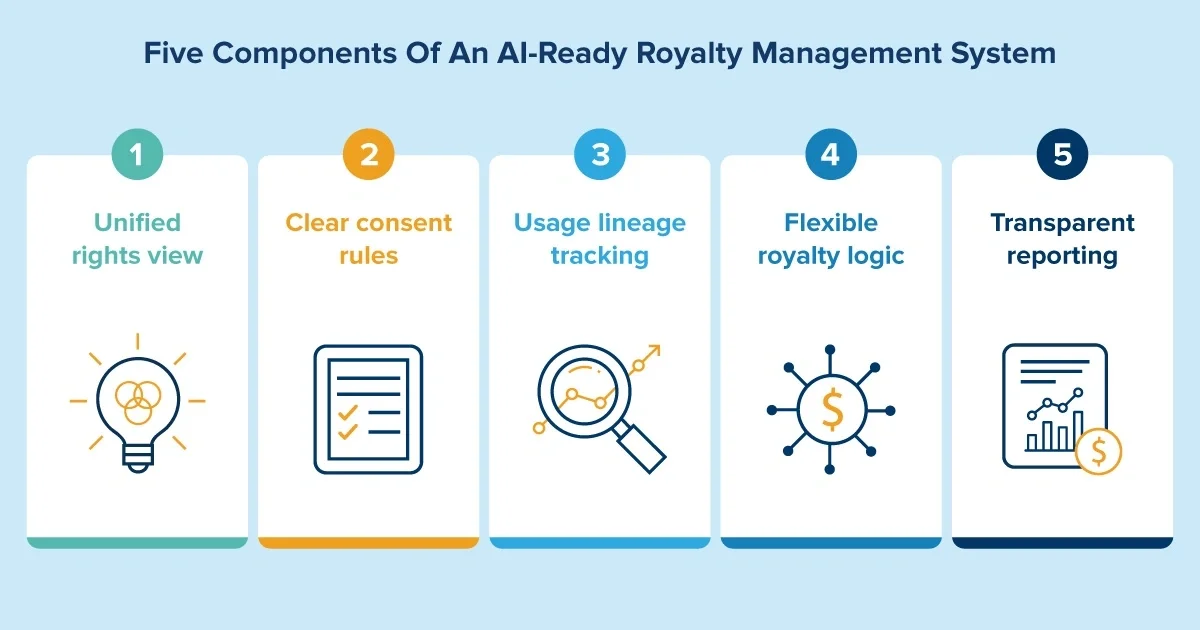
AI training royalties need to align with the existing rights splits. If an asset is split 50/50 between two publishers, AI training royalties should flow accordingly, with usage logs showing which models ingested the data.
Legal, licensing, finance, data governance, and product teams work best when they coordinate around a shared roadmap. One common challenge is that the legal team may negotiate strong contract terms, while finance doesn’t yet have the royalty infrastructure needed to collect on them.
As more companies begin using these systems, the market will gradually establish shared approaches to licensing, reporting, and compliance.
Will AI training data licensing become standardized?
Expect more marketplace norms, template licenses, and industry-specific frameworks. Sector-based licensing for pharmaceutical R&D data, music, and publishing will enable tailored pricing and usage terms.
You should also expect systems that automate usage tracking, royalty allocation, and compliance checks at scale. Such automation is necessary to reduce market complexity.
What regulatory changes are ahead for AI training data?
Evolving laws, class actions, regulatory guidance, and proposed EU transparency obligations that require AI providers to disclose training data sources are now part of the equation.
Companies that build governance now are positioning themselves proactively, while those that wait react to rules already in place.
Licensing leaders should immediately adopt their own ethics policies to ensure that all brand-related activity is genuine and “protectable.” They should also strengthen the skills of team members authorized to detect and block illegal AI use.
The future could see penalty clauses in license agreements for using AI, in whole or in part, but I’ve not yet seen evidence of that.
The market direction is clear, even as the rules evolve. Rights holders must manage AI-related rights, compensation, and compliance now.
Why choose structured licensing over costly exposure?
A clear data licensing strategy protects valuable assets, reduces risk, and creates revenue opportunities. Review your data rights, compensation, and compliance controls to assess your position.
Complacency is the biggest risk. Never assume your IP is “golden” and doesn’t need protection. Remove hubris from the business plan, and make foresight the defining trait of every licensing agreement. A 100% AI-generated IP could take the market by storm. It may not be the next Pet Rock or La Bubu craze, but it could win the emotional battle at checkout over non-AI IP.
This is where Vistex operates: an enterprise platform that unifies rights inventories, royalty calculations, and usage tracking throughout licensing programs. AI training data becomes a governed revenue stream rather than a liability.
While the AI training data market is still taking shape, the companies writing today’s rules through contracts, audits, and compensation models will set the terms that everyone else follows.
Explore more related resources

Get the latest news, updates, and exclusive insights from Vistex delivered straight to your inbox. Don’t miss out—opt in now and be the first to know!