

How royalty management software is reshaping IP audits and licensing revenue control
For decades, royalty management was treated as a routine accounting task. Spreadsheets, quarterly reconciliations, and the occasional audit were enough to keep licensing programs running, and the idea of dedicated royalty management software would have seemed like overkill.
But licensing economics have changed. Contracts are more complex, royalty calculations involve dozens of variables, and audits have evolved into forensic investigations backed by sophisticated data analysis. Companies across the licensing ecosystem rely more heavily than ever on IP-derived revenue.
That combination has quietly turned manual royalty management into a strategic risk. Small operational errors that once went unnoticed can now surface as six- or seven-figure audit findings — along with reputational consequences that reshape licensing relationships.
And most organizations don’t realize the risk is building until an audit exposes it.
Licensing contracts have outgrown the tools managing them
The scale of the licensing industry makes this shift impossible to ignore. According to Licensing International, global retail sales of licensed products reached $369.6 billion in 2024, growing despite persistent economic headwinds.
When contracts became computational systems
Licensing agreements are no longer simple percentage-of-sales arrangements. Today’s contracts often include:
- Multi-tiered, time-phased royalty rates
- Territory- and channel-specific net sales definitions
- Non-cross-collateralized minimum guarantees
- Discount caps and return thresholds
- Performance-based escalators tied to sales targets
Together, these terms create agreements that behave less like static documents and more like computational systems involving dozens of interdependent variables across markets, products, and channels. Spreadsheets were never designed for that.
Why are audits no longer occasional events?
As contracts have grown more complex, licensors have become more disciplined about protecting their revenue. Royalty audits now function as structured financial governance programs, supported by forensic accounting firms and advanced analytics.
What auditors are finding
When auditors dig into royalty data, the findings are rarely minor:
- 86% of audited licensees underreport royalties
- 75% of audits uncover discrepancies
- 60% reveal underreported sales
- 30% involve misinterpreted rate structures
The reputational impact can be even greater. Repeated discrepancies erode trust between licensing partners and shift negotiating leverage toward licensors during renewals. In a relationship-driven industry, that damage lingers long after the financial correction.
Operational gaps turn royalties into audit risk
Royalty exposure rarely appears overnight. It accumulates quietly through operational friction and fragmented data.
Why spreadsheets break under audit pressure
Many organizations still rely on processes built for a simpler era:
- Human interpretation of complex legal language
- Spreadsheet formulas managing conditional thresholds
- Static data extracted from multiple enterprise systems
- Periodic reconciliation instead of continuous validation
The data needed for royalty calculations resides across ERP systems, CRM platforms, e-commerce marketplaces, product lifecycle tools, and third-party logistics providers, each storing information in different formats and requiring manual extraction.
Finance teams often stitch everything together in Excel, creating fragile shadow systems dependent on individual knowledge. That approach may work day-to-day, but it breaks down when auditors start asking deeper questions.
The gap between contractual intent and operational execution is where most audit findings originate.
A 5% error on $10 million in revenue creates a $500,000 discrepancy
Even straightforward royalty structures introduce systematic errors.
The tiered-rate problem in practice
Consider a contract paying 13% on the first 200,000 units and 15% thereafter. If a licensee sells 250,000 units generating $400,000 in revenue, the correct calculation requires separating units and applying each rate accordingly.
Manual workflows introduce shortcuts, averaging the rate, applying the wrong threshold, or using a single percentage across all revenue. A modest 5% error on $10 million in revenue creates a $500,000 discrepancy.
Royalty management software is enhanced by royalty intelligence
Leading licensing organizations are rethinking how royalty operations function. Instead of treating royalty reporting as a retrospective accounting task, they’re implementing royalty management platforms that translate contract terms into executable business logic. These platforms, increasingly referred to as royalty intelligence systems, go beyond traditional royalty management software by embedding contract logic directly into operational workflows, validating transactions continuously rather than months later during reconciliation.
Royalty management software automates calculation while royalty intelligence turns those calculations into continuous visibility, audit readiness, and strategic insight across the licensing portfolio.
What a unified control layer means
This shift introduces something the industry historically lacked: a unified operational control layer. Under this model:
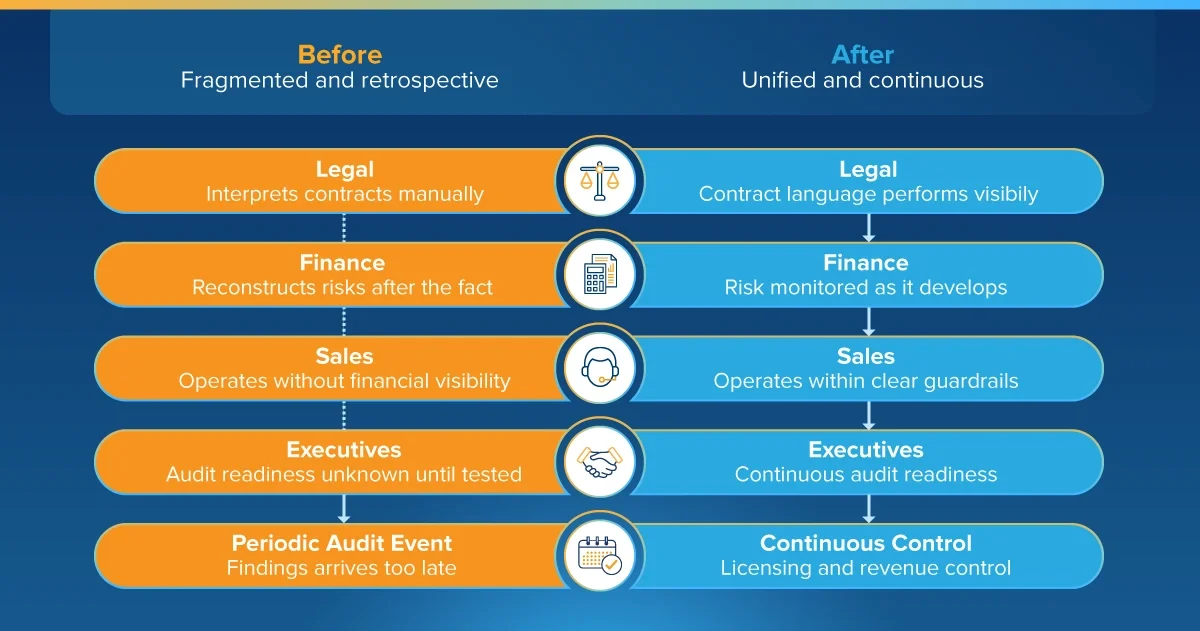
Together, these capabilities create genuine licensing and revenue control as a continuous operational discipline.
Modern systems ingest data from ERP and e-commerce platforms, identify licensed SKUs, apply configurable contract logic, track minimum guarantees, and maintain full audit trails from transaction to payment. Many now incorporate AI for contract ingestion, anomaly detection, and forecasting.
The real breakthrough is continuous control over the economic logic governing licensing revenue.

Royalty intelligence works as strategic infrastructure
When embedded in daily operations, royalty intelligence extends beyond compliance. Licensors gain portfolio-wide visibility for benchmarking, early detection of underperforming licensees, and smarter expansion decisions.
Beyond the licensor: Who else gains visibility
Licensees can model the financial impact of new products or markets before committing resources. Agents gain data-driven insights that strengthen client relationships.
The same infrastructure that protects revenue integrity also unlocks strategic insight, moving organizations from reconstructing financial outcomes after the fact to observing performance as it unfolds.
The licensing industry has reached an inflection point. Contracts are increasingly algorithmic, audits are forensic, and intellectual property (IP) revenue is one of the most valuable assets on many balance sheets.
Manual royalty processes create inefficiencies and exposure that compound financially, operationally, and reputationally over time.
The organizations that succeed in the next decade of licensing will combine strong brands with strong operational control over how those brands generate revenue.
In modern licensing, royalty intelligence is the infrastructure that protects IP economics.
Download our eBook, “Managing IP Audits in the Age of Royalty Intelligence: Why Manual Royalty Operations Have Become Strategically Risky,” for more insights on building defensible, auditable royalty operations that can support sustainable IP monetization in 2026 and beyond.
Learn more about solutions that streamline royalty processing, strengthen rights compliance, and turn complex licensing agreements into profitable, predictable revenue streams.
Get the latest news, updates, and exclusive insights from Vistex delivered straight to your inbox. Don’t miss out—opt in now and be the first to know!