
What is a product placement licensing agreement?
A product placement licensing agreement grants permission to feature a brand, product, or piece of intellectual property (IP) inside film, television, streaming, or digital content, in exchange for defined compensation and creative terms. A brand's on-screen appearance carries real commercial value, and that value needs the same contractual precision as any other licensed asset.
Even more basic than getting the terms right, the most classic example of a product placement licensing agreement came down to a simple decision: whether to enter a placement deal at all. E.T. the Extra-Terrestrial screenwriter Melissa Mathison included M&M’s in the original script.
Still, parent company Mars, Inc. passed on the placement deal, partly because it worried about how the alien's appearance might affect the M&M's brand. Steven Spielberg turned to Hershey, whose Reese’s Pieces had launched 4 years earlier, and a negotiated $1 million placement fee became part of cinematic history, along with a big chunk of Hershey’s more than $2 billion annual revenue for the Reese’s brand.
Where product placement ends and sponsorship begins isn’t always obvious on a first read of the brief. The difference often comes down to cost and commitment.
Sponsorship is typically more expensive and can imply an ongoing commitment, beyond a finite placement. If a producer wants a character to use a particular piece of branded merchandise, from gardening tools or kitchen appliances to personal beauty products, getting your product “in the scene” requires a one-time negotiated agreement, and the placement then lives in perpetuity in the digital media. As long as the placement aligns with the brand, it’s ideal for long-term gains.
Sponsorship generates “buzz” or a surge in sales, but it also comes with costs, including broadcasting deals, advertising costs, sponsorship-specific artwork, event management, and other expenses. Once the sponsorship ends, you lose the opportunity to build brand awareness.
How product placement works across film, TV, and digital media
Product placement started in film and TV, with brands paying to appear in a scene. It’s since expanded into live events, digital content, and gaming, each with its own placement mechanics and rights considerations.
I don’t see many challenges in product placement. It’s a well-established practice dating back to the mid-1900s. Some brand owners aren’t as up to speed on newer media, where they can negotiate placement as they used to, but that won't last long. Whether you place a can of soda in a video from The Beast or have a sitcom character drink from a can of that same soda, the product placement deal terms aren't wildly different. Brand owners need to be clear on how the product is used, but that need transcends the medium and has been standard in placement deals for decades.
How product placement differs from sponsorship and brand licensing
Product placements, sponsorships, and endorsements grant different rights and come with different obligations. Knowing where product placement ends and sponsorship begins is the first step in drafting terms that match what you're licensing.
How product placement fits into IP licensing strategy
Product placement advances IP licensing by boosting brand visibility, reaching new audiences, strengthening partnerships, supporting launches, and creating consumer-product and retail opportunities. Negotiated placements can also generate revenue.
A good way to assess each opportunity is to consider how it supports the brand’s commercial objectives, fits with existing licensing commitments, and contributes to long-term value. When negotiating placement, keep the broader licensing portfolio in mind rather than evaluating each opportunity on its own.
Why do product placement licensing agreements matter?
Placement earns a spot in the portfolio if it produces measurable value. Published studies show that more than half of U.S. adults consider it an effective form of advertising. It all depends on who’s watching, which changes how a licensor approaches pricing and rights.
Demographics, specifically age, can affect a product placement. The financial and legal terms wouldn’t change much, except for a clear definition of how the brand appears or is used. A brand that typically targets tweens wouldn’t easily be featured in a war movie or a western, but it would appear in family-based sitcoms or a docuseries featuring tweens.
How, when, and where the brand is used matter greatly, as does who uses it or references it. The contract terms would require the character to match the target demographic.
How does audience age affect product placement licensing terms?
Not every audience responds to product placement the same. Younger viewers act on what they see at about twice the rate of older viewers. This changes how much a licensor should ask for and what rights a brand should demand.
Strategic value matters only once it’s written into the agreement, where contract mechanics take over.
What are the key components of a product placement licensing agreement?
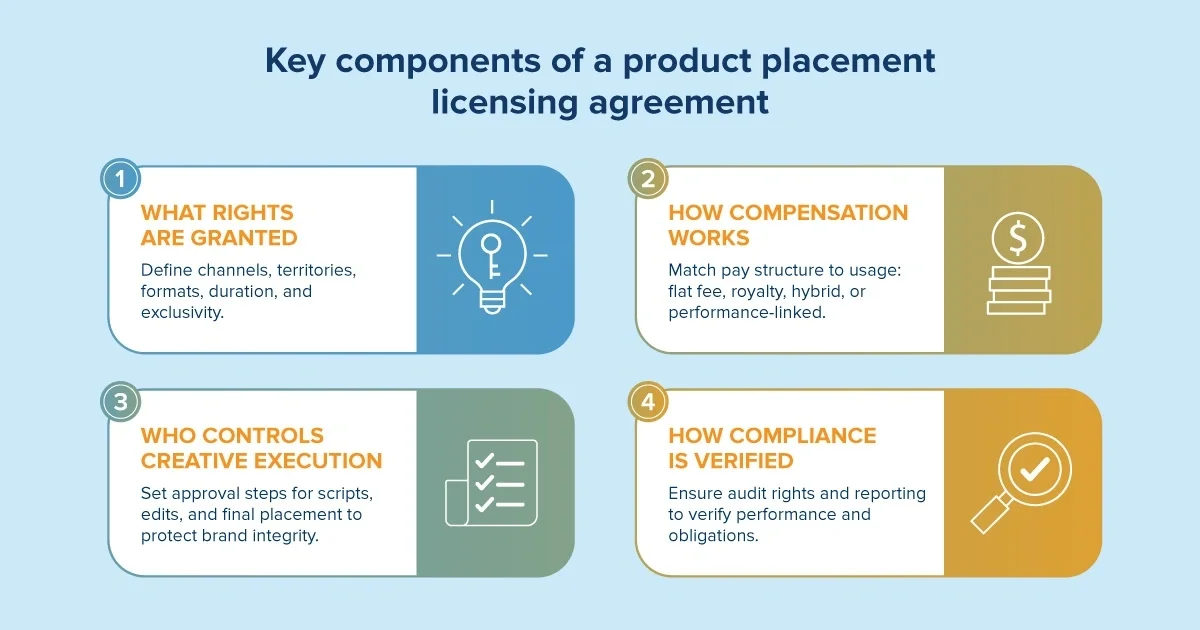
Four elements help determine whether a product placement agreement leaves gaps for later disputes:
- What rights are granted
- How compensation works
- Who controls creative execution
- How compliance is verified
What rights and usage scope belong in a product placement agreement?
Every agreement requires explicit terms that define the licensing scope, including channels, territories, formats, and duration, and specify whether the placement rights are exclusive.
The most common mistake is an unclear definition of distribution. The scope usually clearly defines how the product or brand can appear and for how long. Once the placement airs, the brand or product forever appears in that version of the media forever. If that’s in a film, for example, and the film will be released in territories where the brand's packaging and logos differ, the terms need to define how the placement varies by market.
How are product placement royalties and compensation structured?
With the scope defined, compensation must match how the product placement is used. Flat fees work for a single scene, while royalty-based, hybrid, or performance-linked structures fit product placements that run across multiple releases or platforms.
Flat fees are the most common. If the product or brand appears in multiple releases or platforms, each placement has its own fee. You could structure a performance-based fee, but the brand owner pays the fee.
In my experience, the brand owner walks away from a deal that includes a fee escalation based on something like the number of viewers or box office performance. A product advertisement costs a set amount to produce, and its production cost doesn’t increase when the ad is viewed more times than expected. There may be a residual or name and likeness (N&L) component, but product costs are set, as is typical with placement deals.
Who controls creative approval in a product placement agreement?
If the final product placement fails to reflect the brand, the money and rights mean little. Approval workflows for scripts, edits, and final execution protect brand integrity without stripping away creative control.
The use of the brand or product is negotiated specifically up front, specific enough that the approval process is simple. The placement either falls within the agreed terms or it doesn’t. Brand managers and intellectual property (IP) legal teams are particular about product placement because it's permanent, especially in digital media. It’s a measure-twice, cut-once business.
What compliance and audit rights belong in a product placement agreement?
Every other component in the agreement depends on the ability to verify it happened as agreed.
Compliance and audit rights turn stated terms into enforceable ones, generating the reporting data the technology section depends on. Yet compliance rarely fails at the audit stage.
I’ve seen complicated compliance checklists, especially for food-based products and socially sensitive or controversial products. Still, it would be nearly impossible for an incorrect placement to go undetected at any stage. An audit might catch illegal use or an infringement, but that use would never have gone through any approval process.
Rights, compensation, approvals, and compliance cover a standalone product placement deal. Many placements are bundled with a broader sponsorship, which raises its own drafting questions.
How do you combine sponsorship and product placement in one agreement?
Sponsorship and placement are negotiated together, then documented in separate contracts that never reference each other. That creates ambiguity an agreement should prevent. In practice, few licensors will write one agreement for both.
Rarely are both traditional sponsorship and traditional placement in the same agreement. Each method has a different impetus. Sponsorship is obvious, transparent, and announced. Placement can be subtle and suggestive. Both can effectively reach a target audience, but they're rarely used together in the same promotion.
Where do sponsorship rights and placement rights overlap?
Sponsorship buys association and visibility around content, while product placement buys the presence inside the content. Overlap typically surfaces in co-branded events, integrated promotions, and deals where a brand's name and its product appear.
How do you structure one agreement for exposure, activation, and measurement?
A unified agreement allows a brand to negotiate the on-screen moment and the promotional rights that extend it in a single document. One set of reporting terms covers both.
A notable best practice is to combine rights well. Getting either piece wrong, on its own or in combination, is where most placement deals break down.
What are the common pitfalls in product placement licensing?
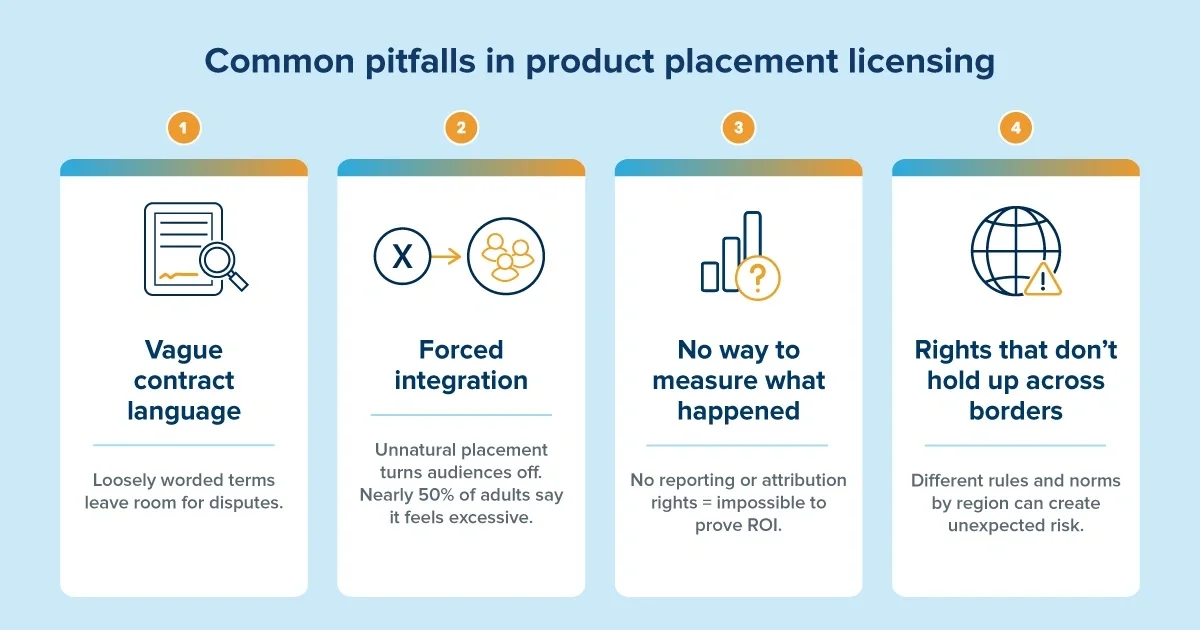
Most product placement disputes are tied to one of four recurring failure points:
- Vague contract language
- Forced integration
- Inability to measure what happened
- Rights that don’t hold up across borders
How vague contract language creates product placement disputes
Loosely worded scope, timing, or payment terms lead to disputes. Standardized templates that reflect consistent business rules remove most ambiguity before negotiations start.
Why forced or unnatural placement alienates audiences
The best contract can’t fix a product placement if the audience doesn’t buy. Forced placement feels excessive, which argues for creative consultation terms.
Unnatural placement has the biggest impact. Placement terms are usually clear, but if the required placement criteria are ambiguous, creative teams will use their inventive license to incorporate the brand in ways the brand owner didn't intend. The clearer the definition of who, what, where, when, and how, the less likely unnatural placement is to be a problem. This ties into vague language, and vagueness leads to unnatural placement, a visible symptom of a larger problem: no one can accurately predict how an audience will respond to a placement before it airs.
Placement is generally a risk because the brand owner doesn’t know how successful it will be or how much it will be seen. It’s difficult to measure ROI. Unless you’re negotiating a “sure thing,” your placement might require a leap of faith or strong gut feeling.
A product placement can spark consumer action and still be impossible to prove if the agreement wasn’t negotiated for the data. Build reporting and attribution rights into the deal up front.
How territory and cross-border rules complicate placement agreements
Product placement agreements that work in one market can create exposure in another, given differing disclosure rules and platform norms by region. Territory-specific terms should be explicit.
Most of these pitfalls share a root cause: fragmented data and inconsistent processes across a growing portfolio of deals. That’s as much a systems problem as a drafting problem.
How technology supports product placement licensing management
Placement deals can be tracked in spreadsheets, but a real portfolio can’t. Centralized systems turn the contract terms above into something a licensing team can monitor and enforce.
Placement doesn’t have the same analytics, requirements, or pitfalls as the other branches of brand licensing. It’s transactional and purposeful. A good system to track contract terms and the approval process is important. Split that tracking need in half, and one side is simpler than the other.
The finance side is the easier element to track. Revenue or expense leakage would only happen because of a poorly negotiated fee. Without recurring financial obligations, compliance issues top the placement list.
Why centralized rights data matters for placement portfolios
When rights, obligations, and renewal dates live in one system instead of across several contracts, licensing teams see the full portfolio, not just the deal in front of them.
How automation improves placement approvals and royalty accuracy
Automated workflows reduce errors and delays from manual approval routing and royalty calculations. They also keep execution consistent across dozens of simultaneous product placements.
How real-time analytics improve placement measurement and pricing
Real-time analytics transform placement performance into pricing data for the next negotiation. Technology is reshaping what a placement agreement covers. What‘s coming next will push those requirements further.
What’s next for product placement licensing agreements?
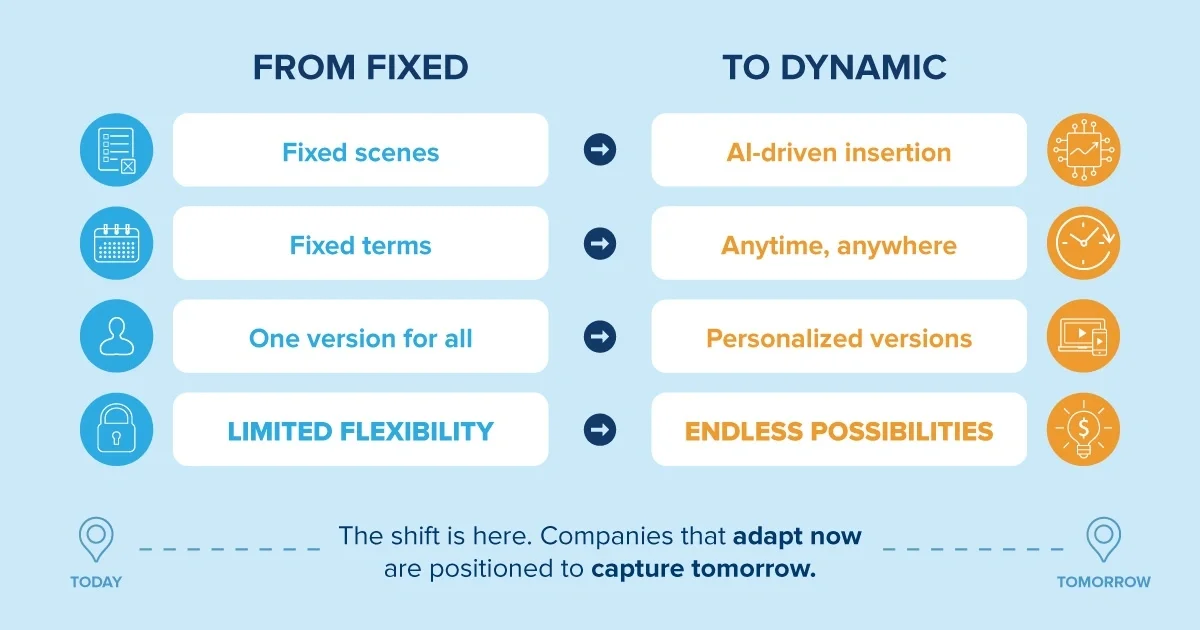
Streaming and AI-driven insertion are pushing product placement beyond the fixed-scene, fixed-term model most agreements use. With virtual and dynamic product placement, an older show can now feature a product that didn’t exist when it was filmed, without any reshoots.
That shift previews where every agreement in this portfolio is heading, and the companies that adapt their contracts now are positioned to capture it.
How do you prove product placement licensing pays off?
When companies standardize terms, centralize rights data, and negotiate measurement rights, they can see whether a product placement drove revenue and find ways to extend its value. Treating each product placement deal as a one-off media buy makes it harder to know what worked and where the deal fell short.
That verdict comes down to infrastructure and intent. Even the best-negotiated terms are only as strong as the system tracking them.
Don’t undervalue what you can gain from product placement. The return may be indirect compared to physical sales, but consumers will notice when your brand isn't there. When all your competitors are already using it, make sure you are, too.
Build a licensing system that proves placement value
Rights scope, royalty structures, approval workflows, and compliance reporting depend on real-time tracking. Most licensing teams still run that portfolio on spreadsheets and disconnected contracts. That’s where most product placement value leaks out.
Vistex brings rights management, royalty calculation, and compliance reporting for product placement and licensing agreements into a single source of truth, ensuring the scope, compensation, and audit terms negotiated into each deal are the terms tracked and enforced. That’s the kind of centralized visibility that turns a well-drafted product placement licensing agreement into one a licensing team can monitor and enforce at scale.
Product placement is becoming more dynamic and measurable, but scattered contracts and spreadsheets complicate management. Centralizing rights, terms, approvals, and compliance helps licensing teams protect their value and demonstrate what each deal delivers.
Explore more related resources


Get the latest news, updates, and exclusive insights from Vistex delivered straight to your inbox. Don’t miss out—opt in now and be the first to know!