
Why intellectual property protection failures keep showing up in licensing agreements
While licensing agreements should generate revenue and protect brand equity, operational gaps often create liabilities and enforcement failures. In one scenario, a licensing audit identifies a seven-figure royalty shortfall. In another, a brand appears in a retail channel it never licensed. Those running the licensing program may understand the basics of intellectual property (IP) protection, but they may lack a contract with the provisions and operational controls to enforce it properly.
Precise definitions in IP agreements prevent expensive errors. Ambiguous terms can lead to brand misunderstandings, reduced sales, and territory disputes. As AI-generated content and intricate sublicensing become more prevalent, robust agreements are increasingly crucial. Proper IP protection comes from carefully crafted contracts and efficient practices.
Start with an IP audit before building a protection strategy
Before a licensing operator can protect IP, they need an inventory of what they own, what they have licensed, and where the documentation gaps are. That inventory work underpins everything else.
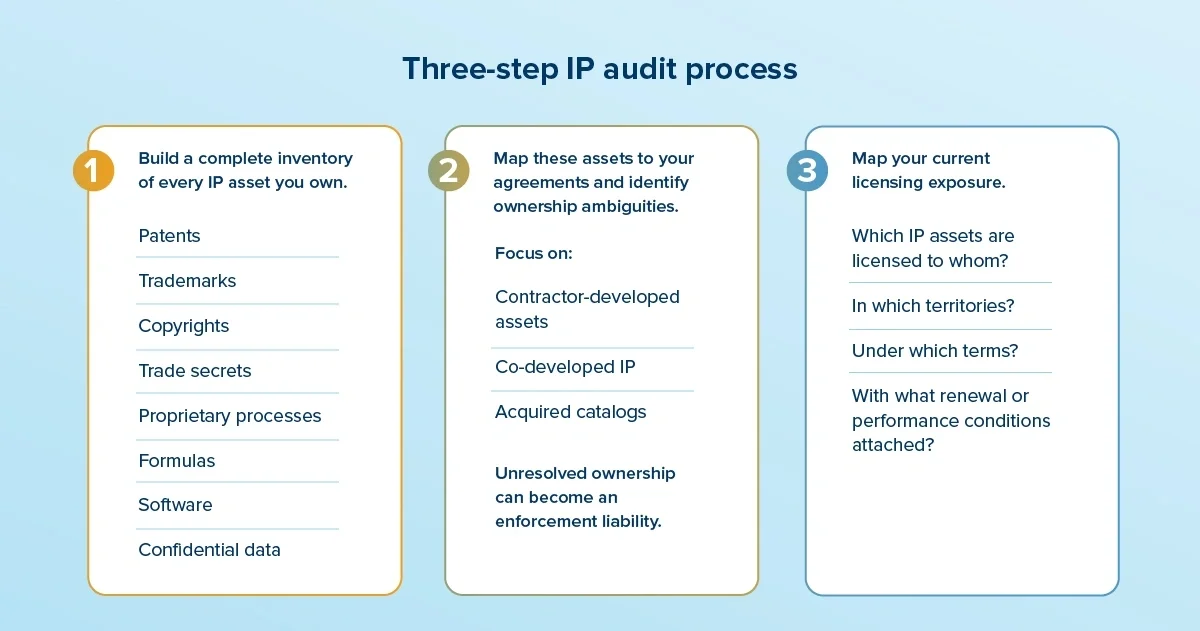
Start by cataloging every IP asset the company holds, including:
- Patents
- Trademarks
- Copyrights
- Trade secrets
- Proprietary processes
- Formulas
- Software
- Confidential data
Map the assets to the agreements in which they appear, and identify ownership ambiguities. Contractor-developed assets, co-developed intellectual property, and acquired catalogs involve chain-of-title questions that can often lead to enforcement liabilities in a licensing dispute.
The audit should also map current licensing exposure:
- Which IP assets are licensed to whom
- In which territories
- Under which terms
- With what renewal or performance conditions attached
Missing creation records, unsigned assignments, and undocumented usage rights create enforcement problems when violations occur. These issues can weaken your case, so keep everything documented and properly signed. The goal of the IP audit is operational visibility into what’s protected, what’s exposed, and where the next problem lies.
The five contract provisions that determine whether IP protection holds
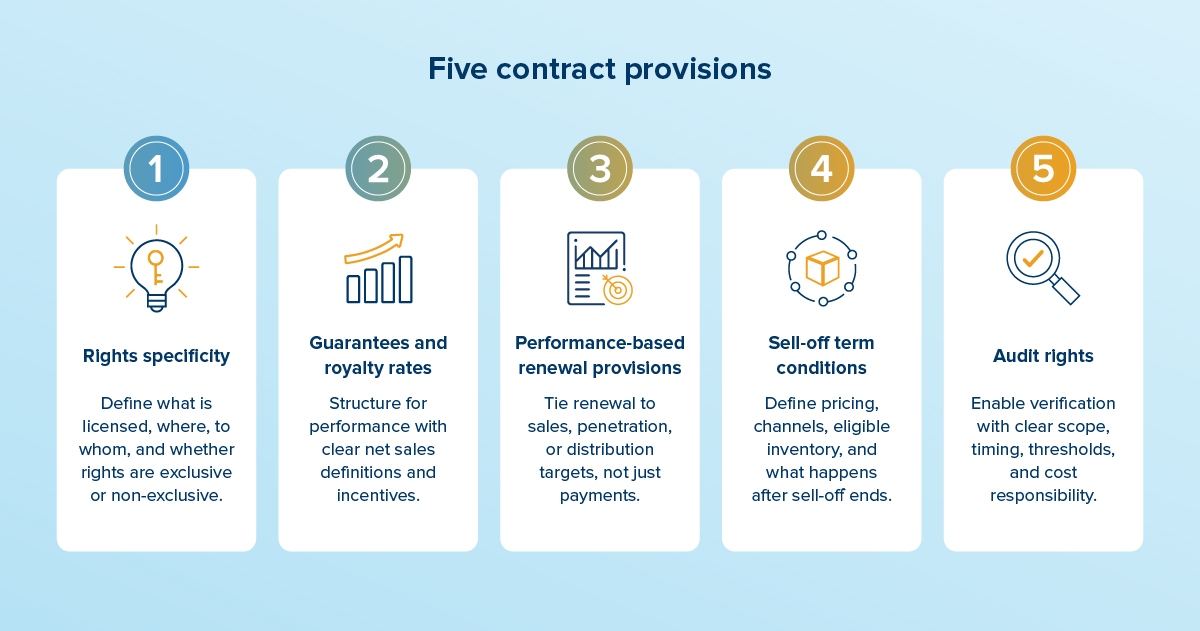
Five contract provisions determine whether IP protection holds in a licensing relationship:
- Rights specificity
- Guarantees and royalty rates
- Performance-based renewal provisions
- Sell-off term conditions
- Audit rights
Rights specificity means defining what is licensed, where, and to whom
Vague rights grants are the most common source of licensing disputes that I encounter. Licensing agreements should clearly define which intellectual property (IP) rights are being licensed, the specific product categories involved, the retail channels or territories, and whether the rights are exclusive. For example, a license that states “North America” without specifying whether it applies to retail, direct-to-consumer, or e-commerce creates ambiguity a licensee could exploit.
The most overlooked rights-definition gap is the lack of a discrete definition of the products and product categories available to each brand and territory. That definition must be tied to the trademark registration for the brand in that territory.
When the rights granted aren’t explicit enough, you end up with legal risk of liability from a product sale the licensee can argue was included, and the licensor can argue was excluded. If that liability arises and there’s no associated trademark protection, the brand owner suffers financially, legally, and in brand recognition and integrity.
Clearly define exclusive rights and keep a strong focus on the commercial rationale. Avoid broad exclusivity, which limits the licensor's ability to profit from the same IP across channels or regions. Additionally, outline sublicensing rights to enable the licensee to transfer rights.
Guarantees and royalty rates should be structured for performance
When royalty rates and minimum guarantees don’t align with market objectives, agreements may meet standards but fall short commercially. Rather than setting a minimum that offers no incentive for performance, create guarantees and royalty rates that encourage product sales in targeted markets or regions.
It’s important to clearly define what net sales entail. Specify trade discounts, the process for reporting returns, and any optional discount arrangements before the first royalty statement is generated. Addressing potential conflicts during the drafting phase helps avoid future legal issues.
Performance-based renewal provisions protect against under-exploitation
Performance-based renewal provisions link a licensee's right to renew their license to such requirements as meeting minimum sales, reaching market goals, or maintaining active distribution.
Failing to include these performance criteria could leave the licensor trapped in an exclusivity contract with a licensee who isn't using the rights effectively. This prevents the licensor from pursuing more advantageous licensing opportunities in the same industry or market.
In my experience, licensors underuse performance-based renewal provisions for convenience. When there’s an established relationship with a licensee, there’s no pressing need to write one in. It’s common to exclude a renewal provision because everyone assumes the licensee will perform and get renewed anyway. That logic fails in the unforeseen, the force majeure event. Something as ordinary as a weather event can shut down a manufacturing plant and leave a licensee unable to meet obligations they've consistently met for years.
An effective performance trigger sets achievable objectives and incentives to meet or exceed them. This provision should be clear-cut, regardless of the parties' background.
Sell-off term conditions determine what happens at the end of the agreement
The sell-off period increases brand visibility through licensing efforts. Clearly outline the guidelines, including price limits and eligible inventory. Communicate the strategy for managing residual inventory to maintain brand exclusivity and avoid unauthorized distribution channels.
A pricing restriction, the single sell-off provision licensors most often forget to include, leads directly to brand degradation in the consumer’s eyes. Consumers will wait for the licensed product to appear in a discount store rather than pay full price at launch. Over time, consumers come to expect the brand at a lower price point, which lowers the likelihood that the brand is considered premier.
Sell-off provisions interact with quality control requirements and brand standards. A licensee selling residual inventory through discount channels can cause lasting damage beyond the agreement.
Audit rights are the enforcement mechanism
Licensing agreements with commercial exposure should grant the licensor audit rights to access the licensee’s financial records. These rights should specify:
- Who can conduct the audit
- The notice period
- The records involved
- How to manage discrepancies above a certain threshold
The licensee pays for audit costs if shortfalls exceed a set percentage.
AI-driven royalty auditing tools detect reporting anomalies before formal audits, so agreements should include data-driven compliance monitoring and routine manual reviews.
Protecting confidential information and trade secrets in licensing relationships
Licensing relationships require sharing sensitive information, such as formulas, processes, pricing models and product roadmaps, with parties whose interests are not always aligned with the licensor’s interests. That exposure requires deliberate protection, starting with the confidentiality documents.
Non-disclosure agreements (NDAs) define confidential information
Non-disclosure agreements (NDAs) should define confidential information and avoid vague terms. They must outline allowed uses, duration, and conditions for third-party disclosure.
The agreement should also specify procedures for handling confidential information after termination, including obligations for return, destruction and certification.
Operational controls require access discipline, authentication, and documentation
Restrict access to sensitive information to individuals who need it, and keep records of who accessed what information and when. Implementing authentication measures and role-based permissions helps reduce the risk of unauthorized disclosures in multi-party licensing agreements.
Comprehensive documentation is crucial for maintaining confidentiality. Accurate records of shared information, involved parties, relevant NDAs, and relationship stages help distinguish enforceable from unenforceable trade secrets, particularly in disputes.
Proper offboarding procedures for employees and contractors are vital. Exit processes must include a formal acknowledgment of ongoing confidentiality responsibilities to mitigate the risk of trade secret leaks.
Detecting and responding to IP violations in licensing
Protecting IP requires vigilance and a robust action plan to address infringements. Key challenges often arise, including:
- Territorial infringements
- Unreported products
- Unauthorized sublicensing
- Undisclosed sales channels
AI tools can detect discrepancies in royalty reporting and channel activities.
The warning signs of a developing royalty compliance problem appear as abnormal patterns before they surface in a formal audit, including:
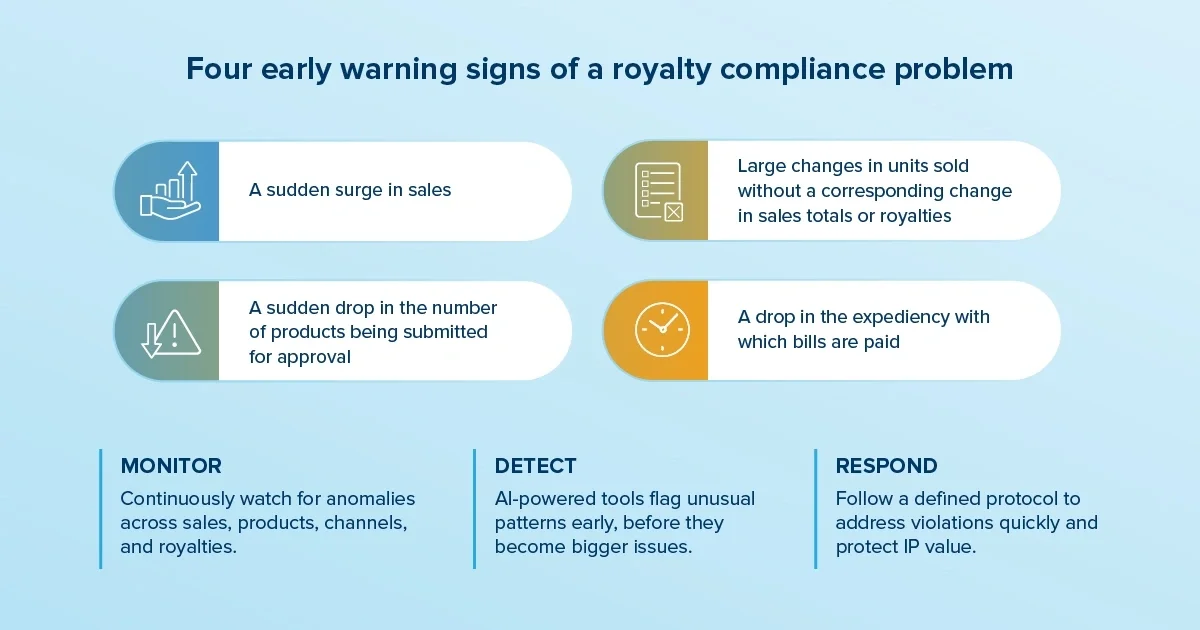
- A surge in sales
- A drop in the number of products submitted for approval
- Large changes in units sold without a corresponding change in sales totals or royalties
- A drop in the expediency with which bills are paid
Irregular patterns signal a notable change, but they can be identified at any stage of the licensing agreement's lifecycle, provided the operation is configured to monitor for them.
Verify ownership and document the infringement. Evaluate the impact on revenue and competition to determine next steps. Most licensing infringements arise from misunderstandings, so take legal action only for evident violations or when financial interests are involved.
IP rights differ by region, so international concerns add complexity. Licensing agreements crossing multiple markets require a strategy that accounts for variations in rights protection, enforcement, and legal timelines in each jurisdiction.
How AI and data-driven tools are changing what IP protection looks like
AI-powered royalty auditing spots errors that once required formal audits. Licensing teams managing large portfolios across regions can use integrated platforms to access real-time information on rights, territories, and owed royalties. This helps close documentation gaps that can affect enforcement.
Contract intelligence tools identify missing provisions and unclear terms during reviews. This reduces the chances of gaps in agreements, but the volume of data may overwhelm small teams. AI processes this data efficiently, helping teams make informed IP decisions.
Good management practices often go ignored. Change will be hard for experienced players until they see AI as a helpful tool. The mindset of “We’ve always done it this way” no longer works.
AI improves data quality, but it can’t fix broken records or unaudited histories. Focus on proper documentation and strong audit controls.
How do you protect intellectual property in a licensing agreement?
Leading licensing companies prioritize IP protection as a core aspect of their operations. IP value diminishes when licensing agreements and market actions are misaligned. To fix this, companies need strong contracts and robust systems to ensure compliance and detect violations early.
If there’s one provision I would add to every licensing agreement, it’s a minimum quality and financial performance goal, and not only for renewals. That goal ensures the partner meets certain minimum standards set by the brand owner. The trickiest part is determining and documenting the consequences of falling short, and sometimes the incentives for exceeding the goal. It works the same way as managing an employee: set annual or periodic goals, reward meeting or exceeding them, and apply consequences for falling short. Protecting a brand is no different than setting minimum standards for the people charged with protecting it.
Companies that view intellectual property protection as a revenue discipline will find that well-enforced agreements lead to more predictable returns. This is where Vistex enterprise software is essential, integrating rights, royalty, and accounting management and giving licensing operators a single source of truth on what is licensed, owed, and paid.
A seven-figure revenue shortfall and unlicensed retail issues stem from poorly structured contracts, making early detection difficult. Licensors can mitigate these risks by adding strong contractual provisions for IP protection to deter unauthorized use.
They could also rely on audits and disputes to uncover problems, but this reactive approach leads to more financial losses and reputational damage. Proactive contract management is essential for protecting IP interests.
No one puts reputational damage on an invoice. It still costs you lost brand loyalty that’s hard to regain. Don’t wait for an audit to spot that gap in your contract. Address issues that don’t pass the day-one test before you lose the next renewal.
Explore more related resources
Get the latest news, updates, and exclusive insights from Vistex delivered straight to your inbox. Don’t miss out—opt in now and be the first to know!