
What are the right medical device pricing strategies?
Setting the right price for your medical device products or services can be a delicate balancing act. This decision can make or break your profitability, market share, and long-term success.
Medical device manufacturers use a mix of cost-plus, competitive, value-based, bundled, usage-based, and contract pricing to balance growth with profitability. The right approach depends on the device’s clinical and economic value, competitive alternatives, reimbursement environment, customer segment, and the terms already committed in contracts.
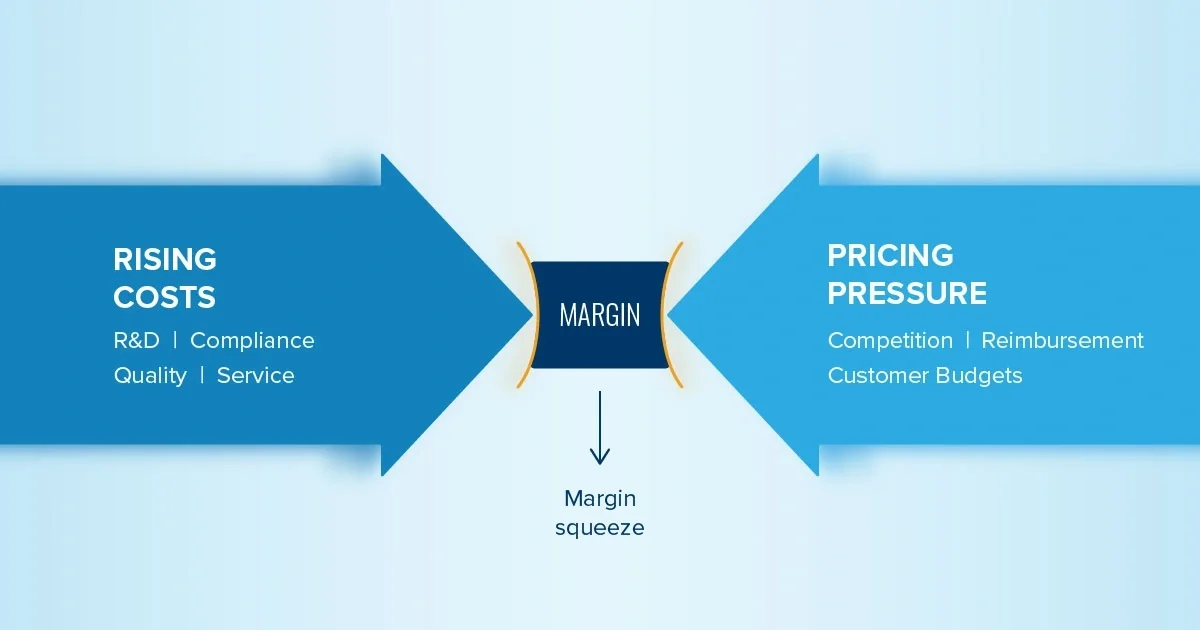
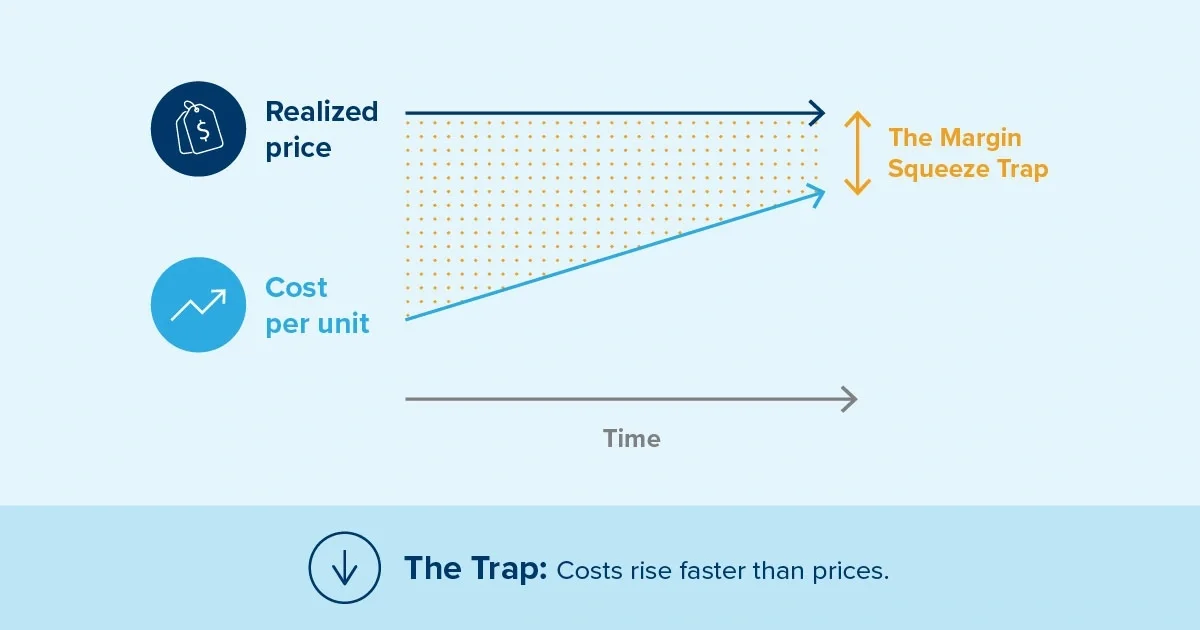
When the cost of manufacturing, compliance, R&D, and service costs rise faster than realized prices, manufacturers face a margin squeeze. Protecting margin requires more than a list-price increase: teams need pricing models that reflect customer value and operational controls that ensure negotiated prices, discounts, bundles, and incentives are executed consistently.
What is the margin squeeze trap in the medical device industry?
What do we mean by the margin squeeze trap in the medical device industry? Strong growth and healthy margins have long characterized the med device industry. As healthcare costs continue to rise, med device manufacturers are under increasing pressure to provide affordable products that still meet the needs of patients and healthcare providers. A margin squeeze is exactly what we see in many companies where costs rise. At the same time, market forces and intense downward pressure on prices make it increasingly challenging to maintain current pricing strategies. This scenario can quickly erode profit margins and put your business at risk.
How a global ultrasound manufacturer addressed margin pressure
A well-known global ultrasound device manufacturer faced a significant dilemma. Costs were steadily climbing because of heavy investment in research and development (R&D), a commitment to advanced technology, quality assurance, and the costs of meeting regulatory compliance and customer expectations. Meanwhile, the healthcare market faced intense competition and pricing pressure. The healthcare landscape was evolving rapidly; new competitors were entering the ultrasound device market, and some were offering lower-cost alternatives.
Despite investments in product excellence, this company found itself trapped in a margin-squeeze scenario. Adding to the pressure, hospitals and healthcare facilities became more budget-conscious and sought cost-effective solutions. Reimbursement rates for ultrasound-guided procedures became more stringent, reducing willingness to pay for these devices. Overall, the company faced rising costs and market pressure, making it difficult to raise prices without risking market share.
As a result, the company's costs were outpacing the prices it could charge for its ultrasound devices. This margin erosion seriously threatened the profitability of its ultrasound product line.
What medical device strategies address a margin squeeze?
No single solution addresses margin pressure. The right approach depends on a manufacturer’s product differentiation, cost structure, customer segments, competitive environment, and ability to demonstrate clinical and economic value. In the ultrasound manufacturer scenario, four actions worked together to help restore healthier margins:
- Innovation: Continue to invest in R&D to develop innovative features and capabilities that truly differentiate you from your competitors. These innovations will also justify premium pricing.
- Cost optimization: Initiate cost optimization efforts throughout production and supply chain to reduce manufacturing costs.
- Pricing models: Explore pricing models that emphasize the clinical and economic value of your medical devices, aiming to demonstrate how your products could lead to cost savings over time.
- Customer education: Invest in customer education initiatives to help customers understand the long-term benefits of your premium products in terms of patient care and cost-effectiveness.
Through these efforts, the company addressed its margin challenge and restored healthier profit margins. For them, value-based pricing was the right pricing model. Their example highlights the importance of innovation, cost management, and strategic pricing in the medical device industry when facing rising costs and competitive pressures. These four actions establish your broader strategy.
The next step is choosing the pricing model — or combination of models — that best reflects the device’s value, the customer’s buying process, and your margin objectives.
When should the pricing team get involved in medical device product development?
Pricing strategy starts in R&D, well before product launch. Developing new features or benefits does not automatically create pricing power. Have the pricing team join product development early to test whether an innovation addresses a meaningful customer need, creates measurable or economic value, and can support a differentiated price.
Without that input, manufacturers risk investing in capabilities that raise product costs without raising customers’ willingness to pay. Settling these questions during development gives every pricing model that follows a stronger foundation.
Which medical device pricing models should manufacturers consider?
- Competitive pricing: Set prices in relation to comparable devices on the market. It keeps you in the conversation during bids, but it can pull you into a race to the bottom when lower-cost entrants enter the market.
- Value-based pricing: Tie price to the clinical and economic outcomes a device delivers, such as shorter procedure times, fewer complications, or lower total cost of care. It supports premium pricing, provided you can prove that value to buyers and properly align price to value.
- Tiered and bundled pricing: Package devices, accessories, consumables, and services into options at different price points. Medical device bundling gives customers flexibility and helps protect the price of your premium offerings, but they require careful tracking so you apply every discount consistently across contracts.
- Subscription and usage-based pricing: Move from a one-time equipment sale to recurring revenue tied to procedure volume, device usage, or service agreements. This eases the upfront capital burden for providers and smooths your revenue, though it depends on your ability to measure usage and bill accurately.
- Contract pricing: Negotiate pricing with group purchasing organizations, health systems, and public tenders. Contract pricing rewards volume and loyalty, and it requires visibility into commitments, tiers, and what each customer pays.
Pricing visibility is now a competitive advantage for medical device manufacturers
Medical device margin is no longer protected by the pricing model alone.
It is increasingly protected by how well companies govern contracts, bundles, discounts, and incentives once the price is set.
The manufacturers pulling ahead are the ones who can see the financial consequences of a pricing decision before it reaches the bottom line.
Here is where Vistex enterprise software earns its place in your pricing strategy.
Instead of running pricing, contracts, and incentives as separate activities, Vistex gives medical device manufacturers one governed framework with greater visibility and control across every customer and agreement.
Vistex solutions give your medical device team the ability to:
- See true net price and margin by product, customer, and contract
- Model the impact of a price change, bundle, or contract before it goes out
- Automate complex contract, rebate, and incentive processes at scale
- Strengthen forecasts with connected pricing and financial data
- Align pricing, finance, and commercial teams around one operational view
The shift: Pricing is no longer an infrequent exercise. It’s a continuous decision framework for protecting margin.
Leading medical device manufacturers are no longer asking where margin went after a contract closes. They are building the ability to see the impact before the deal is signed.
The margin squeeze rarely arrives in a single event. It builds across hundreds of price, bundle, and contract decisions that each look sound on their own, then slip out of control as volume grows.
Connecting those decisions shows what each one is worth, protecting profitability before value is lost.
Seeing the whole picture first is the advantage Vistex is built to deliver.
Watch our webinar, “Prescribing Profitability: Mastering Pricing Strategies in the Medical Device Industry,” to see how medical device leaders can diagnose margin leakage, evaluate pricing options, and operationalize pricing across contracts and customer agreements.
Explore more related resources



Get the latest news, updates, and exclusive insights from Vistex delivered straight to your inbox. Don’t miss out—opt in now and be the first to know!