
Media rights and royalty management complexity creates operational risk
Media rights and royalty management is operationally demanding in ways that weren't imaginable a decade ago. A single media company may now run free ad-supported streaming (FAST), ad-supported video on demand (AVOD), premium subscription tiers, transactional licensing deals, and live event revenue, each with its own billing logic, rights terms, payment flows, and recognition timing.
That complexity creates administrative overhead and risk:
- Revenue leakage
- Billing errors
- Misreported royalties
- Missed contract expirations
- Disconnected finance, operations, and IT systems
Media rights and royalty management is the discipline and the operational infrastructure that brings those moving parts under control. Done well, it turns audience attention into revenue that's accurately accounted for and fully recovered, across every model you run.
Why is media rights and royalty management getting harder?
The challenge media companies face has grown more complex. Each time a new distribution channel, revenue model, or licensing arrangement is added to the portfolio, the coordination demands multiply.
Consider what a mid-size media company manages simultaneously:
- Subscription tiers with different pricing, content entitlements, and churn behaviors.
- Ad inventory across owned platforms and programmatic exchanges, each with different CPM (cost per thousand) dynamics and reporting requirements.
- Content licensing agreements with broadcasters, streaming platforms, and international distributors, each with unique rights windows, territory restrictions, and expiration dates.
- Royalty obligations to rights holders that must be calculated accurately against actual consumption and distribution data.
- Billing and payment systems that may not be integrated, requiring manual reconciliation across finance, operations, and IT.
The downstream consequences of managing this without the right infrastructure are real: revenue goes unrecovered, royalties get miscalculated, rights windows lapse without monetization, and finance teams spend cycles correcting errors instead of analyzing performance.
Understanding the problem is only the first step. Solving it requires more than improving a single billing process or adding another reporting dashboard. High-performing media companies build an operational foundation that connects every stage of the revenue lifecycle.
What media rights and royalty management covers
Media rights and royalty management is the operational discipline that connects:
- Content ownership
- Licensing terms
- Royalty obligations
- Billing
- Revenue recovery
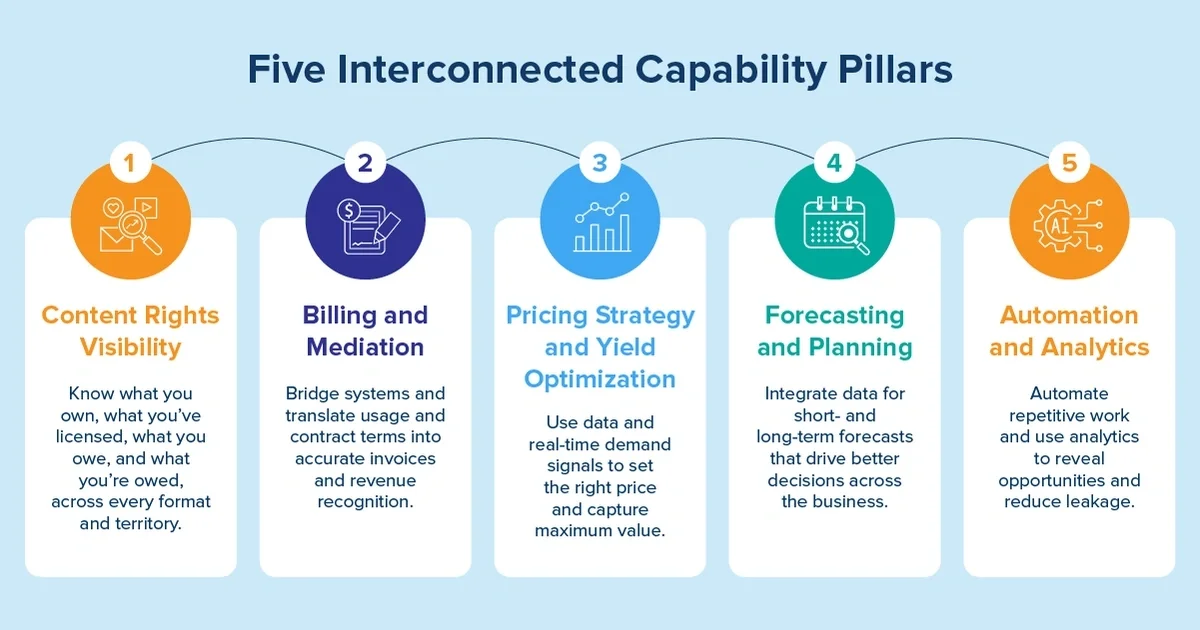
In a multi-model media business, media rights and royalty management depends on five interconnected capability pillars:
1. Content rights visibility
The foundation of media revenue is knowing what you own, what you've licensed, what you owe, and what you're owed, at any given moment, across every format and territory. Strong rights management delivers real-time visibility into content distribution, rights clearance status, royalty obligations, audit trails, and payment schedules. Every license carries its own terms, and without this visibility, rights windows expire unmonetized, royalty calculations contain errors, and licensing compliance becomes a liability.
2. Billing and mediation
Multi-model media businesses run diverse billing and payment systems that must be coordinated, not just tracked in parallel. Billing mediation bridges those systems, translating consumption events, usage data, and contractual terms into accurate invoices and revenue recognition entries. Errors at this layer create partner disputes, delay revenue, and expose the company to audit risk.
3. Pricing strategy and yield optimization
Ad floor rates, subscription tiers, licensing fees, and bundle structures should be driven by data, not intuition. Dynamic pricing tools tied to real-time demand signals, audience analytics, and inventory availability help identify the optimal revenue point for each inventory type, letting media companies capture premium value when conditions justify it and protect yield in any market condition.
4. Forecasting and planning
Accurate revenue forecasting means integrating data from ad platforms, subscription systems, licensing contracts, and billing histories into a single planning view. Short- and long-term demand forecasts that account for seasonality, content release windows, and market conditions enable better decisions across sales, finance, and content acquisition.
5. Automation and analytics
Manual processes break down at scale. Automation handles proposal generation, billing runs, payment retry logic, dunning workflows, and royalty calculations, freeing teams to focus on decision-making rather than data entry, and supporting revenue generation rather than error correction. Analytics close the loop by building a foundation that reveals where revenue is being left on the table.
Together, these five capability pillars provide the operational foundation for rights, royalties, and revenue management. How these capabilities are applied depends on the business model. A company focused primarily on advertising faces different operational demands than one built around subscriptions or licensing. Most media companies now manage all of them simultaneously.
What does each revenue model demand from rights and royalty management?
Most media companies don’t operate a single revenue model. Each model has distinct operational requirements, and the combination creates complexity that no point solution can address.
Advertising-driven revenue
Optimizing advertising revenue requires integrated visibility across inventory, audience segments, CPMs, fill rates, and programmatic yield. Dynamic pricing floors, audience-first targeting, and real-time reporting all depend on clean data flowing across ad platforms and analytics systems. Get pricing and targeting right, and the same inventory can generate revenue without adding headcount. The metric that matters most is effective CPM relative to available inventory.
Licensing and content distribution
Licensing revenue is often the highest-margin stream in a media portfolio, and the most operationally complex. Content licensed to broadcasters, streaming platforms, or international distributors may carry licenses across a dozen territories, each with its own rights window, usage limit, and royalty obligation to track and enforce.
Renewing licenses before they lapse increases revenue rather than creating a catalog gap. Missed expiration dates mean missed renewal opportunities. Inaccurate royalty calculations create audit risk and partner disputes. The companies that monetize their content catalogs most effectively centralize their rights data and automate the contract lifecycle.
Hybrid and diversified models
Running ad-supported and subscription tiers simultaneously requires coordinated pricing strategies and clear value differentiation to avoid cannibalization. Adding licensing, live events, or branded commerce quickly increases operational complexity. A unified platform covering billing, rights, analytics, and finance provides a shared foundation for every revenue model while reducing manual effort across the business.
Different exploitation methods create different priorities, but they all share one requirement: visibility. Without timely, trustworthy performance data, companies can't tell whether pricing is improving yield, billing is recovering revenue, or rights are being fully monetized. That's why successful media companies monitor a common set of operational and financial metrics.
The metrics that signal rights and royalty management health
Effective media rights and royalty management requires real-time visibility into the KPIs that signal health and risk across every model:
- MRR (monthly recurring revenue)/ARR (annual recurring revenue) and revenue growth rate
- ARPU (average revenue per user) and customer lifetime value (CLTV) by segment
- Voluntary and involuntary churn rate; revenue churn vs. subscriber churn
- Fill rate, effective CPM, and average revenue per impression
- Licensing contract utilization and rights window expiration tracking
- Royalty accuracy rate and audit exception rate
- Billing error rate and revenue recovery from payment retry
- Forecast accuracy: variance between projected and actual revenue by model
These metrics only matter when they're current and integrated. A dashboard that brings ad platform data, subscription billing, CRM, and licensing contract status into a single view enables decisions made in real time, the kind that reactive, report-based processes can't match.
Measuring performance is only valuable if those insights lead to action. Once you know where revenue leakage occurs, the next step is to improve the operational processes that prevent it. The following strategies deliver the greatest impact across media companies.
How media companies strengthen rights and royalty management
The following operational changes have the biggest payoff for media rights, royalty, and revenue teams:
1. Centralize rights and contract data.
A single source of truth for content rights, licensing terms, expiration dates, and royalty obligations eliminates the manual tracking that creates errors and gaps. Automating alerts for upcoming expirations ensures renewal opportunities aren’t missed.
2. Audit your billing mediation layer.
Map the data flow from consumption events through billing systems to revenue recognition. Identify where manual intervention is occurring, where reconciliation is required, and where errors originate. Mediation gaps are the most common source of unrecovered revenue in multi-model operations.
3. Implement dynamic pricing and yield management.
Set ad floors and subscription pricing that reflect real-time demand and inventory conditions. Use audience segmentation data to apply premium pricing to high-value ad inventory and high-value subscriber cohorts, and revisit pricing strategy as market conditions shift.
4. Fix involuntary churn before optimizing acquisition.
Smart payment retry logic, automatic card updates, and a structured dunning experience recover revenue that’s already been earned and protect the customer experience by avoiding abrupt cancellations that damage a subscriber relationship.
Revenue increases every time a payment failure gets resolved before it becomes a lost subscriber. Fixing involuntary churn first is one of the fastest ways to improve subscription revenue recovery.
5. Automate royalty calculation and reporting.
Manual royalty processing at scale is error-prone and increases audit risk. Automated calculation and reporting, tied to actual consumption and distribution data:
- Improves accuracy
- Reduces disputes with rights holders
- Supports compliance
6. Build forecast models that integrate across revenue streams.
Siloed forecasting, tracking each revenue stream separately, produces an incomplete picture. Integrated forecasting enables better planning across sales, finance, and content investment decisions.
Many companies can identify these opportunities for improvement. The greater challenge is sustaining them across disconnected systems and growing revenue models. That's where technology becomes a strategic enabler rather than simply another operational tool.
What to look for in a media rights and royalty management platform
Point solutions solve individual problems.
- A billing tool manages invoices
- An analytics platform surfaces dashboards
- A rights database tracks contracts
The value is found in what happens between individual systems. This is where rights and royalty management becomes a competitive advantage.
Translating consumption data into royalty calculations, aligning billing events with rights terms, and connecting ad performance to forecasting models determines whether revenue is fully captured or quietly slips through operational gaps. It’s also where point solutions fall short.
The right platform brings these capabilities together in a single system.
- End-to-end rights and royalty management: content registration, rights clearance, royalty calculation, audit support, and partner reporting in a single system
- Billing and mediation: coordination across diverse billing and payment systems, automated revenue recognition, and error tracking
- Real-time analytics: integrated dashboards across ad inventory, subscription cohorts, licensing contracts, and financial performance
- Forecasting: Scenario-based demand forecasting that accounts for seasonality, content windows, and market conditions
- Dynamic pricing: flexible pricing engines for subscription tiers, ad floors, and licensing fee structures
- Automation: billing runs, payment retry, royalty processing, proposal generation, and dunning workflows
Vistex AI-driven enterprise software brings together content data, contract terms, billing systems, and financial reporting in a single platform so finance and operations teams spend less time chasing data across separate systems and more time making decisions that improve revenue performance.
Knowing what capabilities matter is only part of the equation. Improving media rights and royalty management rarely happens all at once. The most successful companies take a phased approach, focusing first on the areas with the greatest revenue leakage before expanding across the broader revenue lifecycle.
A practical roadmap for rights and royalty management optimization
Closing the gap between revenue earned and revenue recovered starts with a structured approach.
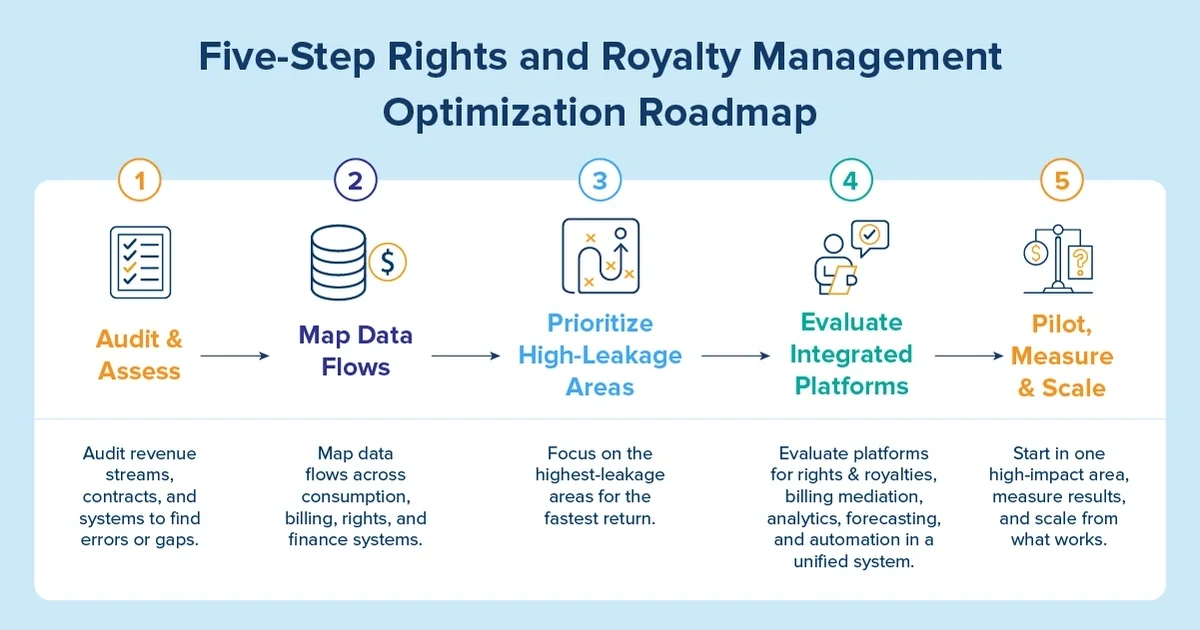
1. Audit and assess
Audit all revenue streams, contract expirations, and current billing and rights systems. Identify where manual processes are creating errors or gaps.
2. Map data flows
Map the data flows between your consumption, billing, rights, and finance systems. Identify integration gaps and reconciliation overhead.
3. Prioritize high-leakage areas
Prioritize the highest-leakage areas first: Involuntary churn recovery, rights expiration tracking, and billing mediation errors typically yield the fastest return.
4. Evaluate integrated platforms
Evaluate platforms against the integrated capability set: Rights and royalties, billing mediation, analytics, forecasting, and automation in a unified system.
5. Pilot, measure, and scale
Start with one high-impact area, such as a payment recovery program, a rights expiration alert system, or an ad yield optimization initiative. Establish a baseline and scale from demonstrated results.
Whether you're improving rights visibility, recovering failed subscription payments, optimizing advertising yield, or forecasting future demand, success depends on connecting processes that too often operate in isolation.
Rights and royalty management is not optional
Media rights and royalty management is the operational capability that helps ensure the value your content generates is accurately accounted for, fully monetized, and recovered on time.
Companies that do this well close the gap between what’s earned and what’s recovered, consistently and at scale. They share a common foundation:
- Centralized rights and contract data
- Integrated billing and mediation systems
- Automated royalty processing
- Connected revenue insights across every revenue model
Vistex helps media companies connect rights, royalties, billing, and licensing compliance across every revenue model on a single platform.
With new revenue models arriving faster than most operations teams can integrate them, media companies that integrate rights, billing, forecasting, and analytics will report revenue more accurately and capture more of the revenue they've already earned.
Explore more related resources

You’re Sitting on a Media Content Rights Gold Mine. Without Rights and Royalties AI, It’s a Very Expensive Filing Cabinet.
Get the latest news, updates, and exclusive insights from Vistex delivered straight to your inbox. Don’t miss out—opt in now and be the first to know!