
What is music catalog cleanup, and why does it directly affect revenue?
Imagine a song that streams for 18 months under the wrong title, with no writer split on file. Its royalties become unpayable black-box income because they’re not matched to a rights holder. The writer gets nothing, even though the money waits for a match to the correct title and split. Music catalog cleanup closes the gap between a stream and payment.
More than a one-time IT or housekeeping task, music catalog cleanup fixes inaccurate, incomplete, duplicate, conflicting, or disconnected catalog, rights, ownership, and metadata records. It helps teams match usage to licensed works, track revenue, and pay the right people, protecting revenue over time.
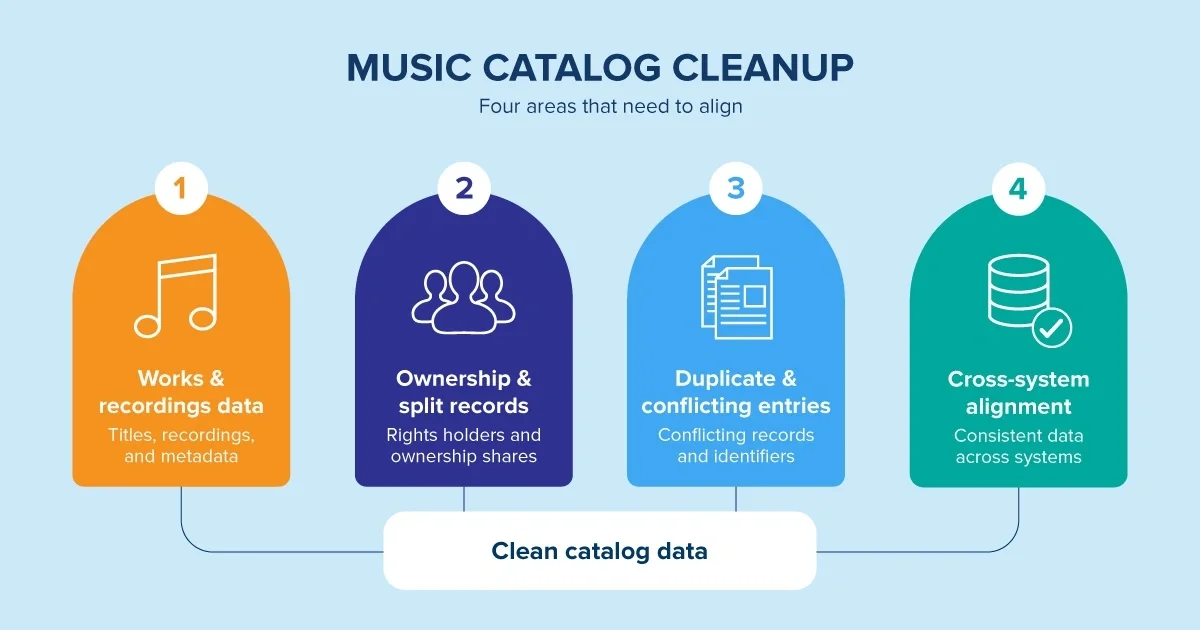
Fixing the metadata alone isn’t enough. Music catalog cleanup covers four main areas:
- Works and recordings data
- Ownership and split records
- Duplicate or conflicting entries
- Cross-system alignment
Many rights holders think music catalog cleanup is about moving old data to a new place. But moving data without verifying it carries the errors into the new system.
Administration manages writer payments and license clearance. Cleanup ensures data accuracy, so operations proceed smoothly. Rights holders often begin cleanup after a missed payment or a blocked deal, when the problem has already occurred.
What’s the difference between unmatched, unclaimed, and disputed royalty income?
These are three distinct problems:
- Unmatched income is usage that no one can tie to a work or a rights holder.
- Unclaimed income is money tied to a work whose owner hasn’t come forward to claim it.
- Disputed income is money held because two or more parties claim the same share.
Terms and their usage may vary, so confirm how each collection partner uses them before establishing your process.
What are black box royalties, and why do they exist?
Black box royalties are unmatched usage revenue that performing rights organizations (PROs), collective management organizations (CMOs), and digital service providers (DSPs) collect but can’t allocate due to metadata or ownership conflicts. Think of it as a package at the post office with postage paid, but no one can read the address.
Black box income is the most obvious, measurable sign of the data problems that music catalog cleanup can solve. For example, when a stream occurs, the service reports it. A collection organization then matches that report to a work and a rights holder. If the title, identifier, or split doesn’t match, the funds go into the pool.
Finding the breakdown matters, since each problem requires a unique solution. Fixing a missing split is different from resolving a duplicate identifier. In my experience, identifiers cause many problems, especially International Standard Recording Codes (ISRCs). When a catalog is acquired, the new owner may assign new ISRCs to the works while the old ones stay in use. This leaves a recording with two active numbers, and services may report usage under either number.
Black box income is not the same as royalties that were never collected
Black box money isn’t lost; the rights holder just hasn’t collected it, even though the platform has already paid it. Catalog cleanup is an opportunity to recover revenue.
Recovering unmatched or unclaimed revenue depends on the issue, the rules, the age of the usage, and proof of rights and ownership. To keep the intellectual property (IP) chain clear, start with works for which the original creators are still available.
What do ISRC, ISWC, and IPI numbers actually do?
Each one identifies something different, and people often confuse them.
- The ISRC identifies a specific recording.
- The International Standard Musical Work Code (ISWC) identifies the underlying composition.
- The interested party information (IPI) number identifies the rights holder party that files with a society.
Recording, composition, and person. Three numbers, each with a distinct role.
A common mistake is thinking an ISRC guarantees a recording will be paid correctly. If the ownership or split data is wrong, or if the ISWC link to the composition is incorrect, the recording might go unpaid. If the identifier is correct but the data is wrong, you need to check as much information as possible against what a PRO or the Mechanical Licensing Collective (MLC) has on record for the work.
How does catalog cleanup speed up royalty matching at PROs, CMOs, and the MLC?
Cleaner metadata helps matching systems route more usage to the correct work and rights holder, rather than letting it end up in the black box pool. This matters at every collection point, including PROs, CMOs, and the MLC.
Licensing also benefits from clean data. Buyers often walk away from a deal if the chain of title is unclear, even when the terms are favorable. A reputation for being easy to work with helps publishers and labels do more business and encourages repeat deals.
Does cleanup pay off the same way for a 50-song catalog as a 50,000-song catalog?
A 50-song catalog can usually be cleaned up affordably. For a 50,000-song legacy catalog, prioritize revenue: start with top earners and best-performing works, and ensure every party and share is attributed for each song.
Catalog size isn’t the only cost factor. Other variables matter, too:
- Revenue concentration
- Catalog age
- Rights complexity
- Territories
- Acquisition history
- Known disputes
- Data quality
Don’t base your cleanup priorities on size alone. A small catalog with a complicated history can cost more per song to clean than a large, well-organized one.
What role does AI play in music catalog cleanup?
AI accelerates pattern recognition and matching at scale, but it can’t replace human decision-making or legal review. Relying on automated matches without human approval can create the same audit risks that catalog cleanup is meant to prevent.
Can AI fully automate music royalty matching?
No. Automation vendors have overpromised before, and rights teams haven’t forgotten.
Automation helps with fuzzy matching of titles and writer names. It resolves near-duplicate records and flags split conflicts for review. However, it doesn’t make ownership or legal decisions. Use automation for identification and exception detection, not for legal ownership decisions.
AI is effective at matching suggestions, pairing a work title with what’s already in an owner’s catalog. For example, Vistex uses AI to speed up this process for analysts. A human still needs to review and verify the final match.
What does a music catalog cleanup initiative cost?
Time, budget, and internal support remain essential. Conflicting priorities, unclear ownership, and difficulty demonstrating cleanup’s value slow progress. Costs depend on:
- Catalog size
- Data quality
- Systems
- Territories
- Rights types
- Legacy records
- Acquisitions
- Staff availability
- Amount of legal or rights research required
Smaller or newer music catalogs are easier and more affordable to clean up because they contain less legacy data to sift through. Teams with limited budgets, staff, or technical skills must follow established procedures to ensure each asset is accurately added to the company catalog.
How often should a music catalog be reviewed?
Significant catalog events like these should trigger most reconciliations:
- New releases
- Acquisitions
- Ownership changes
- Disputes
- Licensing activity
The process starts with intake. Establish a clear process for recording or updating key metadata, train all employees who work with it, and verify that everyone knows how to handle assets properly.
What changes when your music catalog data is clean?
Returning to the song mentioned at the start of the blog, once the title is matched and the split is filed, royalties are paid to the writers during the normal reporting cycle rather than remaining in black-box income for 18 months.
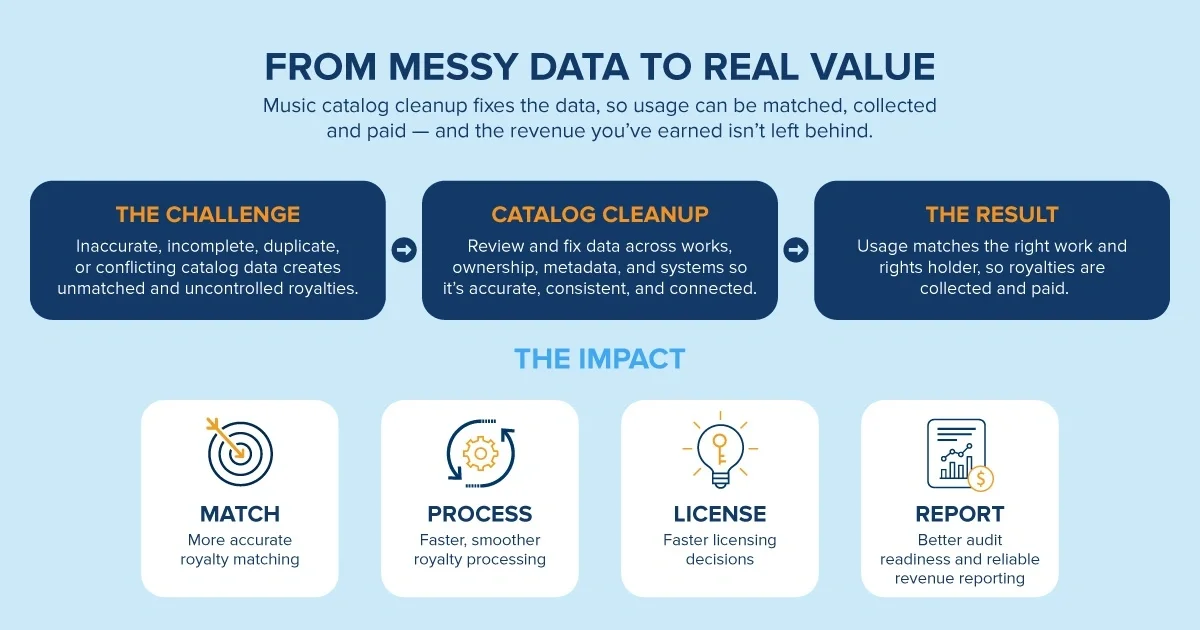
Music catalog cleanup doesn’t generate revenue directly. It removes barriers to usage, rights attribution, royalty calculation, collection, and payment, recovering earned but uncollected value. For rights holders, this means:
- More accurate royalty matching
- Fewer unresolved exceptions
- Faster royalty processing
- Better visibility into ownership and rights
- Faster licensing decisions
- Lower dispute exposure
- Better audit readiness
- More reliable revenue reporting
You can prevent catalog data problems from hurting your revenue by following your company's procedures and avoiding shortcuts. Saving time now can lessen bigger problems later.
Vistex extends ERP systems with rights and royalties management, real-time usage tracking, and contract-to-cash visibility. It gives music publishers and rights holders a single source of truth across platforms, enabling accurate streaming revenue calculations and faster distribution.
Every month that a title variant remains unresolved, more of your music catalog’s revenue flows into that same black box pool. The longer it sits there, the harder it is to untangle. You don’t need to fix ten thousand records this quarter. Pull a report on your ten highest-earning works, check the splits and identifiers for those first, and you’ll find a fix that pays for itself before this reporting cycle closes.
Explore more related resources


Get the latest news, updates, and exclusive insights from Vistex delivered straight to your inbox. Don’t miss out—opt in now and be the first to know!