
How can rights holders maximize music revenue?
Rights holders can maximize music revenue by capturing more of what they’ve already earned, identifying new income opportunities, and making better decisions about catalog value. Effective music revenue optimization depends on the right information, but disconnected rights data, reporting, and royalty processes can make it hard for rights holders to spot those opportunities.
Without a clear picture of what’s generating revenue and where income may be going uncollected, you can't build a roadmap for improvement. It’s like driving at night on dark roads without headlights. Once you know what you've earned and where it comes from, you can plan more effectively and focus efforts on improving revenue recognition.
What is music revenue optimization?
Music revenue optimization means improving how rights holders identify, collect, and manage earnings from existing music assets while evaluating opportunities to increase their value.
Rights information lets an owner understand which aspects of the music can generate revenue. Based on that, an owner can identify how best to exploit other works in a catalog with similar categorizations, and determine which sources will ultimately provide the best opportunities for royalty collections.
A common misconception is that music revenue optimization means finding new ways to monetize a catalog. Inaccurate rights or metadata may already cost rights holders income from revenue-generating music.
Why is music revenue optimization important?
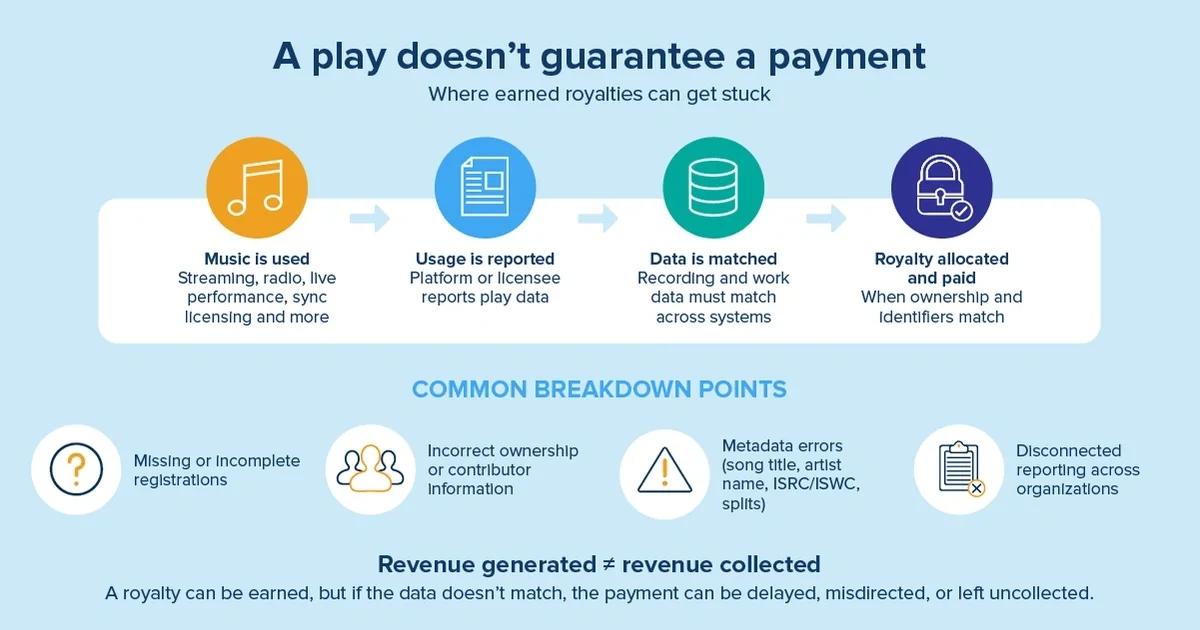
Incomplete rights information, disconnected reporting, and gaps in the royalty process can delay payments, obscure earnings, or leave revenue uncollected.
Incorrect rights and metadata create bigger problems for downstream revenue collection because royalty payments can end up in a black box or, worse, go to the wrong rights holder.
When revenue-generating works become black-box income, owners can't see what they’ve truly earned unless they identify and reclaim those royalties.
Royalties can go unclaimed when usage reports fail to identify the correct rights holder. Finding where the process breaks down is the first step to recovering lost income.
Which music revenue streams offer opportunities for optimization?
Streaming, performance, and mechanical royalties, along with sync licensing, offer opportunities to improve revenue collection, address payment gaps, and increase catalog value.
How can rights holders improve streaming royalty capture?
Accurate rights and recording information, reliable reporting, and timely discrepancy reviews help rights holders identify missing or delayed streaming income.
At streaming scale, royalty management challenges go beyond missing registrations. Diverse payment models, reporting requirements, and rights records make it difficult to reconcile a catalog's earnings with what rights holders receive.
Common streaming mistakes that most affect royalty collection include:
- Improper registration with performance royalty societies
- Failing to assign International Standard Recording Code (ISRC) numbers to sound recordings
- Failing to register with the Mechanical Licensing Collective (MLC)
What causes performance royalties to be lost or delayed?
Missing registrations, incomplete ownership information and inaccurate songwriter or publisher details can cause performance royalties to be lost or delayed.
Regularly check performing rights organization (PRO) registrations to confirm that works, ownership shares, and songwriter and publisher information are accurate and current.
How can rights holders reduce missing mechanical royalties?
Clear ownership records, accurate registrations, and attention to payment discrepancies help reduce missing or delayed mechanical royalty payments.
To avoid information gaps, always keep a copy of the agreed-upon mechanical license for reference, and ensure, with periodic checks, that the information exists and is correct.
What makes a music catalog ready for sync licensing?
Clear ownership and accessible, reliable catalog information make it easier to evaluate and respond to sync licensing opportunities.
Before pursuing an opportunity, a licensing team needs clear ownership of the music publishing and the sound recording.
Whether revenue comes from streaming, live performances, mechanical royalties, or sync licensing, you need to know what you’ve earned, what you’ve collected, and where discrepancies may arise.
Which metrics help reveal music revenue problems?
Payment delays, unmatched income, revenue discrepancies, and platform- or territory-level results can help rights holders identify where to investigate.
Unmatched income often signals a gap between reported usage and the rights data needed to allocate royalties. Payment delays and platform or territory discrepancies can also point to where to investigate.
How does music metadata affect royalty revenue?
Metadata links works and recordings to ownership and usage information, helping royalty organizations identify the right recipients.
When it comes to metadata problems that most often interfere with royalty collection, the song title and the songwriter's name are often the culprits. For example, if a song is registered to an artist who originally signed as Lil’ V on his contract but then advertises as Li’l V as the writer, collection societies may not know whom to attribute the song to.
The more places that music is distributed, the more important it becomes to keep that information consistent.
How can music distribution improve revenue visibility?
Distribution decisions influence where music is available and how effectively rights holders can track usage, reporting, and revenue.
Adding more distribution channels can benefit a catalog owner, provided they solidify the processes for tracking how each channel reports their music. If this isn't fixed early, it can create more reconciliation work down the line.
When it comes to distribution reporting, rights holders should look for proper attribution of key fields/questions for a catalog owner:
- Where the music is playing
- How many times it's listened to
- How it's categorized to the listener
How can music catalog intelligence reveal revenue opportunities?
Closing the music catalog intelligence gap starts with connecting catalog, rights, usage, and revenue data to identify overlooked assets and potential collection or licensing opportunities.
Better visibility lets a catalog owner spot missing rights or metadata more easily, correct it before exploiting those works for profit, and avoid an audit that flags improper usage.
One revenue opportunity you might miss without better catalog visibility is discovering that you own the music rights to songs written by a popular artist who may be early in their career or who may have recently passed away.
What makes music revenue optimization difficult?
Disconnected systems, inconsistent information, delayed reporting, and limited resources can prevent rights holders from addressing revenue problems. Limited resources require prioritizing the most consequential problems.
Among these obstacles, disconnected systems and inconsistent information typically cause the most trouble in day-to-day operations. Both create more manual work and make it harder to identify which revenue problems need attention.
How can AI and automation support music royalty management?
Automation can reduce repetitive royalty tasks and help flag potential inconsistencies, but human review remains important for ownership and contractual decisions.
Human review will always be needed to double-check or spot-check an AI algorithm's work. For matching, AI can use a grading system to determine the best song match in a catalog. This could save a lot more time than manual matching.
How do you start optimizing music revenue?
Start by reviewing revenue sources, checking rights and metadata quality, and investigating the most consequential collection gaps. Priorities should include:
- Review revenue and collection reporting
- Check catalog and ownership information
- Address the most consequential gaps
- Establish ongoing monitoring
Revenue discrepancies need different levels of effort. A large unmatched balance with clear ownership may need immediate attention, while a small discrepancy over disputed rights may take longer to resolve. Weigh financial impact against resolvability to help teams prioritize
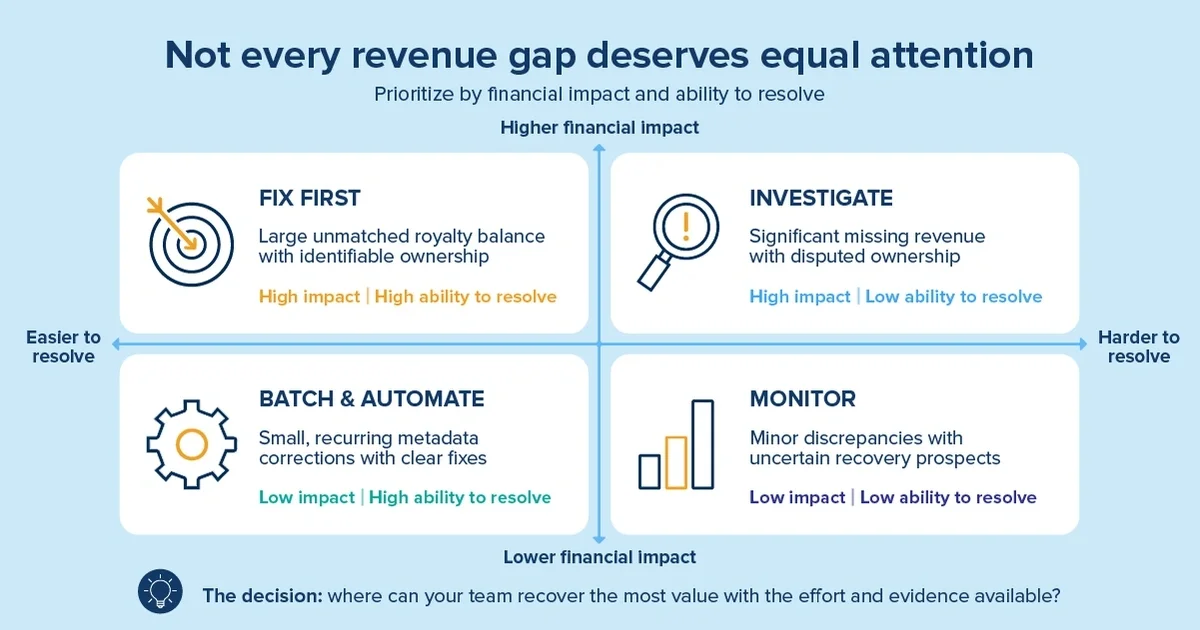
The goal is to direct limited time and resources to the problems most likely to affect revenue.
How can rights holders sustain music revenue growth?
Sustaining music revenue growth requires accurate rights information, consistent processes, and ongoing visibility into earnings and collection gaps. Fixing problems once isn't enough. Rights holders need a reliable way to detect new discrepancies, monitor revenue performance, and spot opportunities as their catalogs evolve.
It starts with a consistent methodology for creating and updating rights and metadata, supported by a centralized source of truth. Without it, errors and fragmented records can undermine even the best music revenue optimization efforts.
This is where Vistex enterprise software can help. By connecting rights, catalog, and royalty information through its rights and royalty management solutions, Vistex helps music businesses spend less time reconciling disconnected data and more time identifying revenue opportunities worth pursuing.
How much revenue is your music catalog leaving on the table? Missed royalties, delayed payments, and overlooked licensing opportunities can represent value that’s still within reach. Find where that value is hiding, close the gaps, and make more from the music you already own.
Explore more related resources


Get the latest news, updates, and exclusive insights from Vistex delivered straight to your inbox. Don’t miss out—opt in now and be the first to know!