
What is automotive Original Equipment Manufacturer (OEM) fleet pricing?
OEM fleet pricing is how motor vehicle manufacturers set and manage vehicle prices, discounts, incentives, and other commercial terms for customers who purchase in large quantities. Unlike retail pricing, fleet pricing may involve customer-specific bids, volume-based price levels, VIN-based requirements, combined arrangements with third parties, and agreements that affect pricing and profitability over time.
Why are OEM fleet sales important to Original Equipment Manufacturers?
Fleet is much more than a secondary route for vehicle sales; it is a major direct channel that serves commercial businesses, government agencies, daily rental companies, leasing organizations, Fleet Management Companies (FMCs), and other buyers.
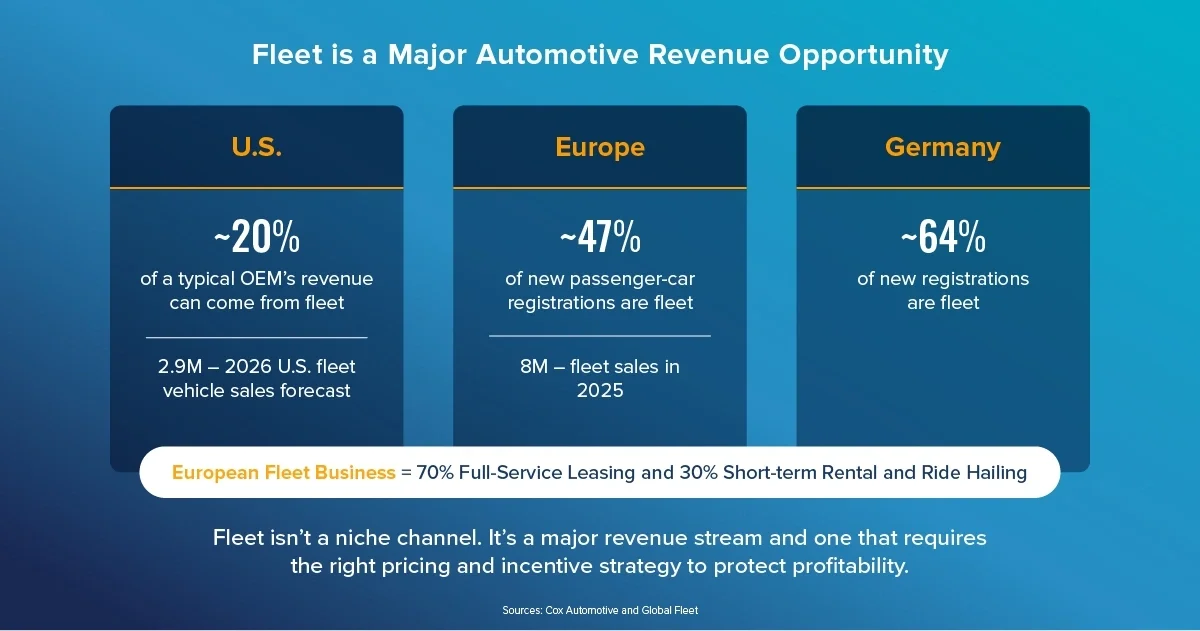
In the U.S., fleet can represent approximately 20% of a typical automotive OEM’s revenue. The scale of the opportunity becomes even clearer when looking at industry sales. At midyear, Cox Automotive forecast 2.9 million fleet vehicle sales in the U.S. for 2026. Cox has since increased its overall 2026 new-vehicle market forecast from 15.8 million to 16.1 million vehicles following stronger-than-expected market performance.
Fleet plays an even larger role in Europe. According to Global Fleet, passenger-car fleets account for approximately 47% of European new-vehicle registrations, with full-service leasing representing roughly 70% of the fleet business and short-term rental and ride-hailing accounting for approximately 30%. In Germany, Europe’s largest automotive market, fleet registrations represent as much as 64% of new registrations.
The figures show the market size, but they don't tell the full story. Different sub-channels of the fleet sector operate in different ways, with different purchasing patterns and commercial needs. A company that rents a large number of vehicles has priorities that differ from those of a government fleet, a leasing company, or a business that manages specialist work vehicles. For original equipment manufacturers, these differences create opportunities to offer more specific solutions, but they also add significant commercial complexity.
Why fleet is more than a vehicle-volume opportunity
The value that a fleet customer offers doesn't cease when the vehicle has left the dealership, and revenue from fleet relationships can be generated throughout the entire vehicle lifecycle via:
- Vehicle sales
- Financing
- Delivery
- Vehicle upfits
- Parts
- Maintenance and service
- Warranty support
- Connected services and subscriptions
- Replacement programs
- Remarketing
Fleet customers are also likely to place several orders. Once a strong relationship is in place, new opportunities emerge as vehicles wear out, fleets expand, and replacement cycles begin.
Where automotive OEMs can create fleet value
For motor vehicle manufacturers, fleet value extends well beyond the first sale. A manufacturer's fleet pricing strategy should account for the entire customer relationship and identify opportunities to add value at every stage of the vehicle's life.
In order to aid customer acquisition and retention, OEMs may offer bid pricing, volume deals, loyalty bonuses, maintenance programs, and replacement campaigns. These programs also drive repeat purchases among customers who operate large fleets when vehicles reach their planned replacement cycles.
The opportunity continues after delivery, as parts, service, warranty support and connected subscriptions can generate ongoing revenue during the ownership period and help OEMs build longer-term relationships with their fleets.
Fleet programs can also be structured around how vehicles will actually be used. That may include electrification strategies, charging partnerships, financing, and ongoing support, particularly as fleet operators evaluate where electric vehicles make operational and financial sense.
OEMs should also consider factors beyond the vehicle itself, such as job-specific equipment and fittings, future replacement needs and eventual resale or remarketing. Since these factors can influence the overall economics of the customer relationship, they should be included in fleet pricing and incentive schemes.
When you put these opportunities together, the focus changes from "How many vehicles can we sell?" to "What is the long-term value of this fleet relationship?" This broader perspective allows OEMs to design pricing and incentive programs based on both customer needs and sustainable profitability.
Why are OEM fleet pricing and incentives so difficult to manage?
Selling motor vehicles is difficult in part because so many organizations are involved. One transaction can include an original equipment manufacturer (OEM), a dealer, a fleet account, a lessor, a Fleet Management Company (FMC), and an upfitter. Each party may play a different role in ordering, delivery, modification, financing, or payment for the vehicle.
There are also the commercial terms.
Fleet agreements may include:
- Special bid pricing
- Volume-based incentives
- Retroactive volume tiers
- VIN-level eligibility requirements
- Multiple incentive combinations
- Customer-specific programs
- Aftersales and connected services programs
- Different effective and transaction dates
- Claims and settlement requirements
A customer in a fleet group who becomes eligible for a higher incentive after reaching a certain annual purchase volume can now access an additional benefit because they had already reached a higher tier retroactively.
If you are an OEM, you have to decide which vehicles are eligible, calculate the additional amount, make the necessary accrual adjustments, and then settle the correct payment. When you apply this process to thousands of vehicles, customers and programs, the chance of error increases rapidly.
Duplicate payments, different prices, and disputed entitlements not only create a lot of administrative work but can also affect the fleet business's actual profitability, as well as damage fleet customer relationships.
What is the problem with manual fleet program management?
Managing fleet program complexity through disconnected spreadsheets, contracts, and systems makes it hard to maintain a consistent view of the business. Contracts may exist in one location, vehicle records in another, pricing somewhere else, and claims in yet another system. Teams then spend significant time reconciling information to determine what a customer earned and what the OEM owes.
More importantly, information that is disconnected can make profitability difficult to see.
Without this visibility, manufacturers may focus on vehicle volume without knowing the actual net financial result.
What should OEM fleet revenue management software do?
Technology should go beyond simply calculating an incentive; an integrated fleet commercial management platform should connect the processes that determine the financial outcome of a fleet agreement.
That starts with creating a centralized environment for:
- Managing agreements and account structures: ensure that customer agreements, hierarchies, effective dates, approvals, and program terms are maintained.
- Determining pricing and eligibility: assign the correct pricing and check whether particular customers, vehicles, or transactions are eligible.
- Incentive calculations: Automate the calculation of incentives, including those based on volume tiers and retroactive adjustments.
- Accruals: Set up financial accruals and make any necessary adjustments when there are changes in fleet performance.
- Validating the claims: Check if the claims submitted comply with the requirements of the program and spot any possible exceptions or duplicate payments.
- Settlements: Determine and carry out the proper financial settlement in accordance with the contract and the performance of the program.
- Regarding visibility and auditability: Make sure that the workflows, the way exceptions are handled, and the audit trails are kept so that teams can understand both how and why a payment or adjustment was calculated.
These capabilities help connect the agreement made at the beginning of the relationship with the financial result at the end.
How to evolve from fleet volume to true-net profitability
Fleet profitability should not be judged only by vehicle revenue. Instead, the original equipment manufacturers should take into account the financial circumstances associated with each transaction, including:
- Sales revenue
- Discounts
- Rebates
- Incentives
- Claims
- Fees
- Allowances
- Manufacturing costs
- Logistics costs
- Service commitments
Combining these factors provides a clearer view of true-net profitability. This allows OEMs to assess results across dimensions such as customer account, vehicle, program, dealer, geography, and time period. Rather than judging success only by units sold, OEMs can compare offers and reallocate spending to the customers and programs driving stronger financial results.
What do OEMs gain from an integrated fleet platform?
Connecting fleet commercial processes can benefit both operations and financial performance. OEMs can gain greater margin visibility by understanding the complete economics surrounding each account and program. They can execute programs faster because pricing, eligibility, and incentive rules are managed in a connected environment rather than through fragmented manual processes.
Automation can also produce more accurate accruals and fewer invalid claims, while giving account managers and customers clearer explanations of payments. Perhaps, most importantly, a connected platform creates a more complete record of the customer relationship. Over time, that information can help OEMs better understand buying patterns, program performance, vehicle replacement cycles, and overall lifecycle value of fleet customers.
How Vistex supports profitable automotive growth
Managing fleet growth means OEMs must link the commercial agreement to the final financial result. Vistex AI-driven enterprise software helps automotive manufacturers manage the processes across the lifecycle, from before the initial bid and customer agreement to pricing, incentives, claims, accruals, settlements, and performance analysis.
When OEMs combine those processes, they can better understand how their fleet programs are performing and assess the financial impact of their commercial decisions. Instead of considering pricing, incentives and settlements as separate activities, they can treat them as closely linked elements of the fleet relationship. This, in turn, enables teams to detect exceptions, improve financial accuracy and determine whether volume is driving profitable growth. Vistex also provides modeling capabilities so that OEMs can understand true net margin before the OEM proposes a deal to a fleet customer.
The road ahead: What's next for OEM fleet growth?
Fleet customers want more than vehicles. They need predictable economics, reliable uptime, vehicles suited to their operations, useful data, and dependable support. For OEMs, meeting those expectations requires coordination across vehicles, dealers, partners, pricing, incentives, and services.
The opportunity is significant, but gaining more fleet volume is only one part of the issue. To achieve sustainable fleet growth, OEMs must understand the financial implications before, during, and after the sale of the vehicle. By using connected commercial processes and obtaining better insight into true-net profitability, manufacturers can design programs that strengthen fleet relationships while protecting their value.
Frequently Asked Questions (FAQs)
Q: What are automotive fleet sales?
A: Automotive fleet sales are direct vehicle sales to organizations such as businesses, government agencies, rental companies, leasing organizations, and fleet management companies rather than individual retail consumers.
Q: Why are fleet sales important to automotive OEMs?
A: Fleet sales can provide significant vehicle volume and repeat purchasing while also creating lifecycle revenue opportunities through financing, parts, service, upfits, subscriptions, and replacement programs.
Q: Why are fleet incentive programs complex?
A: Fleet incentive programs can involve customer-specific pricing, volume tiers, VIN eligibility, special bids, multiple parties, and retroactive adjustments that affect claims, accruals, and settlements.
Q: How can OEMs measure fleet profitability?
A: OEMS can evaluate true-net profitability by considering vehicle revenue along with discounts, rebates, incentives, claims, fees, logistics costs, and service commitments rather than looking at vehicle sales alone.
Q: What should fleet revenue management software manage?
A: Fleet revenue management software should provide the capability to understand true net margin before the OEM proposes a deal to a fleet customer. The software should also connect agreements, pricing, eligibility, incentives, claims, accruals, settlements, and performance analysis to provide a more complete view of program profitability.
Explore more related resources
Get the latest news, updates, and exclusive insights from Vistex delivered straight to your inbox. Don’t miss out—opt in now and be the first to know!