
Demand forecasting drives every major commercial decision
Demand forecasting is one of the most important capabilities in consumer products. No longer simply a supply chain function, demand forecasting sits at the center of sales, finance, trade promotion management, category management, and revenue growth management.
Imagine the aisles of a grocery store to visualize demand planning in action.
Displays of soft drinks may be stacked near the entrance, with essential baking ingredients filling endcaps and seasonal snacks conveniently placed throughout the store. These emplacements all represent decisions made months earlier. Manufacturers predicted what consumers would buy. Retailers predicted how much shelf space to allocate. Supply chain teams determined how much inventory to produce and distribute. Finance teams projected revenue and margins. Trade teams invested promotional dollars to influence buying behavior.
Accurate forecasts mean consumers find what they want, retailers maximize sales, and manufacturers achieve profitable growth.
Inaccurate forecasts mean everyone pays the price and customer satisfaction is lowered.
What is demand forecasting in consumer products?
At its core, demand planning is the process of predicting future consumer demand using historical sales data, market signals, promotional plans, pricing information, and predictive analytics. Manufacturers and retailers use these forecasts to make decisions about inventory, production, promotions, pricing, and financial planning.
The challenge is that consumer demand has become increasingly difficult to predict.
Manufacturers and retailers look at consumer demand through different lenses
Although manufacturers and retailers both depend on demand forecasts, they often approach forecasting from very different perspectives.
A manufacturer typically asks questions such as:
"How much product should we produce? Which retailers should receive inventory priority? How much incremental volume will a promotion generate? Will a pricing change impact demand?"
A retailer is focused on a different set of questions:
"How much inventory should we order? Which products deserve additional shelf space? Which promotions will drive category growth? How can we avoid stockouts while minimizing excess inventory?"
Both organizations are trying to predict future consumer behavior, but each has access to different data and hold different objectives.
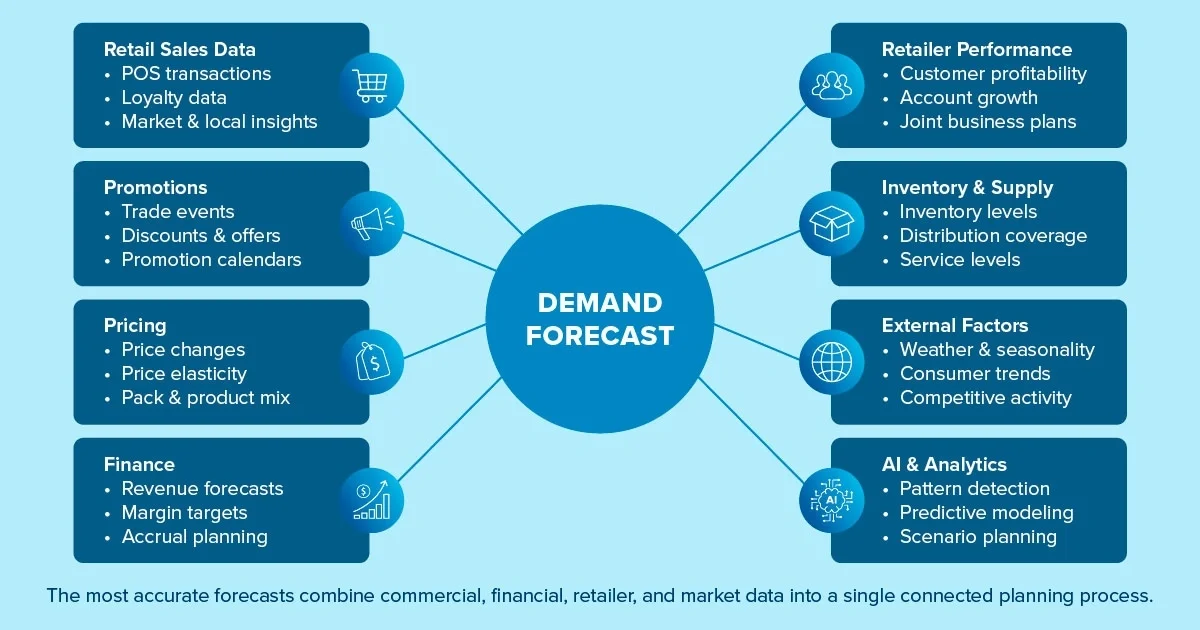
Retailers often have visibility into point-of-sale transactions, loyalty card behavior, local market trends, and category performance. Manufacturers may have deeper visibility into trade spending, pricing strategies, promotional investments, product innovation plans, and broader market dynamics.
The most successful forecasting strategies occur when both perspectives are considered.
Why traditional demand forecasting techniques are reaching their limits
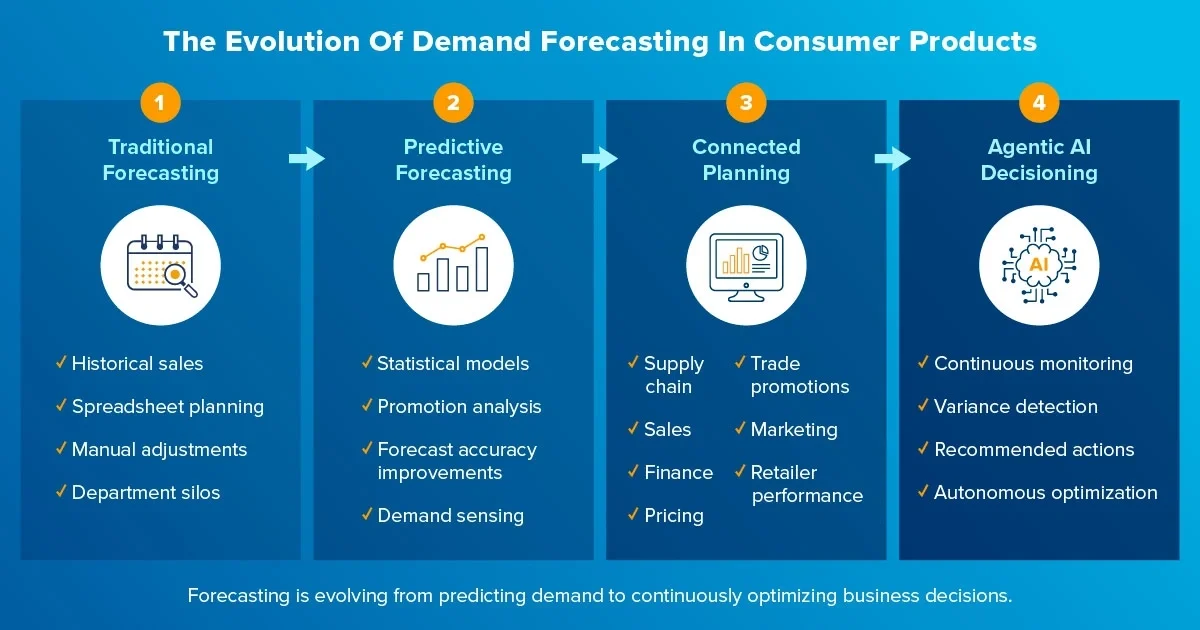
For decades, demand forecasting largely relied on historical sales data and planner experience.
The process was straightforward. Teams examined prior sales performance, adjusted for seasonality, incorporated known business events, and developed a forecast for the months ahead.
The problem is that today's consumer products environment rarely behaves like yesterday's.
A forecast built primarily on last year's sales data may fail to account for shifting consumer preferences, changing retailer strategies, competitive pricing moves, supply disruptions, economic uncertainty, or the growing influence of digital commerce.
Promotions create an even greater challenge. A retailer's circular placement, a digital coupon campaign, an in-store display, or a competitor's promotion can all shape demand in ways that are difficult to predict using traditional methods.
As a result, many consumer products organizations find themselves spending more time adjusting forecasts than trusting them.
This is one reason AI-powered forecasting has moved from an emerging capability to a strategic priority for many consumer products manufacturers and retailers.
As forecasting complexity has increased, organizations have begun turning to artificial intelligence and machine learning to uncover patterns and demand drivers that traditional forecasting methods often miss.
AI is changing how consumer demand is predicted
Traditional forecasting models often evaluate a relatively limited set of variables and historical data and require planners to manually adjust forecasts when market conditions change.
Artificial intelligence approaches forecasting differently.
Rather than asking planners to identify every possible demand driver, AI models evaluate thousands of data points simultaneously and uncover patterns that would be impossible for a human analyst to detect on their own.
For example, an AI model may identify that a specific retailer promotion consistently performs differently in urban versus suburban markets. It may recognize that a price increase affects demand differently depending on package size, product category, or competing offers on shelf.
More importantly, machine learning continuously improves.
As new sales, promotion, retailer, and market data become available, forecasting models can adapt and refine their predictions. This allows organizations to respond more quickly to changing conditions instead of waiting for quarterly planning cycles.
The result is a forecasting process that becomes increasingly dynamic rather than static.
What data is used in demand forecasting?
Modern demand forecasts combine multiple data sources, including historical sales performance, market research, retailer point-of-sale data, promotional plans, pricing changes, inventory levels, market trends, seasonal patterns, and external factors such as economic conditions or weather. AI-powered forecasting models can analyze these inputs together to generate more accurate predictions than historical sales data alone.
Ways trade promotions create big forecasting challenges
Few variables disrupt demand forecasts more than promotions.
Consider a consumer products manufacturer preparing for a retailer promotion. The sales team expects volume growth. The retailer anticipates increased store traffic. Finance teams are forecasting incremental revenue. Trade teams are allocating significant portions of their budget to support the event.
Some promotions create meaningful incremental demand and attract new buyers. Others simply encourage consumers to purchase earlier than they otherwise would have. In some cases, promotions generate volume but erode manufacturer profitability through excessive discounting.
Retailers face similar uncertainty. A promotion that performs well in one region may underperform elsewhere. A display that succeeds with one product category may have little impact on another. Retailers are challenged to determine whether a promotion will grow the category, shift purchases between brands, or simply pull demand from future weeks.
Without accurate forecasting, promotional planning becomes an exercise in educated guesswork.
This is one reason demand forecasting is increasingly becoming intertwined with trade promotion management and revenue growth management strategies.
Companies are no longer asking only, "How much will we sell?" They're asking, "How much profitable demand will this investment generate?"
How AI improves trade promotion forecasting
Promotion success depends on many factors, including:
- Retailer execution
- Display location
- Timing
- Competitive activity
- Product availability
- Regional demand patterns
- Price elasticity
- Consumer buying trends
AI allows organizations to analyze these variables together rather than independently.
Instead of assuming a promotion will generate a fixed percentage uplift, forecasting models can estimate likely outcomes based on similar conditions and continuously refine those predictions as actual performance data becomes available.
For companies investing millions of dollars annually in trade promotions, even modest improvements in forecast accuracy can have a significant impact on revenue, margin, and trade-spend efficiency.
How to evolve from forecasting consumer demand to explaining demand
One of the most significant developments in AI is that organizations are no longer focused solely on predicting demand. They also want to understand why demand is changing.
This distinction is important.
A forecast that predicts a 12% increase in sales is useful. A forecast that explains the increase is being driven by a specific retailer promotion, favorable pricing conditions, expanded distribution, and growing category demand is far more actionable.
For manufacturers, this deeper visibility helps improve decisions around production planning, promotional investments, and trade spending.
For retailers, it helps category managers understand which products deserve additional shelf space, merchandising support, or inventory commitments.
The most advanced AI systems are increasingly moving beyond answering the question, "What will happen?"
They are helping organizations answer, "Why will it happen, and what should we do about it?"
Understand the hidden cost of poor demand forecast accuracy
Most discussions about demand forecasting focus on inventory management. Stockouts. Overstock situations. Warehouse costs.
Those consequences certainly matter, but the financial impact often extends much further.
When forecasts are inaccurate, manufacturers can struggle to evaluate retailer performance to a meaningful degree. Trade accruals may no longer align with actual sales activity. Financial forecasts become less reliable. Deduction reconciliation becomes more complicated when promotional performance differs from expectations.
Retailers face their challenges, too. Overestimating demand ties up working capital in inventory that sits on shelves. Underestimating demand creates empty shelves and frustrates consumers who may purchase competing products instead.
In both cases, forecast inaccuracies can create a ripple effect that impacts profitability long after the original forecasting error occurs.
This is why many organizations are shifting their focus from forecast accuracy alone to forecast accountability, using technology and methods to seek not just whether forecasts were right or wrong, but why.
The future of demand forecasting is connected planning
The organizations achieving the greatest forecasting success no longer treat forecasting as an isolated process.
Instead, they are connecting demand forecasts with pricing strategies, trade promotion planning, retailer performance analysis, financial forecasting, deduction management, and revenue growth initiatives.
This broader view creates a more complete picture of demand.
Rather than producing a forecast and hoping it proves accurate, organizations can continuously evaluate how actual performance compares to expectations and adjusts accordingly.
For manufacturers, this means understanding not only what demand is likely to occur, but also which retailers, products, promotions, and investments are generating the most profitable growth.
For retailers, it means improving category performance while maintaining product availability and maximizing inventory productivity.
Why data quality matters in demand planning
Despite the excitement surrounding AI, technology alone cannot solve forecasting challenges. AI is only as effective as the data supporting it.
Many manufacturers still struggle with fragmented information spread across ERP systems, trade promotion platforms, retailer portals, spreadsheets, deduction systems, and financial applications.
When pricing data, promotional plans, retailer performance metrics, and financial information are disconnected, forecasting models lack the context needed to generate reliable insights.
This is why leading organizations are investing not only in AI capabilities but also in integrated data foundations that connect commercial planning, trade management, retailer performance, deductions, and financial processes.
Without connected data, even the most sophisticated AI models will have blind spots.
Agentic AI and autonomous planning
While today's AI systems primarily generate predictions and recommendations, agentic AI introduces the ability to monitor conditions continuously, identify emerging risks or opportunities, and proactively suggest actions.
Imagine a scenario where a forecast begins to diverge from actual retailer sales.
Rather than waiting for a planner to discover the issue during a monthly review, an AI agent could automatically identify the variance, determine likely causes, assess financial impact, and recommend corrective actions.
Those actions might include:
- Adjusting promotional plans
- Reallocating inventory
- Revising accrual assumptions
- Updating demand projections
- Alerting account teams to retailer-specific risks
For finance, sales operations, and trade leaders, this represents a significant shift. Forecasting becomes less about creating static plans and more about continuously optimizing decisions as market conditions evolve.
How Vistex helps consumer products companies improve forecasting decisions
Demand forecasting is only as effective as the data and insights supporting it.
Vistex helps consumer products manufacturers bring together the commercial data that directly influences demand, including pricing, promotions, trade investments, deductions, retailer performance, data science analytics, and revenue management information.
By connecting forecasting inputs with trade promotions, pricing, retailer performance, deductions, and revenue management processes, Vistex helps organizations move from reactive forecasting to more proactive, data-driven decision-making. They can then gain a more complete understanding of what is driving demand and profitability across customers, products, brands, and promotional programs.
Instead of relying on disconnected spreadsheets and fragmented data sources, finance, sales, and trade teams can work from a shared view of performance and make decisions with greater confidence.
The result is not simply better forecasts; it’s better business outcomes.
Demand forecasting is a growth strategy for consumer products manufacturers
Demand forecasting has evolved far beyond predicting how many cases of product will be sold next quarter.
Today, it sits at the intersection of commercial planning, retailer collaboration, financial management, and revenue growth.
For both manufacturers and retailers, the goal is no longer just forecast accuracy. The goal is making better decisions about where to invest, how to serve customers, and how to drive profitable growth.
In an increasingly volatile market, organizations that can anticipate demand more accurately—and act on those insights faster—gain a measurable competitive advantage.
Explore more related resources
Get the latest news, updates, and exclusive insights from Vistex delivered straight to your inbox. Don’t miss out—opt in now and be the first to know!