
Why do licensing royalty rates and minimum guarantees matter?
Most companies treat licensing success as a partner-selection problem. Find the right licensee, sign them, and the rest takes care of itself. In reality, licensing royalty rates and minimum guarantees (MGs) often influence commercial outcomes more than the partner alone. The partner rarely determines the outcome; the agreement does. The same licensee can turn into an aggressive market builder or a passive rights holder, depending entirely on the deal structure.
Three commercial levers decide which one you get: rights, royalty rates, and MGs. Get them right, and they work together to encourage market expansion and IP commercialization. Get them wrong, and even a strong partner will sit on the license.
What are licensing royalty rates and minimum guarantees?
Licensing rights define what a licensee is permitted to do: which territories, product categories, sales channels, and time period the agreement covers. Royalty rates are the percentage of net sales or per-unit amounts a licensee pays the licensor in exchange for those rights. Minimum guarantees are the floor, a fixed dollar amount that the licensee commits to pay regardless of actual sales performance. Individually, each term is administrative. Together, they're a commercial system that either encourages a licensee to build a market or lets them coast.
To see how these three elements interact in practice, consider a hypothetical. A licensor grants rights to an animated character property for apparel, such as T-shirts, hoodies, and long-sleeved tees, across the U.S., Canada, and Australia, sold through mid-market retailers and mass merchandisers, with no e-commerce, on a non-exclusive basis for a three-year term with a 90-day sell-off period.
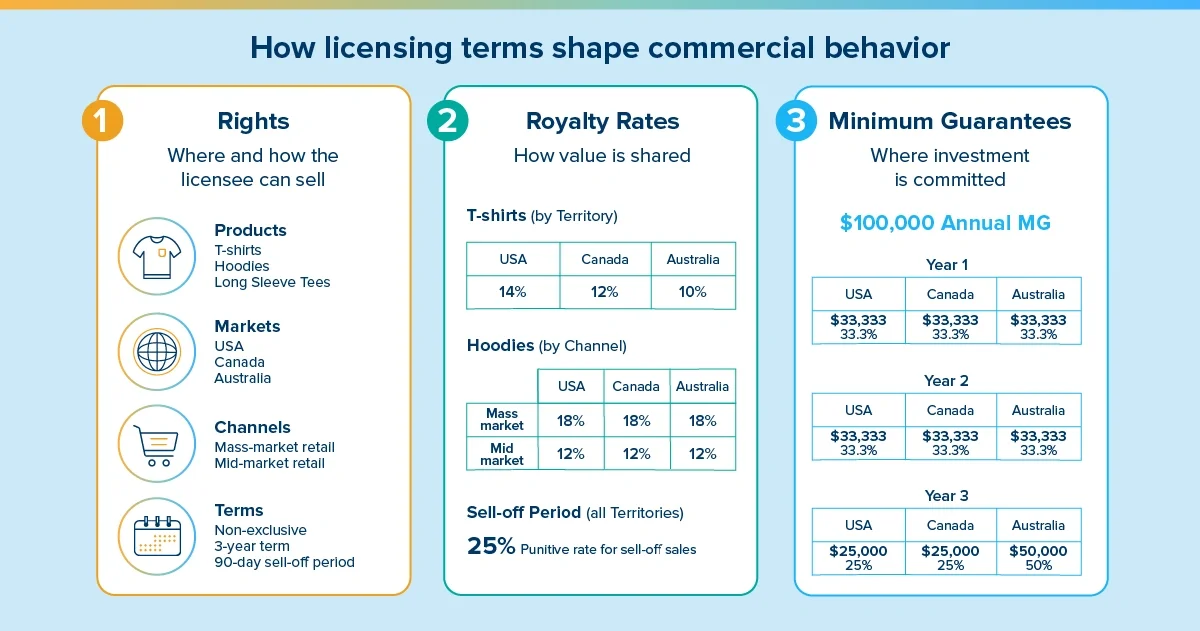
The MG is set at $100,000 in Year 1, split 50% U.S., 25% Canada, and 25% Australia; $100,000 in Year 2, split evenly across all three territories; and $100,000 in Year 3, split 25% U.S., 25% Canada, and 50% Australia, a structure that deliberately shifts the licensee's investment priority toward Australia as the deal matures.
Royalty rates aren't flat, either. T-shirts run 14% in the U.S., 12% in Canada, and 10% in Australia. Hoodies run at 18% through mass-market channels versus 12% through mid-market channels across all territories. And anything sold during the sell-off period is subject to a 25% rate. That last number is a punitive rate during a sell-off that discourages a licensee from treating the closeout period as a second selling season.
This example illustrates something many licensors miss: none of these numbers exist in isolation. They're levers, and they're meant to be pulled together.
Rights determine what the licensee can do
Rights are the deal's boundary lines: territory, product category, distribution channel, exclusivity, and term. They establish what's commercially possible before a single royalty dollar changes hands.
In the apparel example, the licensee can sell T-shirts and hoodies in three territories through brick-and-mortar retail only, with no e-commerce. That's a deliberate boundary, not an oversight, and it shapes everything that follows.
Royalty rates determine how value is shared
Royalty rates set the financial relationship between licensor and licensee, and I believe intended exploitation should drive how they're set, not administrative convenience.
Favorable rates encourage more sales in the areas tied to those rates. Lower rates still allow a licensee to use its existing supply chain, but they create a disincentive: selling in certain channels or territories incurs higher royalty expenses. That's not a penalty for its own sake; it's how a licensor keeps a portfolio of licensees aligned with a single brand plan.
Timing matters too. Seasonality, tie-ins to entertainment property release windows, and event-based rates all shift the calculus. In the example above, the 25% sell-off rate does exactly that: it tells the licensee, in financial terms, to sell full-price product during the term and clear inventory quickly once it ends.
Minimum guarantees create commitment
MGs provide licensors with predictable revenue and give licensees a reason to invest in the property rather than treat it as optional inventory. Realistic MGs come down to two things: brand strength and the partner's footprint.
A licensee's supply chain dependability and market presence matter as much as the property's popularity. Larger licensees generally carry larger MGs because their expected sales are larger. Set the MG too high, and the licensee walks away. Set it too low, and the licensor is carrying the risk of underperformance with no real recourse.
And, as with royalty rates, MGs can be weighted toward specific rights; a larger, isolated MG in one territory or category signals exactly where the licensor wants the licensee to focus. That's what's happening in Year 3 of the example, when the MG split shifts toward Australia: the licensor is using the guarantee to direct the licensee's attention.
Why do licensing terms matter beyond the contract?
Licensing agreements get filed away as legal documents, but that undersells them. The commercial terms inside them, not the boilerplate, determine whether a licensee invests, expands, or pays the minimum and moves on.
Licensing is a strategic growth model
When done well, licensing lets an organization enter new markets, product categories, and customer segments without the capital and operational risks of doing so directly. That's the whole appeal. But it only works if the terms are built to reward the behavior the licensor actually wants.
This is becoming more common, and it should never be confused with a minimum guarantee. A minimum net sales (MNS) clause always sets the bar higher than what's needed to satisfy the MG. Where an MG protects the licensor's revenue floor, an MNS clause concerns brand availability, keeping the licensed product actively in market to maximize exploitation and protect brand integrity.
Commercial incentives shape partner behavior
Rights, royalty structures, and MGs together determine how much a licensee is willing to invest in marketing, product development, distribution, and long-term growth. Loosen one term without adjusting the others, and the calculus changes whether the licensor intends it to or not.
Passive agreements create passive results
A generic agreement, broad rights, a flat rate, and a low MG will generate baseline revenue almost by default. What it won't do is motivate a licensee to maximize the property's commercial potential. Passive terms produce passive licensees. That's not a coincidence; it's the terms doing exactly what they were built to do.
How do rights, royalty rates, and minimum guarantees work together?
Agreements that look strong on paper fall apart because the rights, royalty rates, and MGs aren't calibrated to one another. Here’s an example:
- A well-known animated character franchise with multiple characters was over-licensed, and many of the guarantees were set too high, based almost entirely on the property's popularity in its first few years rather than a proper market tolerance study.
- Some of the smaller licensees had reasonable MGs, but their royalty rates were set too high for them to generate enough profit to grow the business or even afford the expense. The property was so hot that MGs and royalty rates got assigned and agreed to without any real long-term vision.
- Many of those contracts never met their MG and were eventually written off. The brand went through a multi-year slump while it sorted itself out, and the rights holder ultimately relaunched the licensing program with a far more strategic approach.
- Today, it's one of the most recognizable brands on the planet, and still highly lucrative, but it took a painful correction to get there.
What happens when rights are too broad, and royalty rates are too low?
Overly permissive rights, paired with a flat, low rate, remove the licensee's urgency to develop any specific market actively. Why prioritize one territory or channel when the rights and the economics don't push in any particular direction?
What happens when minimum guarantees aren't calibrated to market opportunity?
A guarantee set too low signals that the licensor doesn't expect genuine commitment. That expectation becomes self-fulfilling. Licensees tend to invest to the level a deal implies they should, not necessarily to the level the market could actually support.
How aligned terms create a self-reinforcing commercial structure
When rights, royalty rates, and MGs are calibrated together, each term reinforces the others. Rights define where a licensee can play. Royalty rates make some plays more attractive than others. MGs put a financial stake behind the plan. None of the three works in isolation; that's the core failure in the character brand franchise example above, and it's the core opportunity when a licensor gets it right.
How can licensing agreements encourage market expansion?
Contractual incentives mostly work by keeping a single agreement performing at the standard the licensor has already set, not by dangling something new. For the licensee, the real motivation is holding onto the rights to a profitable property for as long as possible, so those rights don't go to someone else. Incentives like exclusivity or expanded rights are rarely spelled out in advance.
Performing well against existing MGs, royalty rates, and sales targets is what keeps the relationship going.
Expanding into new territories
Territory rights, exclusivity, and performance expectations, set correctly, give a licensee a reason to actually build out a region rather than hold the rights defensively.
Growing new product categories
The same logic extends to adjacent product categories: licensing terms can encourage a licensee to invest in new lines while protecting brand integrity and long-term value.
Supporting strategic sales channels
Agreements can also prioritize specific channels, such as retail, e-commerce, direct-to-consumer, marketplace, or emerging formats, depending on where the licensor wants the brand to appear.
Rewarding stronger commercial performance
Tiered royalty structures, performance milestones, and expanded rights all give a licensee a reason to keep investing as results improve.
Going back to the apparel example: a licensee that hits its Year 1 targets in the U.S. has a real incentive to push harder in Year 2, because the MG split and rate structure are already built to reward exactly that kind of performance.
How should licensors structure successful licensing agreements?
The deal terms above only work if they're built in the right order. Here's the sequence for structuring or evaluating a licensing agreement.
Step 1: Define business objectives
Start with the commercial goals: target markets, growth priorities, revenue expectations, and the long-term vision for the partnership.
Step 2: Establish the rights framework
Define the scope of licensed rights so they align with the products, territories, distribution channels, and commercialization strategy the licensor intended for the brand.
Step 3: Design royalty structures
Build royalty models that balance financial return against the incentive for the licensee to invest in growing the property, not just maintaining it.
Step 4: Determine minimum guarantees
Set MGs that reflect real market opportunity, establish mutual commitment, and protect both parties, not a number pulled from how hot the property feels this quarter.
Step 5: Measure and refine performance
Use reporting, analytics, and periodic reviews to evaluate how the agreement is actually performing, and be willing to adjust it.
Common mistakes companies make when structuring licensing agreements
Once a licensing portfolio is well-structured, the biggest operational challenge shifts. Managing large volumes of agreements is solvable with systematic, data-driven tools, and global complexity tends to evolve organically without becoming a real problem.
The harder issue, on the licensor side, is knowing that what's being reported back is an accurate reflection of reality, the only way to validate a marketing and exploitation plan and confirm proper remuneration.
On the licensee side, it's about compliance: running a profitable licensing program without risking a violation of the terms. For both parties, the same mechanism governs it all: audits.
Treating every licensing agreement the same
Different products, markets, and partners need different commercial structures. A one-size-fits-all agreement almost guarantees a mismatch somewhere in the portfolio.
Negotiating financial terms independently
Rights, royalty rates, and MGs should be developed together as a single commercial strategy, rather than negotiated in separate conversations that never reference one another.
Setting guarantees without market insight
An MG set without real market data, including historical performance, partner capability, and launch investment, is a guess wearing a contract's clothing.
Failing to build performance review into the agreement itself
Without defined reporting cadences, milestone checkpoints, and renegotiation triggers, neither party has a real mechanism to course-correct. The agreement runs until the term expires, for better or worse.
From better licensing agreements to better business outcomes
Successful licensing agreements create incentives that encourage sustainable growth, stronger partnerships, and more effective IP commercialization, rather than merely legally compliant contracts.
Align commercial incentives with business strategy
Well-designed licensing agreements align the interests of licensors and licensees. That alignment, not the legal language sitting around it, is what supports stronger commercialization, sustainable growth, and long-term value.
From agreement management to licensing intelligence
As portfolios grow, the constraint shifts from deal structure to visibility. Licensors need centralized data on agreements, rights, and royalties; automated royalty calculations and payment management; real insight into licensing performance; and audit-ready compliance and reporting.
This is where Vistex AI-driven enterprise software comes in, giving licensing companies the operational backbone to execute the strategy built into the agreement and scale IP monetization with confidence, not guesswork.
How can you optimize licensing royalty rates and minimum guarantees?
Evaluate your current licensing agreements to determine whether your rights framework, royalty structures, and minimum guarantees align with your commercialization goals. As portfolios grow more complex, modernizing how you manage rights and royalty operations helps maintain alignment and unlock the long-term value of your IP.
Explore more related resources

Get the latest news, updates, and exclusive insights from Vistex delivered straight to your inbox. Don’t miss out—opt in now and be the first to know!