
What are music royalties?
Music royalties are payments made when music is used, performed, reproduced, distributed, or synchronized. Rights ownership, metadata quality, and licensing practices all affect how royalties are tracked, calculated, and paid. Royalty sources include streaming, radio, live shows, sync, gaming, social media, and physical sales. Payments depend on rights ownership and contract terms, not just play counts.
If it captures, matches, and pays the royalties it earns from its catalog, then it passes the test for a music company.
The critical issue for businesses is accurately recording, identifying, and monetizing royalties they generate.
Royalty management has gotten harder in the past 10 years. Two changes stand out:
- Micropenny payments cause older systems, built to round to two decimal places, to create rounding errors. The bigger the statement file, the longer processing and calculation take.
- Registering a musical work requires more metadata than it used to, including interested parties, associated territories, and alternative song titles.
Here’s a common misconception: An artist says, “I was hired to sing on a song that’s being played on American radio. Why aren’t there any royalties for it?” Radio royalties are performance royalties, and in the U.S., they pay only the song's songwriters. Artists or musicians hired to sing on a song will only receive a share of the sales royalties.
U.S. territorial radio pays no performance royalty for the sound recording, so the money goes to songwriters and their publishers through performing rights organizations (PROs). Session vocalists and musicians can share in digital performance royalties through SoundExchange, and their contracts could include additional compensation.
Newer rights professionals often make another assumption: Artists and songwriters may think that if they post their music on a streaming service and their name and song title appear, royalties will arrive automatically. They’re rarely told that they must register their music with performance rights societies, such as the American Society of Composers, Authors and Publishers (ASCAP) or Broadcast Music, Inc. (BMI) in America, and register International Standard Recording Code (ISRC) numbers for their sound recordings to track sales royalties.
Understanding music royalties is essential. So does knowing that one song is considered two assets. That’s where the confusion begins and where missed revenue stacks up.
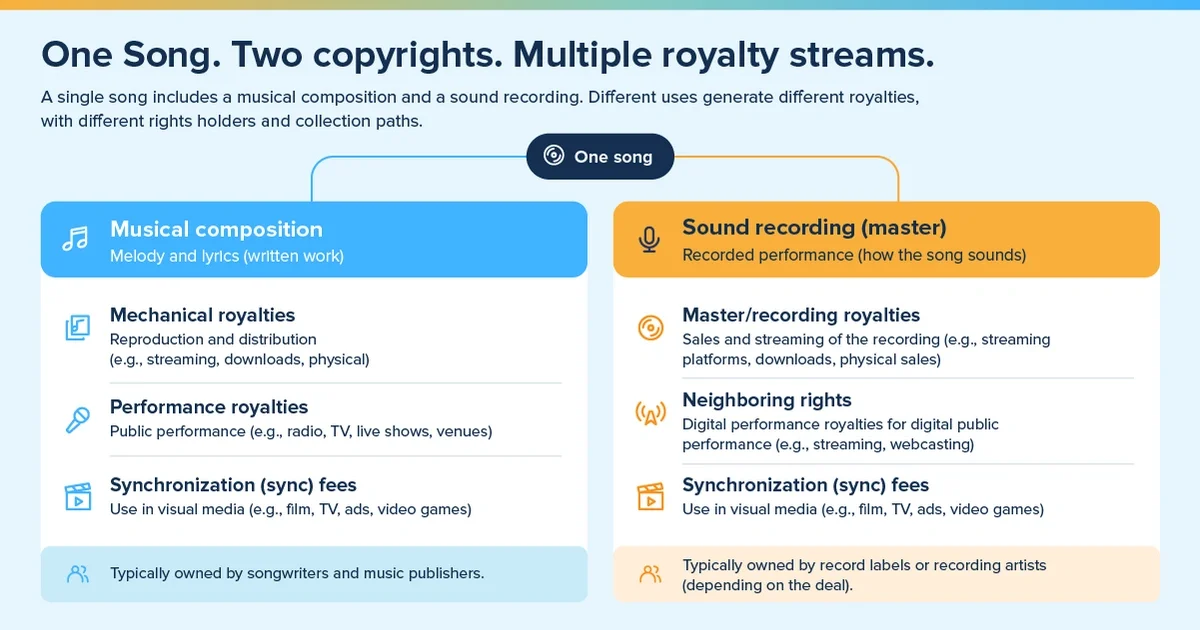
What are the two copyrights behind every song?
The difference is simple: a master recording and the underlying composition. That’s where different owners, collectors, and payout systems come in, and where most questions about types, collections, and royalty payments come up.
- Sound recording (master) rights
These rights cover the unique recorded performance version as heard on a streaming service. Depending on the deal, they may be owned by a label or an artist. Revenue for the master goes to the owner through labels, distributors, and, for digital performances, SoundExchange.
- Musical composition rights
These rights protect the melody and lyrics and pay songwriters and publishers. Songwriters and publishers get a share of the earnings, and composition royalties follow a different collection process from master rights.
These two copyright categories have different ownership and authorization structures and different types of royalties. For media like film, TV and advertising, a synchronization (sync) license is required, which requires authorization for both.
The difference between copyrights is often misunderstood, and companies make mistakes by assuming they have one type of copyright when they have the other. The music publisher may not hold the master recording, and the record label may not hold the copyright on the song.
Here’s what it looks like in practice: A music supervisor I once knew wanted to license a rap song for a movie. He spoke to the owner of the master recording, who assured him he owned the copyrights, so he told the producers to put the song in the film. As the film's lock date approached, the song’s copyright owner contacted him, saying he hadn’t secured permission, and used the deadline to force a more expensive license rate. The music supervisor learned from that; from then on, he did his own due diligence and secured the copyrights himself.
This mistake came down to relying on two different owners’ assertions of two separate rights.
Why does one song generate multiple royalty payments?
One song performance can result in a master-side payment, a mechanical royalty, and a performance royalty. Different people receive each one through different channels. One play, three payments, and three sets of records that all must agree.
That’s just one stream. Multiply that by five royalty types, each with its own trigger, collector, and payout system, and you get complicated royalty operations.
What are the five types of music royalties?
Each type of music royalty has a different trigger, collector, and recipients. Here’s how the five types break down:
- Streaming royalties
Streaming triggers payments across several other categories listed below. It’s not a numbers game.
How streaming providers generate payouts, and why streaming volume doesn't translate into transparent or predictable revenue.
- What triggers it: A song or recording is streamed on a digital platform.
- Who receives payments: Artists, record labels, songwriters, publishers, and rights holders, depending on the rights involved.
- Who collects it: Streaming services pay through the label, distributor, publisher, or collection agency.
- Why it matters: Many streams don’t mean accurate or predictable payouts. Missing rights data, unclear revenue splits, or inconsistent reporting can mean earnings go uncollected.
- Mechanical royalties
These are tied to reproducing a composition, whether on vinyl and other physical formats or through digital reproduction.
- What triggers it: When a composition is reproduced, either physically on vinyl or digitally.
- Who receives payment: Songwriters, composers, and publishers.
- Who collects it: Publishers, publishing administrators, and the mechanical royalties collection societies, such as the Mechanical Licensing Collective (MLC) for streaming and downloads in the U.S.
- Why it matters: Errors in ownership or split data lead to misallocation, delays, or uncollected mechanical royalties.
- Performance royalties
Public performance income comes from radio, venues, TV, and digital use, and may rely on accurate repertoire registration with a PRO.
- What triggers it: When a composition is used in a public performance on radio, at a venue, on TV, or through other public uses.
- Who receives payment: Songwriters, composers, and publishers.
- Who collects it: PROs like BMI, ASCAP, and the Society of European Stage Authors and Composers (SESAC).
- Why it matters: If repertoire isn’t properly registered, a performance can produce royalties that don’t reach the right owners.
- Synchronization royalties
Sync fees for film, television, advertising, and video games. Unlike the other royalty types, sync is negotiated and isn’t passively collected.
- What triggers it: Music is licensed for use in films, TV, advertising, video games, or other visual media.
- Who receives payments: Songwriters, composers, publishers, artists, labels, and rights holders, depending on the agreement.
- Who collects it: Sync fees are negotiated directly with rights holders, publishers, labels, or licensing agents.
- Why it matters: Sync deals are negotiated and agreed upon under terms that will differ from one deal to the next. Weak contracts or incomplete rights information can lead to missed opportunities or unpaid royalties.
- Neighboring rights
These are performance-related royalties outside the traditional songwriter-publisher structure, allowing foreign collection societies to collect revenue.
- What triggers it: It occurs when a sound recording is performed or broadcast in ways that generate neighboring-rights income in certain territories.
- Who receives payment: Recording artists and owners of sound recording rights.
- Who collects it: Collection societies and groups that manage neighboring rights, often in different regions.
- Why it matters: International use creates royalties the rights holder might never receive if the right collection society, registration, or territory gets overlooked.
Why are neighboring and mechanical royalties so misunderstood?
Neighboring rights often confuse American rights holders because the U.S. lacks protections common elsewhere. Overseas, radio stations pay performers and labels when recordings air. U.S. terrestrial radio pays songwriters and publishers through PROs, but not recording rights. SoundExchange partly fills the gap for satellite and internet radio.
American artists can run into neighboring rights challenges abroad. When a U.S. recording plays on a foreign station, that country’s music society collects the royalties. Without a corresponding U.S. right, American performers and labels may miss out on their share. It’s money they’ve earned but may never receive.
Mechanical royalties are confusing. The term comes from physical copies pressed onto vinyl, with royalties tied to the product. Streaming broke that link, but royalties still reach songwriters only when works are registered and matched. Otherwise, the money waits.
How has streaming music changed music royalties?
Streaming doesn’t add a new royalty type; it adds volume and touches nearly every type at once. Mechanicals changed the most. Since January 2021, the MLC has run the blanket mechanical license for digital streaming services in the U.S., which replaced the old song-by-song approach with a single collective. Sync is the exception. Those deals still get negotiated one at a time, so streaming hasn’t changed how they work.
So who registers the work, who collects the money, and who ends up with the check?
Who collects music royalties?
The seven types of earners include:
- Recording artists record music and take part in generating income from streaming, digital performance, and other licensed uses.
- Songwriters compose the lyrics, melody, or other underlying aspects of a song.
- Composers create music, such as for film, TV, video games, and other applications.
- Publishers oversee composition rights and gather and manage royalties for songwriters and composers.
- Labels own or control master recordings and manage their commercial distribution and accounting.
- Rights holders are individuals or companies that own or control the rights that generate royalty income.
- Other contractual participants receive a portion of royalty income based on a particular agreement.
The five types of collectors include:
- PROs such as BMI, ASCAP, and SESAC, collect public performance royalties for songwriters and publishers.
- SoundExchange collects digital performance royalties, and it matters to sound recording owners and performers rather than songwriters.
- Music publishers and publishing administrators collect mechanical and composition royalties and manage international rights through sub-publishing agreements.
- Record labels and distributors collect and account for revenue at the master level, and the label sits ahead of the artist in the payment hierarchy. Distributors handle master-side revenue, and they don’t collect every revenue stream a song generates.
- Collection societies and foreign collective management organizations (CMOs) run the international collection channels, and the local society in a given territory can decide whether royalty income gets recovered or goes uncollected.
When rights holders get frustrated about delayed or missing payments they’re entitled to, is it a collection or registration problem? The answer is both. Poor registration leads to poor collection.
How are music royalties calculated?
Compensation depends on the rights of use, agreements in place, and how and where the music is used.
- Ownership percentages set the royalty amount each rights holder receives.
- Contract terms determine the rates, divisions, charges, and additional payment conditions for each contract.
- Licensing structure determines which rights are being licensed and how the resulting revenue is shared.
- Territory influences the applicable rights, the entity that collects royalties, and the amount paid.
- Platform changes the licensing agreements, reporting methods, and payment structures in play.
- Subscription tier influences the revenue from a stream or other digital use.
- Usage type activates different royalty responsibilities, whether the use is a stream, radio performance, or sync placement.
There’s no standard rate for each stream. Payments are based on the contract terms and platform factors, not on an equation.
Some people think each venue that plays an artist’s music must pay that artist directly. In practice, venues pay a PRO for a blanket license, and the PRO distributes royalties to its members.
If the calculation varies this much, the collection process must be disciplined enough to ensure the right amount reaches the right party. That discipline runs through a repeatable four-stage lifecycle.
How are music royalties collected?
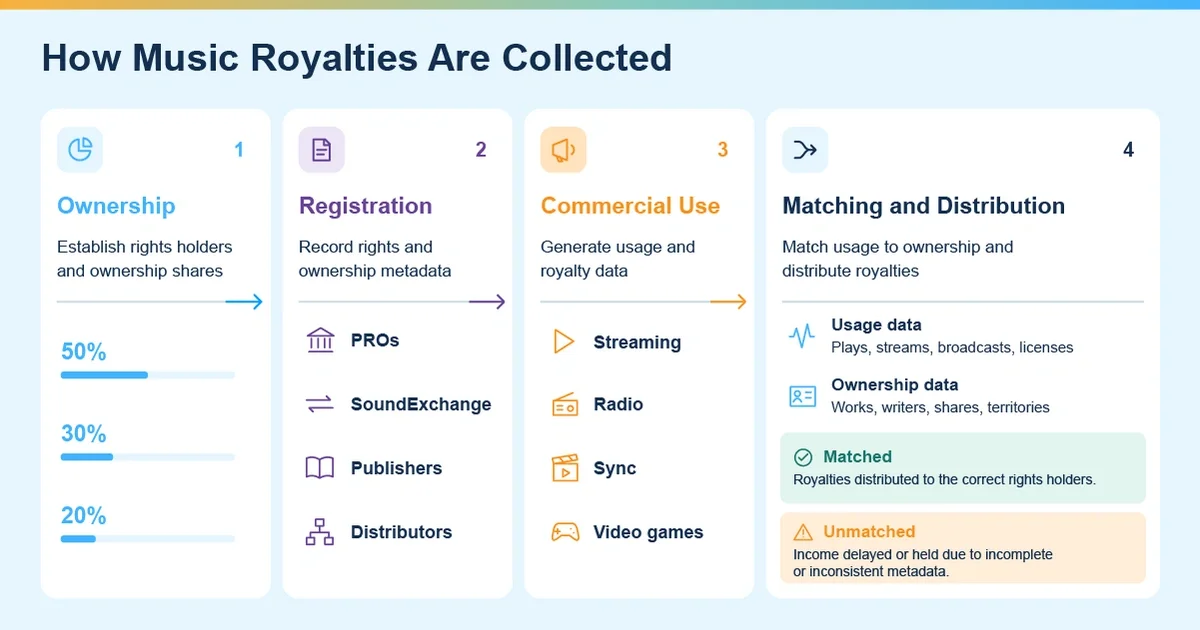
Collecting music royalties requires linking ownership records, rights registrations, and usage reports—not just tracking plays. Missing or inconsistent metadata can prevent royalty matching and distribution, delaying or losing income.
- Music is created and ownership is established.
The arrangement and recording are established. Ownership starts with authorship and production, and continues with contractual assignment.
- Rights are registered.
Creators and owners register with PROs, SoundExchange, publishers, and distributors, and metadata must stay consistent across all parties.
- Music is used commercially.
The music is used for streaming, radio, sync, and video games; licensing agreements define royalty responsibilities.
- Royalties are reported, matched, and distributed.
Compare usage data with ownership data. Missing or inconsistent metadata can prevent royalties from matching to the rightful owners, leaving revenue unclaimed as black-box income.
Why does missing songwriter information delay music royalty payments?
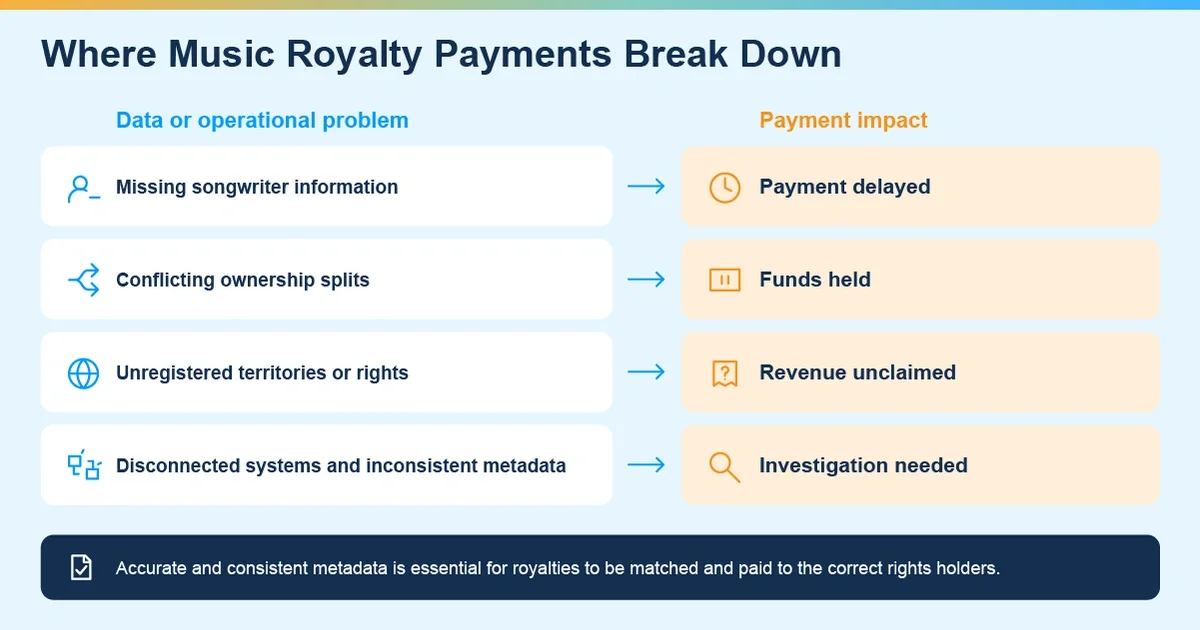
Delays often occur when music societies can't register a musical work quickly because they lack information about additional songwriters. Publishers focus on registering their signed songwriters for a musical work. Still, if the work involves collaborations with unrepresented songwriters, they may lack the information needed to report it to a performance society.
Five reasons music royalties go unpaid or uncollected
- Metadata errors and registration gaps happen when the writer, publisher, or ISRC information is missing, or when splits are incomplete or contradictory.
- Fragmented systems lead platforms, organizations, labels, and publishers to pass along unreliable data. Royalty collection ends up working like a network of banks that never agreed on a shared ledger.
- International complexity rises because geographic regulations and differences among collection societies complicate payments.
- Ownership disputes cause payment delays until split agreements are resolved.
- Artificial streaming and fraud invalidate royalty allocation and deprive genuine beneficiaries of their right to royalties.
Five best practices for maximizing music royalty collection
- Register with PROs, SoundExchange, publishers, and distributors.
Accurate registration, with composition and master data kept in sync, guarantees each royalty has the information needed to reach the right recipient.
- Audit metadata regularly.
Fast identification and resolution of split discrepancies ensure timely collection without the risk of mismatched or stalled royalties.
- Monitor usage across channels.
Linking usage to royalty data shows income that was earned but not collected. - Upgrade royalty operations with better tools.
Catalog insights, paired with specialized accounting tools, reduce manual reconciliation and clarify amounts owed vs. payments received.
- Identify collection societies by region.
Understanding where royalties are collected helps prevent leakage from foreign usage across societies and regions.
If your team still runs manual music royalty collection, Vistex can help with integrated rights and royalties management, real-time usage tracking, and contract-to-cash visibility by providing music publishers and rights holders with a single source of truth across platforms, ensuring accurate, timely streaming revenue calculations and distributions.
Better royalty management starts with better visibility
So, back to the first question at the start of the blog: What proportion of the money those plays generate ends up with the right person? The answer is subjective and depends on how visible the item is. Here are four points to hold onto:
- Every track carries two copyrights, generating distinct royalty streams.
- Distributors don't collect all forms of revenue.
- There’s no fixed per-play fee for streaming providers.
Accurate metadata and documented splits prevent unmatched income.
What are the biggest operational challenges in music rights management?
One of the biggest operational obstacles in music rights management is deciding how to allocate resources between manual catalog management and investing in the right software and services to improve efficiency and accuracy.
How does integrated royalty management improve catalog visibility?
Integrated royalty management provides a single, reliable source of truth for reviewing musical works across a catalog, reducing fragmentation and inconsistencies associated with manual systems.
How will music royalty companies evolve in the coming years?
Court rulings, licensing negotiations, and industry advocacy will help shape music royalty compensation. Organizations such as the Association of Independent Music Publishers (AIMP) will continue to fight for fair compensation for their songwriters. At the same time, digital service providers (DSPs) will balance licensing costs, subscription pricing, and competing service offerings.
Who gets paid when a song is played?
Songwriters, publishers, recording artists, and record labels all earn royalties when a song is played, depending on which rights are involved and how they are licensed.
But how much of that money reaches the right people? Most rights holders can’t say for certain. Not because the money doesn’t exist. Earned income sits in a queue because a name, split, or identifier doesn’t match. I believe that’s the real story.
The rules aren’t a mystery. Two copyrights, five royalty types, and a handful of collectors. What separates a catalog that gets paid from one that leaks is consistent data behind each play. Registration, splits, and metadata: unglamorous work, and expensive to skip.
Before the next quarter closes, trace your highest-earning track from usage to payment. Check the writer names, splits, ISRC, and which society or collector holds it. If that one track takes an entire afternoon, imagine how long the full catalog would take.
Explore more related resources


Get the latest news, updates, and exclusive insights from Vistex delivered straight to your inbox. Don’t miss out—opt in now and be the first to know!