
What did wholesale distributors learn about protecting margins in 2026?
Before distributors decide how to improve margins in 2027, they should review where they gained or lost profit in 2026. One of the most important wholesale pricing lessons from 2026 is that raising prices isn’t always the best way to improve margins. In fact, it may not be the first place to look.
Valuable profit opportunities may already exist within distributors’ everyday transactions. The challenge is identifying where value is lost across supplier costs, landed costs, customer agreements, pricing decisions, and ultimately, realized margins.
Consider what happens when a supplier raises costs. Procurement receives the update, but customer pricing doesn’t reflect it immediately. A salesperson discounts an order without understanding its full margin impact.
Meanwhile, an earned supplier rebate or chargeback goes uncollected. Each activity affects profitability, but the information and processes needed to manage them often reside in different parts of the business.
Individually, these might seem like separate operational problems. Together, they reveal something more fundamental.
You can’t manage pricing as an isolated activity. It has to function as an end-to-end business process, connecting costs, supplier programs, customer agreements, pricing execution, and margin performance.
That’s the most important lesson I would take away from 2026. It should change how distribution executives approach margin protection, pricing intelligence, and profitable growth in 2027.
What were the biggest wholesale pricing lessons of 2026?
The biggest lesson from 2026 is that protecting margins requires more than setting the right price; it requires executing the decisions that determine what a distributor actually earns.
An unrecovered supplier cost increase, a discount that goes beyond its intended purpose, an unprofitable customer relationship, or an uncollected supplier rebate can each create profit leakage. These issues may originate in different departments, but their financial impact ultimately shows up in the same place: the bottom line.
For distributors, improving profitability in 2027 means looking beyond individual pricing decisions and examining how costs, customer agreements, sales execution, data, and technology work together.
Five lessons from 2026 offer a practical starting point.
1. Why does reactive pricing put wholesale margins at risk?
Reactive pricing puts margins at risk because supplier cost changes can affect profitability long before a distributor can recover those increases through customer pricing.
When costs rise, it’s tempting to adjust selling prices broadly. But that approach doesn’t account for differences in inventory costs, customer agreements, competitive conditions or the timing of future purchases.
Consider a distributor facing a supplier cost increase while still holding inventory purchased at an earlier price. Some customers have negotiated contracts that restrict when selling prices can change, while replenishment inventory will arrive at a higher cost. Applying one price adjustment across every product and customer may create unnecessary competitive risk or fail to recover the actual increase in acquisition costs.
Before making price adjustments, distributors need to understand:
- Which cost should inform the next pricing decision: current inventory cost, replacement cost, or another measure of landed cost?
- When should a new selling price take effect?
- Which customer agreements permit an adjustment, and which require a different approach?
- How much of the cost increase needs to be recovered to maintain the intended margin?
The answers depend on the circumstances. Automatically raising every price could harm competitiveness, while delaying adjustments could quietly erode profitability.
A more effective approach is to make cost recovery an ongoing business process rather than an occasional pricing exercise. That means understanding which costs changed, which products and customers are affected, how quickly those changes can be reflected in selling prices, and whether the intended recovery is actually achieved.
The 2027 lesson: Measure how effectively and quickly supplier cost changes are reflected in customer pricing. Identify where inventory timing, contractual obligations, or delayed execution prevent cost recovery and erode profitability.
2. Why does price realization matter more than announced price increases?
Price realization matters because an announced price increase doesn’t always translate into higher gross profit.
A distributor might approve a 4% price increase, but that doesn’t mean every applicable transaction generates 4% more revenue. Discounts, contract exceptions, overrides, and outdated pricing information can reduce the revenue ultimately collectcollected.
The quoted price, order price, invoice price, and realized margin can tell very different stories.
Consider a salesperson who overrides a recommended price to win an order. The discount may be justified, but do they understand its impact on margin? Is the exception supported by a competitive opportunity or customer commitment? And are similar discounts becoming routine across the sales organization?
The override itself may not be the problem. The real challenge is making that decision without first understanding its financial impact or having visibility into how frequent how often similar decisions occur.
Profitability can erode at multiple points between the initial pricing decision and the completed transaction. Distributors need visibility into the difference between recommended, approved, and realized pricing, including the discounts, incentives, and exceptions that influence the final outcome.
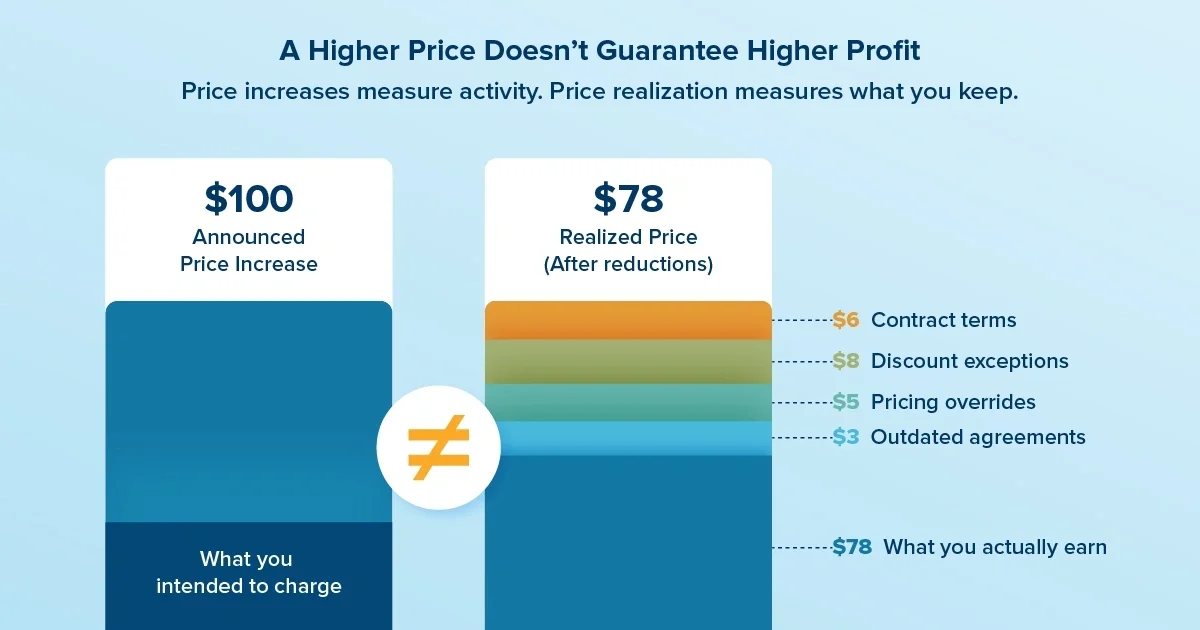
A closer look at recommended and invoiced prices, approved exceptions, and realized gross profit by product, customer, and sales team can help identify where intended margins are being lost.
It also gives pricing leaders an opportunity to distinguish between necessary commercial flexibility and discounting behavior that consistently undermines profitability.
The 2027 lesson: Stop treating approved price increases as proof of improved profitability. Measure the gap between recommended, approved, and realized pricing, and understand where transaction-level decisions are eroding the margin you intended to achieve.
3. Why does customer profitability require more than one pricing strategy?
A single pricing strategy can’t work for every customer because products, purchasing behavior, competitive alternatives, contractual obligations, and service requirements vary.
Cost-plus pricing suits some products, while market-based pricing is more appropriateworks better when comparable alternatives are readily available. Value-based pricing can be effective when a distributor provides meaningful differentiation through availability, expertise, service, or other customer benefits.
The objective isn’t to introduce more pricing rules;. i It’s to apply the right pricing logic to the right situation.
Wholesale distribution spans distinct markets, each with different supplier relationships, acquisition costs, customer expectations, and service requirements. Even within one distribution business, customer economics can vary considerably.
Consider two customers purchasing the same product at the same price. One places predictable, consolidated orders that are easy to fulfill. The other requires frequent deliveries, special handling, smaller order quantities, or extensive customer support. Their gross margins may look similar, but their profitability can be considerably different after accounting for the cost to serve.
That doesn’t automatically mean the second customer should pay more. Rather, it illustrates why pricing decisions should reflect the broader economics of the customer relationship.
Gross margin is an important performance measure, but it doesn’t always tell the complete profitability story. Distributors should also consider delivery frequency, transportation costs, order processing, credit terms, payment behavior, and the resources required to support each account.
Understanding these differences helps distributors identify which customer relationships are generating sustainable returns, where service costs are affecting generate sustainable returns, where service costs affect profitability, and where commercial strategies may need to change.
The 2027 lesson: Evaluate customer and product profitability beyond gross margin. Incorporate cost to serve, purchasing behavior, competitive conditions, and commercial value when determining where pricing strategies need to differ.
4. How does disconnected data undermine pricing decisions?
Disconnected data undermines pricing decisions by preventing teams from working with a consistent, up-to-date view of costs, agreements, transactions, and profitability.
A pricing analyst might rely on one set of product costs, while Procurement has more recent supplier information. Sales may reference customer agreements maintained separately, and finance may discover the resulting margin discrepancy only after transactions have been completed.
In wholesale distribution, even seemingly small data inconsistencies can have significant consequences:
- Incorrect units of measure can distort product costs and selling prices.
- Outdated supplier costs can lead to inaccurate margin calculations.
- Inconsistent customer and product hierarchies can undermine segmentation.
- Missing or outdated supplier agreement information can affect rebate and chargeback recovery.
Adding more sophisticated analytics doesn’t necessarily solve these problems. A pricing recommendation based on outdated costs, incorrect product information, or inaccurate contract terms can be calculated precisely and still be wrong. This is why data quality and integration should be treated as business requirements, not simply technology projects.
Reliable profitability information depends on Procurement, Master Data, Pricing, Sales, Finance, and Supply Chain working from consistent information. But connecting systems is only part of the solution. Distributors also need clear ownership and governance to ensure information is accurate, maintained, and updated as business conditions change.
Before investing in more advanced pricing capabilities, distributors should determine:
- Which data elements have the greatest impact on pricing and profitability?
- Who owns the information and is accountable for its accuracy?
- How frequently do costs, agreements, and product attributes change?
- Where do inconsistencies affect pricing decisions or financial reporting?
Addressing these foundational issues can improve decision-making today while creating a more reliable foundation for future analytics and automation.
The 2027 lesson: Prioritize the data elements that directly influence pricing and profitability. Establish ownership, governance, and consistent processes before investing in greater analytical complexity.
5. When does AI actually improve wholesale pricing performance?
AI creates value when it moves beyond identifying pricing opportunities and helps distributors turn insights into measurable business outcomes.
Analytics might identify a product with declining margins, recommend a different price, or flag an unusual discount. Identifying an opportunity isn’t the same as capturing it. What happens next?
- Does the recommendation reach the right person?
- Can the sales team understand the reasoning?
- Is there an approval process?
- Can routine actions be automated while exceptions receive appropriate review?
- Is the financial outcome measured?
The conversation often jumps to what AI can do before addressing where automation is useful today, where human judgment remains essential, and what business foundations must be in place.
Automation, analytics, and AI each play different roles:
- Automation can execute predefined cost updates, pricing workflows, and approvals.
- Analytics can identify trends, exceptions, and opportunities.
- AI can help uncover patterns, generate recommendations, and support increasingly complex decisions.
Distributors don’t need to introduce every capability at once. A more practical approach is to build maturity over time:
- Establish the foundation
Identify cost changes, outdated prices, missing data, and unusual margin patterns. Improve visibility into existing processes and address the information gaps that prevent effective decision-making. - Improve execution
Automate routine updates, pricing simulations, exception routing, and recommendations. Give pricing and sales teams better tools to evaluate decisions and respond consistently. - Advance decision support
Introduce more sophisticated analytics, AI-driven recommendations, and increasingly autonomous execution within defined business controls. Maintain appropriate oversight, transparency, and accountability for decisions that affect customers and profitability.
The progression should depend on the distributor’s readiness and on the business problems worth solving, not on a desire to reach the most advanced stage.
A straightforward automated cost-update process that reliably prevents margin erosion may offer more immediate value than a sophisticated pricing model that sales teams rarely use.
Ultimately, technology should help distributors make better decisions, execute them more consistently, and measure the results.
The 2027 lesson: Evaluate pricing technology by its impact on business outcomes, including realized margin, decision speed, exception rates, and user adoption. Start with practical opportunities, establish trust, and expand capabilities as the business matures.
Where is hidden margin leakage occurring in wholesale distribution?
Margin leakage often occurs in the everyday transactions distributors already manage:
- Delayed cost recovery
- Pricing errors
- Unnecessary discounts
- Uncollected supplier incentives
- Inconsistent execution
Distributors can become so focused on the next price increase that they overlook opportunities to protect profitability within the business they already have. Those opportunities often exist within existing transactions.
Not every margin improvement requires higher selling prices or increased sales volume. Sometimes, it starts with retaining more of the value already built into each transaction.
What causes distributors to lose margin on existing transactions?
Distributors often lose margin through everyday transactions when they:
- Fail to recover supplier cost increases.
- Apply customer agreements or pricing terms incorrectly.
- Approve discounts that exceed intended pricing guidelines.
- Miss opportunities to collect earned incentives.
These issues may originate in different departments and business processes, making them difficult to identify as connected sources of profit leakage.
Margin leakage rarely has a single source. Following a transaction from supplier cost through customer pricing, order execution, supplier incentives, and final financial results can reveal where expected profitability is lost and which processes need attention.
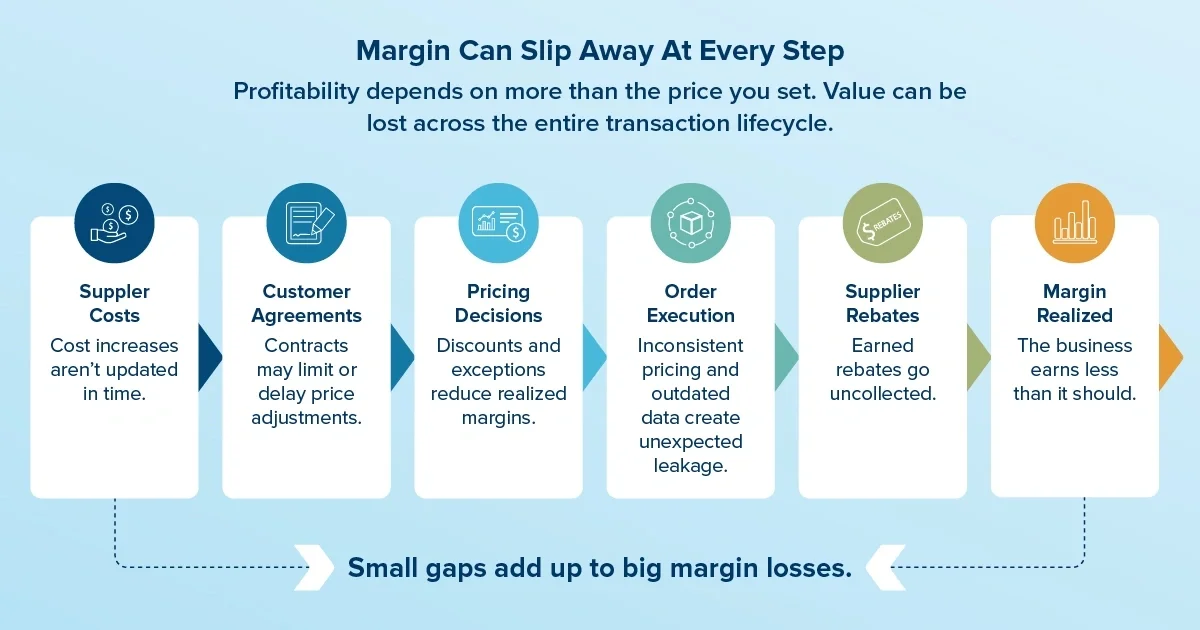
The opportunity isn’t always to sell more products or charge customers higher prices. Often, it’s about executing existing transactions more effectively and retaining more of the margin already available to the business.
How can distributors identify their biggest sources of margin leakage?
Distributors need to establish a measurable baseline to understand where profitability is being lost. Compare actual financial results against expectations, accounting for changes in supplier costs, product mix, sales volume, and other margin-influencing factors. Define what success looks like before launching improvement initiatives.
Margin protection isn’t solely pricing’s responsibility. Missed rebates may originate in Procurement or supplier agreement management. Incorrect invoice prices may stem from master data or contract administration. Unnecessary discounts may reflect gaps in sales guidance, pricing policies, or approval processes.
The next step is to identify which problems occur most frequently, quantify their financial impact, and identify the underlying causes.
This requires connecting each margin problem to the business process, the data supporting it, and the systems involved in its execution.
The objective isn’t to find someone to blame for a poor transaction; it’s to understand where processes break down, establish ownership, and determine what needs to change to prevent future losses.
Identifying margin leakage is only the first step. Preventing it from recurring requires a more connected approach to how distributors develop, execute, and measure pricing decisions.
What does an effective wholesale pricing operating model look like?
An effective wholesale pricing operating model integrates reliable data, differentiated pricing decisions, clear accountability, frontline execution, and financial measurement.
The goal is to go beyond simply setting prices and take a more hands-on approach to managing the entire margin lifecycle, from supplier costs and customer prices to the profit the business ultimately earns.
That requires more than assigning additional responsibilities to a pricing team.
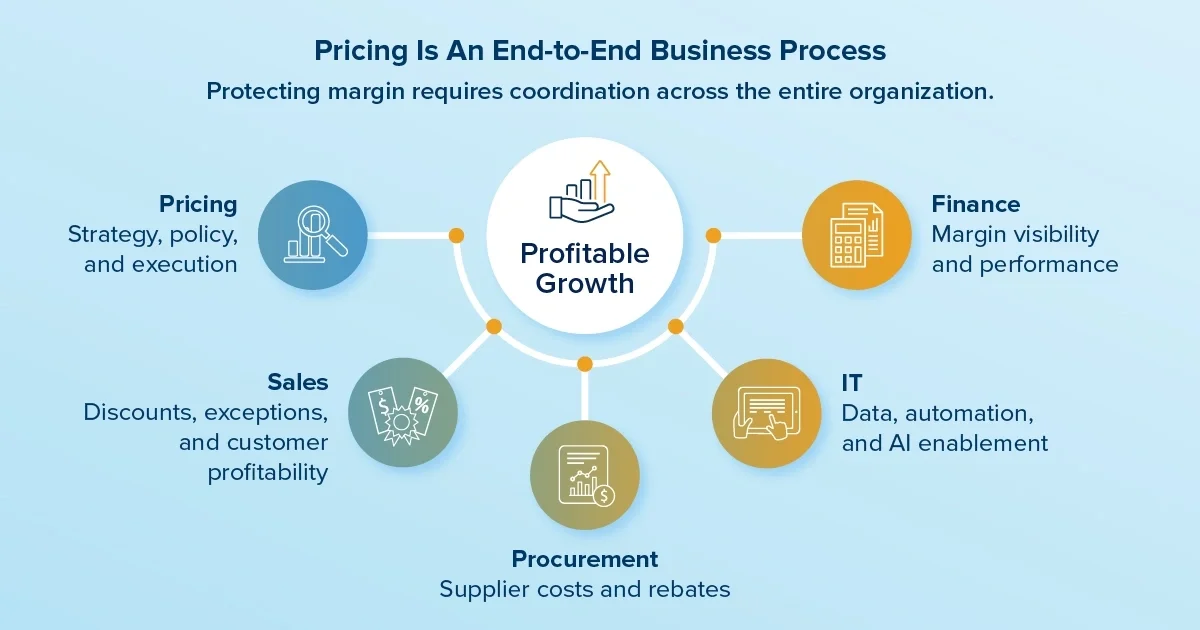
How should Finance, Procurement, Pricing, and Sales work together?
Finance, Procurement, Pricing, and Sales should share responsibility for protecting profitability while clearly owning their respective decisions.
The CFO sets financial priorities and success metrics. Procurement tracks supplier costs and terms. Pricing translates objectives into policies and guidance. Sales applies these policies while balancing profits and customer relationships. Technology and data teams support the process by providing reliable information for decision-making.
The challenge is organizational as much as it is analytical. Pricing policies must reflect customer and product economics; sales teams need actionable guidance; and executives need a reliable way to measure financial value.
That means agreeing on practical questions before introducing more automation:
- Who’s responsible for validating supplier cost changes?
- Which pricing decisions can be automated, and which require approval?
- When should sales representatives be allowed to override guidance?
- Who investigates recurring exceptions and margin discrepancies?
- How will finance verify whether the changes improved profitability?
Without clear answers, even a well-designed pricing strategy can produce inconsistent results.
What should distributors fix before automating pricing processes?
Distributors should first standardize the processes and data that determine whether automated pricing decisions are accurate and actionable.
Implementation experience shows the discussion must extend beyond automation to reliable data, standardized processes, clear decision rights, and practical adoption strategies.
Start with a clear problem: a distributor could reduce the time to incorporate supplier cost changes into customer pricing. This requires reliable cost data, defined pricing rules, appropriate approvals, and a way to measure cost recovery.
Once the process is consistently reliable, automation can help extend it to more products, customers, or business units.
The same principle applies to discount governance, rebate recovery, and customer profitability analysis.
Don’t automate a poorly understood process and expect better results just because it runs faster.
How can wholesale distributors protect margins in 2027?
Distributors can protect margins in 2027 by identifying their primary sources of leakage, improving the decisions and processes that drive them, and measuring the financial impact.
Rather than focusing exclusively on price increases or new technology, I’d prioritize five actions:
- Establish a reliable margin baseline
Start by examining profitability across customers, products, segments, and transactions. Compare expected and actual margins to identify where supplier costs, discounts, rebates, and service requirements are affecting results.
For CFOs, the central question is whether the business is capturing the profit it expects and where opportunities exist to improve profitability without relying solely on higher prices or increased sales volume.
Useful measures include realized gross margin, gross profit dollars, cost recovery, rebate realization, and customer profitability. - Investigate the biggest execution gaps
Examine the processes most likely to affect realized profitability. These may include supplier cost updates, contract pricing, discount approvals, rebates, and chargebacks.
Not every exception represents a problem. Some are necessary to support customer relationships or competitive opportunities. The objective is to distinguish justified exceptions from recurring process weaknesses. Measure how often issues occur, how much financial value they affect, and what causes them. Prioritize the gaps with the greatest impact on profitability. - Improve the data that supports pricing decisions
Prioritize the data that directly influences transaction profitability. That includes current supplier and landed costs, product attributes, customer agreements, pricing rules, and transaction history.
Establish clear ownership, validation procedures, and processes for keeping information current. - Guide sales teams on what they can actually use
Sales representatives need pricing guidance to make commercially sound decisions without causing unnecessary delays.
For commercial leaders, the challenge is protecting profitability while staying competitive, supporting customer relationships, and helping sales make informed trade-offs between volume and margin.
Make recommendations clear, set pricing boundaries, clarify when exceptions are appropriate, and provide a straightforward approval process. Just as importantly, monitor adoption and evaluate whether the guidance is helping sales teams make better decisions.
The objective isn’t simply to restrict discounting; it’s to give sales the information and flexibility to make informed trade-offs between volume, customer value, and margin.
Before launching an improvement initiative, define what success looks like and how you'll measure it. Compare outcomes against a credible baseline, accounting for changes in costs, product mix, sales volume, and other factors that may affect profitability.
A strong business case for pricing improvements clearly connects the initial challenge to the operational changes and the results they deliver, rather than simply claiming that technology improves margins. It should demonstrate how improvements in pricing execution, cost recovery, or transaction management contribute to gross profit.
A CFO should be able to ask what a pricing initiative contributed to gross profit and receive an answer backed by financial evidence.
That’s a much stronger measure of progress than the number of prices updated, recommendations generated, or processes automated.
What should distribution executives rethink about pricing in 2027?
The biggest opportunity for 2027 may be keeping more of the profit already earned, not raising prices again.
The next level of pricing maturity shifts the focus from asking how much more the business can charge to examining how much of its existing profit opportunity it captures. That requires a different view of pricing, not as a periodic adjustment, an isolated department, or a technology project, but as an enterprise capability that connects decisions across the business.
Distributors will continue to face supplier cost changes, competitive pressures, and shifting customer expectations. These challenges aren’t going away, but distributors can make decisions that more consistently lead to profitable transactions.
Vistex enterprise software supports this shift with price management capabilities that help distributors link pricing decisions to execution, improve pricing consistency, and protect margins across their business.
Here’s the question I’d leave with distribution leaders: If you could recover more of the margin already available in your current business, how would that change your 2027 growth strategy?
Explore more related resources
The Margin Gap: Why Wholesale Distribution Profit Margin Is Harder to Protect Than You Think
Get the latest news, updates, and exclusive insights from Vistex delivered straight to your inbox. Don’t miss out—opt in now and be the first to know!